B2B Payment Processing Solutions: A Buyer’s Guide for 2026
Find the best B2B payment processing solutions for 2026. Learn how to cut hidden fees, compare pricing models, and choose the right payment processor today.
Published

What if the payment processor with the longest feature list still costs your business more? B2B payment processing solutions should fit the way you collect invoice payments, handle larger transactions, and reconcile deposits. But unclear statements can obscure the real cost, while sales pitches may highlight features without showing how pricing affects your bottom line.
Look beyond the headline rate. The right fit depends on your payment mix, transaction patterns, and day-to-day workflow, not a polished demo or a one-size-fits-all promise. Get those details clear before comparing options.
This guide covers payment acceptance methods, common pricing structures, and operational needs to weigh before choosing a processor. You’ll learn how to compare costs against your actual processing activity, what to review in a merchant statement, and which questions can reveal fees or workflow gaps. Renegade Payments offers dual pricing and interchange-plus processing, along with a complimentary savings analysis of your existing statements. The goal is to make the numbers easier to understand so you can choose processing that works for your business.
Key Takeaways
- Separate merchant card acceptance from supplier payouts and lending so you can focus your comparison on the payment workflow you need.
- Match B2B payment processing solutions to where customers pay and how your team handles reporting, reconciliation, and staff access.
- Compare dual pricing and interchange-plus by how each presents processing costs and affects the customer payment experience.
- Use transaction records and merchant statements to compare pricing against real processing activity, not a sales pitch.
- Map your sales channels, payment habits, reporting tasks, and transition needs before deciding which option fits.
Table of Contents
What B2B Payment Processing Solutions Actually Handle
B2B payment processing solutions help a business accept and manage payments from its business customers. That’s merchant acceptance: your customer pays an invoice or completes a purchase, the card transaction is authorized, funds are settled, and transaction details are available for review. The broader B2B payments category also includes paying suppliers, moving funds between accounts, and arranging financing. Those are different jobs. A merchant card processor focuses on collecting payments for your sales, not paying vendors or lending money.
This distinction matters because “B2B payments” can refer to a wide range of financial tools. Don’t judge a card processor by features built for accounts payable, supplier payouts, or credit. Start with how your customers pay you. Invoice amounts, repeat billing, agreed payment terms, and the work required to match transactions to invoices all shape what your processing setup needs to handle.
How B2B card acceptance differs from consumer checkout
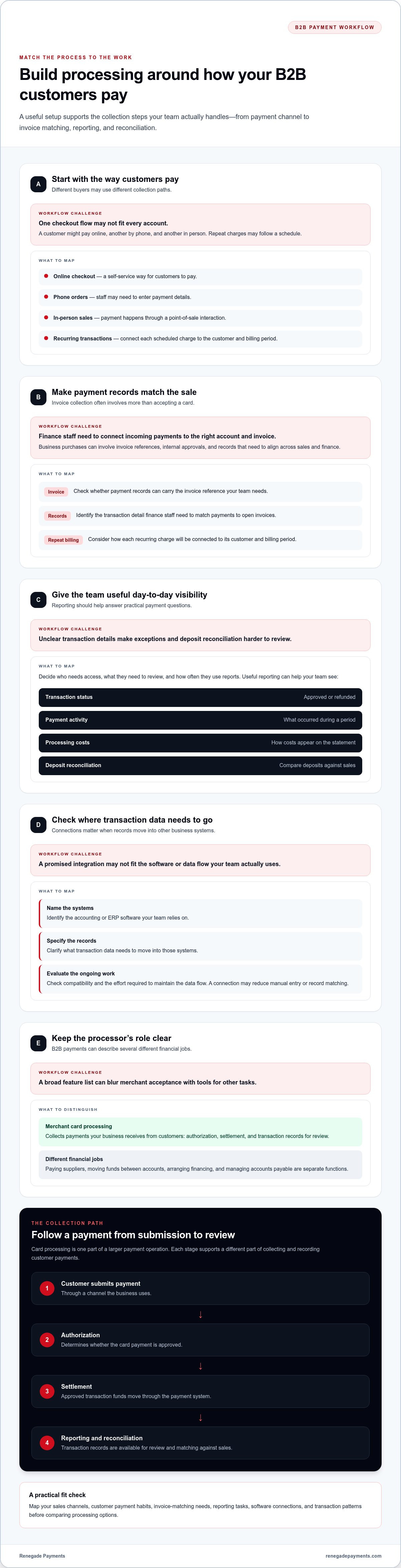
Business purchases often involve invoices, internal purchase approvals, and records that must align across sales and finance. A buyer may need an invoice reference on the payment record, while your team needs enough transaction detail to connect the payment to the right account. Larger transactions can make clear reporting and payment tracking especially important. Repeat customers may also have established billing routines. But B2B sales don’t all follow the same path: one customer might pay online, another by phone, and another in person.
Those differences affect the collection workflow, not just the payment button. Recurring billing may suit repeat charges, while invoice-based collection may be central when each sale has its own terms and documentation. Map your customers’ actual payment habits before assuming one checkout flow will fit every account.
Which parts of the payment workflow a processor supports
Think of card processing as one part of a larger payment operation. Your customer submits payment through a channel you use. The processor sends the transaction for authorization, which determines whether the card payment is approved. Settlement follows, moving approved transaction funds through the payment system. Reporting then gives your team transaction records to review and reconcile. For background on the wider mechanics of online acceptance, see the E-commerce Payment System Overview.
A processor’s transaction reports can support reconciliation, but that doesn’t make the processor your accounting system or ERP. Those systems handle broader records and business processes. Accounts-payable tools manage money your business owes suppliers. Merchant processing handles payments your business receives from customers. Keep that boundary clear when comparing platforms.
Assess the setup against your actual sales channels: invoices, online checkout, phone orders, or in-person payments. Then consider what finance staff need to see and how transaction data fits existing reconciliation work. The right solution depends on your transaction patterns, payment channels, and ability to understand processing costs. A long feature list proves little if it doesn’t fit the way your business collects and records customer payments.
Match B2B Processing Features to Your Payment Workflow
Start with how customers actually pay. A feature matters when it supports a real step in your collection process. List your sales channels, then note what happens after each payment: who checks it, how it’s matched to an invoice, and where the record needs to appear. This keeps a polished feature list from distracting you from the workflow your team runs every day.
Payment channels, invoices, and recurring transactions
Online checkout gives customers a self-service way to pay. Phone orders may require staff to enter payment details, while in-person sales use a point-of-sale interaction. Recurring transactions follow a schedule, so your team needs a clear way to connect each charge to the customer and billing period. These workflows have different requirements. Don’t assume one channel or payment method suits every buyer.
Invoice references and consistent transaction records can help finance staff match incoming payments to open invoices. Consider which methods customers prefer and which fit your internal process, then prioritize accordingly. For government-related payment programs, the GSA SmartPay Strategic Payment Solutions page describes options such as ePayables and card-not-present payments. Use it as context, not as a substitute for assessing your own acceptance needs.
Reporting, integrations, and daily visibility
Useful reporting should help your team answer practical questions: which transactions were approved, which were refunded, what activity occurred during a period, and how processing costs appear on the statement. Clear records make it easier to investigate exceptions and reconcile deposits against sales. Decide who needs access, what they need to review, and how often they use those reports.
Integrations matter when transaction data needs to move into accounting or ERP software. A connection may reduce manual entry or record matching, but compatibility depends on the systems involved. Identify the software your team relies on and the records it needs. Treat compatibility and the work required to maintain the data flow as requirements to evaluate, not vague promises of “seamless” operation.
Use this short checklist to rank features before comparing B2B payment processing solutions:
- List each channel customers use to pay.
- Record the payment methods customers expect and your team can manage.
- Identify the invoice details and transaction reports finance staff need.
- Map where payment records must go and what matching work happens today.
- Compare how pricing is presented alongside the workflow. The merchant services pricing models guide explains key approaches such as dual pricing and interchange-plus.
Rank must-haves above nice-to-haves. If understanding current processing costs is your main concern, Renegade Payments’ complimentary savings analysis reviews existing merchant statements to identify costs and assess potential savings. Explore a statement review to ground your comparison in actual processing activity.
Compare B2B Processing Pricing with Your Actual Transactions
A headline rate can look attractive and still fail to show what your business pays across a full statement. Transaction mix, card types, average sale size, refunds, and recurring charges all affect the comparison. No pricing model proves cheaper without reviewing the merchant’s processing activity. Use actual statement data, not a sales pitch or a single advertised figure.
What interchange-plus and dual pricing show merchants
Interchange-plus separates the underlying interchange costs from the processor’s stated markup. That structure can make the markup easier to identify, but you still need to review the full statement to understand all costs. Dual pricing presents separate cash and card prices at checkout. That makes the customer-facing price difference explicit, so the way prices are displayed and explained is part of the comparison.
| Comparison point | Interchange-plus | Dual pricing |
|---|---|---|
| How costs appear | Interchange and processor markup are shown as separate components. | Cash and card prices are presented separately to customers. |
| What to inspect | Statement detail, processor markup, and other listed charges. | Price presentation, customer communication, and processing activity. |
| Customer-facing effect | Customers see the business’s set price at checkout. | Customers see distinct cash and card prices. |
Neither pricing model tells you which approach will cost less for your business. Your sales mix and customer response matter. Dual pricing also has compliance considerations; review the dual pricing compliance checklist for a focused overview. A pricing comparison is not a compliance determination.
How to compare processor statements fairly
Make the comparison like for like. Use the same statement period, then account for total transaction volume, payment mix, refunds, and transaction counts. A month with different sales patterns can distort the result. Review line items, processor markups, recurring charges, and other listed fees. Separate charges you can identify from items that need clarification rather than forcing every line into a simple percentage.
- Record the statement period and total card activity.
- Note transaction counts, payment types, refunds, and recurring charges.
- Compare listed fees and markups against the same activity.
- Label statement figures as actual and any future estimates as projected.
That last step matters. A statement shows what happened under the current arrangement. A projected comparison estimates what might happen under another model, based on stated assumptions. Keep those figures separate and make the assumptions visible. Renegade Payments’ complimentary savings analysis reviews existing merchant statements to identify processing costs and assess potential savings. It gives you a clearer basis for comparing B2B payment processing solutions without presenting an estimate as a guaranteed result.
Use This Checklist to Evaluate B2B Merchant Services
Compare how you collect payments today with how an alternative would work. Write down the details before reviewing proposals. This gives you a practical basis for judging workflow fit, pricing clarity, and transition effort instead of relying on a feature list or projected savings claim.
- Map your sales channels. Record where customers pay, such as invoices, online checkout, phone orders, or in person. Note transaction types, recurring charges, customer payment habits, and the steps staff take to collect payment.
- Review your statements. Use the same statement period to document transaction volume, payment mix, listed fees, recurring charges, and total processing costs. Keep verified figures separate from estimates.
- Rank operational needs. List the reports finance staff use, how transactions connect to invoices, who needs access, and which reconciliation tasks take time. Mark each item as essential or optional.
- Compare pricing models. Assess dual pricing and interchange-plus against equivalent processing activity. Write down the assumptions behind any projected outcome, including payment mix and transaction patterns.
- Assess the transition. Identify the records, staff routines, and reporting processes that would need to change. Consider what your team must learn and how payment activity will be reviewed during the switch.
Keep the comparison grounded. If an estimate assumes a different volume or payment mix than your current statement, it isn’t an equivalent comparison. Flag unclear charges and distinguish them from costs you can verify. Separate what a statement proves from what a projection suggests.
Questions that reveal operational fit
Check whether the payment channels match how your customers actually pay. Consider whether invoice references and transaction records support your reconciliation process. Identify who needs to view activity, which reports they rely on, and what support your team needs to resolve payment questions. A solution that adds manual steps can create extra work even if its feature list looks impressive.
Questions that reveal pricing clarity
Review how the pricing structure appears on a merchant statement and which charges are included in the comparison. Check whether the assumptions reflect your real transaction mix and business activity. Flag any unclear line items and keep them separate from costs you can verify. Don’t treat a sales claim or an estimate as a confirmed processing cost.
Use this rule: prioritize workflow fit, transparent pricing, and costs you can verify. That keeps the evaluation focused on what your business does and what the numbers actually show. B2B payment processing solutions should be judged against your own activity, not a generic example.
Renegade Payments reviews existing merchant statements through a complimentary savings analysis to identify processing costs and assess potential savings. Request a statement review to ground your comparison in your actual processing activity.
See How Renegade Payments Can Help You Compare Options
A useful comparison starts with your own processing records, not a generic rate or a promise made before anyone has reviewed your activity. Renegade Payments provides merchant card processing with dual pricing and interchange-plus options. Its complimentary savings analysis reviews current merchant processing statements, identifies processing costs, and assesses potential savings. That gives you a practical starting point for comparing options against the way your business accepts card payments.
What a statement-led savings analysis can clarify
Your statements show what your current processing arrangement charged during a specific period. Reviewing them can help identify listed costs and provide context for comparing pricing approaches. Interchange-plus and dual pricing present card acceptance costs differently, so the useful question is how each model fits your actual transactions and customer experience.
The review is a comparison tool, not a promise of a particular outcome. Potential savings depend on the merchant’s processing activity and the assumptions used in any projection. Keep the difference clear: statement figures describe recorded costs, while projected figures estimate what could happen under another arrangement. A sound comparison examines the merchant’s information before drawing conclusions.
- Start with actual activity. Use your existing statements to understand current processing costs.
- Compare relevant options. Consider dual pricing and interchange-plus in relation to your transaction patterns.
- Keep estimates in perspective. Treat potential savings as an assessment, not a guaranteed result.
A practical next step for your business
Bring your existing merchant processing statements into the decision. Alongside the cost figures, consider your payment channels, transaction patterns, and the reporting your team relies on. A lower-looking quote is not automatically a better fit if the comparison uses different assumptions or overlooks how your business accepts payments.
Renegade Payments focuses on merchant card acceptance. The comparison is about processing customer card payments and understanding the costs shown in your statements, not supplier payouts, lending, or standalone business software. The goal is straightforward: make current costs clearer, then assess potential alternatives against your real operating needs.
If you’re weighing B2B payment processing solutions, start with evidence you can verify. Request a complimentary savings analysis to review your current processing statements and compare options based on your business’s actual activity. You’ll have a clearer basis for deciding whether dual pricing or interchange-plus deserves a closer look, without treating a projected outcome as certain.
Make Your Next Processing Decision With Clear Numbers
Your next step isn’t to chase the lowest-looking rate. It’s to make a decision you can explain using your business’s actual activity, customer experience, and operating needs. That keeps a processor’s pitch from becoming your only point of comparison.
Renegade Payments works with US businesses on merchant card processing, including dual pricing and interchange-plus. Its complimentary savings analysis reviews existing merchant statements to identify current processing costs and assess potential savings. The review gives you a grounded starting point, not a promised outcome. Bring the numbers into focus, then decide which B2B payment processing solutions make sense for the way you accept payments.
Ready to compare with evidence? Request your complimentary processing savings analysis and take the next step with clearer information. A confident decision starts with numbers you can see and understand.
Frequently Asked Questions
Can a newly formed LLC get payment processing without processing history?
Yes, a newly formed LLC can apply even if it has no processing history, though approval depends on the processor’s review. Be ready to explain what the business sells, how customers pay, and the transactions you expect. A processor may consider the business’s operating details and owner information instead of past card volume. Don’t estimate sales casually; use a realistic forecast that reflects your launch plan.
What documents are typically needed to apply for B2B card processing?
Processors commonly request documents that verify the business, its owners, and where funds will be deposited. These may include formation or registration records, tax identification details, owner identification, and a business bank account record. An established merchant may also be asked for recent processing statements. Requirements vary by application, so prepare accurate, consistent information about your business activity and expected transactions.
Is a merchant account the same as a payment processor?
No. A merchant account is an account used to receive card transaction proceeds, while a payment processor handles transaction communication between the merchant, card network, and financial institutions. Businesses may encounter these as separate services or within a combined processing arrangement. Review the agreement and statement to identify which entity handles each function and where deposits and transaction records appear. That distinction helps you understand the flow of funds and who handles an issue.
What happens if a processor declines a B2B card transaction?
A declined transaction means the payment wasn’t approved, but the message may not reveal the exact cause. The card may have insufficient available funds, an incorrect entry, or an issuer security restriction. Confirm the invoice amount and payment details with the customer, then have them contact their card issuer or use another approved method. Avoid repeated attempts without new information, since they may not resolve the underlying issue.
Can a business accept card payments without an ecommerce website?
Yes. A business can take card payments without running an online store. Depending on its setup, it may accept payment in person, take a phone order, or send an invoice with a way to pay. For example, a wholesaler could invoice a business buyer after confirming an order. Choose a collection method that fits how customers place orders, and give staff a clear process for recording each payment.
What happens when a customer disputes a B2B card payment?
A dispute may lead the cardholder’s issuer to request evidence supporting the transaction. Gather the invoice, order details, delivery or service records, customer communications, and any confirmation of agreed terms. Follow the instructions and response deadline provided for the case; missing the deadline can affect the outcome. Keep transaction records organized from the start, especially for large orders or repeat business, so you can respond with relevant documentation.
Frequently Asked Questions
Clear, straightforward answers about payment processing rules, rates, and terms.
Get your free savings
analysis in 24 hours
Upload a recent processing statement and we'll show you exactly how much you can save. No commitment, no pressure, no sales pitch.