Dual Pricing Payment Processing: A Clear Guide for Merchants
Learn how dual pricing payment processing works, compare cash vs card costs, and discover if this model fits your merchant business with our expert guide.
Published

What if your processing statement doesn’t tell the whole story about what your business pays? Dual pricing payment processing displays cash and card prices to customers before they pay. But changing your pricing model without comparing the numbers can create confusion instead of clarity.
If your fees are hard to untangle or a proposed pricing change is difficult to compare with your current setup, you’re not alone. Dual pricing displays cash and card prices upfront. Surcharging adds a fee when a customer pays by card. They’re different approaches, and the distinction matters at checkout.
This guide explains how dual pricing fits into payment processing, how to evaluate its effect on costs and customer experience, and what to review before deciding. It also compares dual pricing with interchange-plus, a separate pricing model. Start with your processing data, not a promise of savings. Reviewing your current statements can show what you pay now and provide a fair basis for comparing another model.
Key Takeaways
- Understand how dual pricing payment processing connects the prices customers see with the way card payments are processed and reviewed.
- Compare dual pricing, surcharging, and interchange-plus by looking at how each presents prices and what costs you need to assess.
- Use your transaction mix and checkout experience to judge whether dual pricing fits your business.
- Compare current processing costs with a proposed arrangement over the same period and using the same assumptions.
- Review your processing statements to identify costs and potential differences between pricing models.
Table of Contents
- Dual Pricing Payment Processing: What the Model Means for Merchants
- How Dual Pricing Payment Processing Fits into a Card Transaction
- Dual Pricing, Surcharging, and Interchange-Plus: Compare the Models
- How to Evaluate Whether Dual Pricing Fits Your Business
- Renegade Payments: Compare Dual Pricing with Clear Merchant Data
Dual Pricing Payment Processing: What the Model Means for Merchants
Card acceptance lets customers pay the way they prefer, but the cost of accepting payments deserves a clear look. Processing statements can bundle charges into lines that are difficult to interpret. Changing how prices are presented won’t automatically eliminate those costs. Before making a change, understand the model and measure its effect against your own transactions.
Dual pricing is a pricing model that displays a cash price and a card price for the same purchase before the customer chooses how to pay. The pricing model determines what customers see; the payment-processing service handles card transactions and related processing activity. These work together, but they are not the same thing. Understanding how a payment card works helps explain why card purchases move through a payment network rather than being treated like cash payments.
What does dual pricing mean at the point of sale?
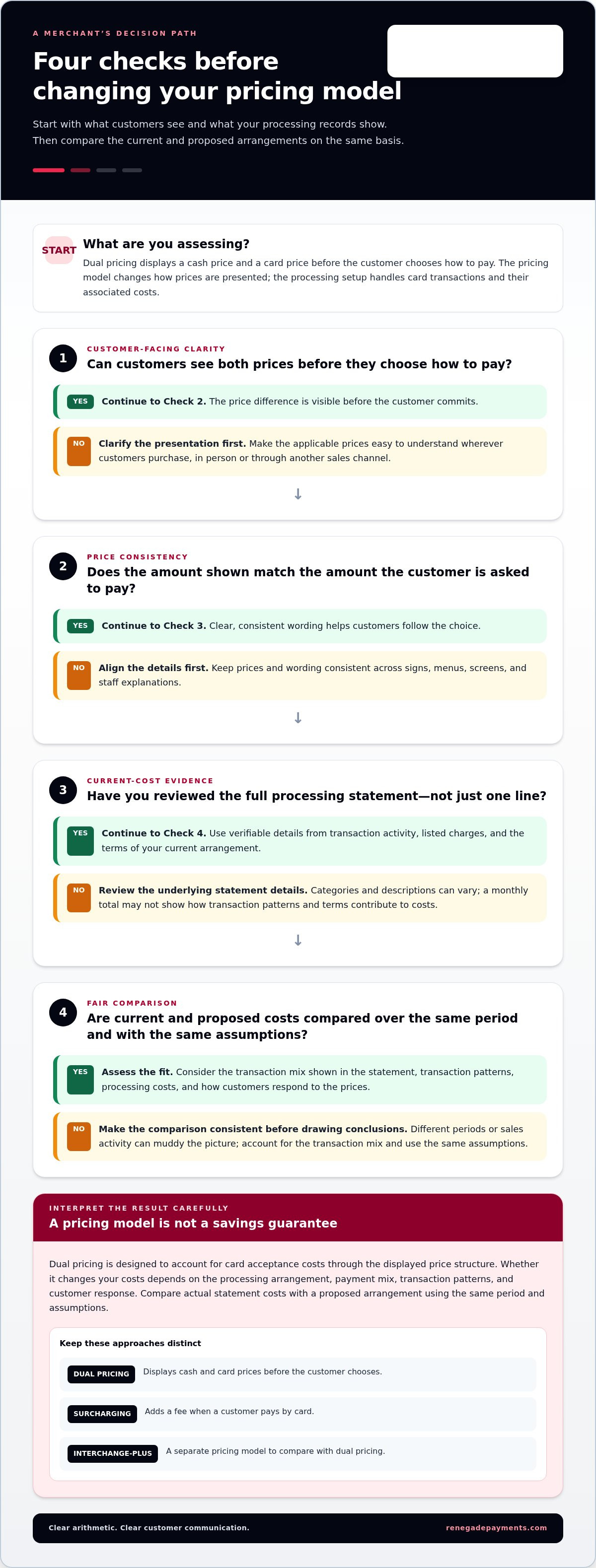
Customers see both prices before paying, then choose a payment method with the price difference already visible. The goal is clear pricing, not a surprise added after the customer has decided to buy. Make the prices easy to understand wherever customers make a purchase, whether in person or through another sales channel.
For example, a menu, price list, or product display could show one price for cash and another for card payment. The key is that customers can tell which price applies before they commit, and the amount displayed matches the amount they are asked to pay. Consistent wording across signs, menus, screens, and staff explanations makes the choice easier to follow.
How does dual pricing relate to payment processing fees?
Choosing a card price doesn’t remove the payment-processing system from the transaction. A card payment still moves through the merchant’s processing setup, and its costs appear in the business’s processing records or statement. These costs are the charges associated with accepting and processing electronic payments. Since they may be grouped or labeled in ways that obscure the total, review the full statement rather than focusing on one line.
Dual pricing is designed to account for card acceptance costs through the displayed price structure. That is an intended way to offset costs, not proof that every merchant will save money. The result depends on the processing arrangement, payment mix, transaction patterns, and how customers respond to the prices.
Keep the distinction clear: the model changes how prices are presented, while processing determines how card payments are handled and what costs the merchant incurs. To assess whether dual pricing payment processing fits, compare actual statement costs with a proposed arrangement using the same period and assumptions. Then consider whether customers can understand the choices without confusion. Clear arithmetic and clear communication both matter.
How Dual Pricing Payment Processing Fits into a Card Transaction
The prices a customer sees are only the first part of a transaction. After the customer chooses a payment method, the payment moves through the merchant’s payment acceptance setup. The processor handles the card transaction, and the merchant can later review transaction activity and processing charges in business records. Keeping these stages separate helps clarify what the pricing model changes and what it doesn’t.
What happens after a customer chooses a payment method?
The customer’s choice determines how they pay. If they choose a card, the merchant’s payment acceptance setup routes the transaction for processing. Price presentation happens at the sale; authorization and settlement are separate parts of handling a card payment. Dual pricing payment processing connects those pieces, but the displayed prices don’t explain every processing charge.
Think of the transaction in three parts:
- Price choice: The customer sees the available prices and selects a payment method.
- Transaction handling: If the customer pays by card, the merchant’s processing setup handles the transaction.
- Cost review: The merchant examines processing records and statements to understand the charges associated with accepting payments.
This distinction matters. A price choice is a customer decision. Authorization and settlement are transaction functions. The records and labels that appear afterward depend on the merchant’s processing arrangement, so don’t assume every provider reports activity in the same format.
Where can merchants see the processing impact?
Start with your merchant processing statement. It details your existing processing activity and charges, although categories and descriptions can vary by arrangement. A monthly total may not explain how card types, transaction patterns, or other terms contribute to the amount. Review the underlying details, not just the summary.
For a fair comparison, use the same statement period and account for the transaction mix shown in it. A business with a different blend of card transactions may see a different result under the same proposed pricing model. Comparing periods with different sales activity can muddy the picture. Keep the period and assumptions consistent, then examine which costs are included in each model.
If statement labels feel like a maze, a practical guide on how to read a merchant processing statement can help you identify relevant details. Focus on information you can verify: transaction activity, listed charges, and the terms attached to your current processing arrangement. That gives you a grounded starting point for evaluating a change.
Renegade Payments’ complimentary savings analysis reviews existing processing statements to identify costs and assess potential differences under available pricing models. Treat the review as a data-based comparison, not a promise of savings. Explore statement analysis to bring your current processing costs into clearer view.
Dual Pricing, Surcharging, and Interchange-Plus: Compare the Models
These pricing models handle customer-facing prices and processing costs differently. Don’t assume one will be cheaper for every business. Transaction size, payment mix, transaction patterns, operating priorities, and the full terms all affect the comparison. Start by separating how prices are presented from how processing charges are calculated.
| Model | Price presentation | Cost visibility | What to evaluate |
|---|---|---|---|
| Dual pricing | Cash and card prices are displayed before purchase. | Processing charges remain visible in merchant records; the displayed prices don’t show the full cost breakdown. | Compare statement costs with the proposed arrangement, and assess whether customers understand the price choices. |
| Surcharging | A fee is added to a purchase when the customer pays by card. | The added fee is distinct from the processor’s full charge structure. | Review the arrangement’s terms and applicable card-network and legal requirements. |
| Interchange-plus | One selling price is presented; processing charges follow the agreed pricing structure. | Interchange is shown separately from the processor’s fixed markup. | Review interchange, markup, other applicable charges, and transaction mix. |
How is dual pricing different from surcharging and cash discounting?
With dual pricing, customers see separate cash and card prices before choosing how to pay. With surcharging, a fee is added when a customer pays by card. These approaches present the amount due differently. A cash discount, meanwhile, describes a discount from a stated price for paying with cash. The terms can overlap in how merchants describe a program, but they aren’t automatically interchangeable. Clear disclosure and accurate price presentation matter. Legal and card-network requirements can vary, so don’t assume one model’s rules apply to another. For deeper context, consult dedicated comparisons of dual pricing versus surcharging and dual pricing compliance.
When should merchants compare dual pricing with interchange-plus?
Compare them when you need to understand both the customer-facing pricing structure and the underlying processing costs. Interchange-plus passes the wholesale interchange cost directly to the merchant, paired with a clear, fixed markup. This can make the processor’s markup easier to identify, but it doesn’t make every statement simple or guarantee a lower total. Review the full terms and transaction mix, not just one rate or line item. The article Interchange-plus pricing, explained plainly can provide a closer look at how this model is structured.
For a sound comparison, use the same statement period and transaction assumptions for each option. Include all listed processing charges, then consider how each model fits daily operations and customer expectations. A business with one payment mix or sales pattern may reach a different conclusion from a business with another. The useful question isn’t which label sounds best. It’s which structure makes sense for your costs, records, and checkout experience. That’s how to assess dual pricing payment processing without treating potential savings as a promise.
How to Evaluate Whether Dual Pricing Fits Your Business
A pricing change should pass a basic test: does it make sense given your actual processing costs and the way customers pay? Don’t decide based on a sales pitch or headline comparison. Build your own evidence, then weigh the numbers against checkout clarity and the work your team will need to do.
What information should merchants gather before comparing costs?
Start with recent merchant processing statements. Look beyond the total and note recurring fees, transaction categories, and any terms that affect overall costs. Then pair those records with what happens in your business: the payment methods customers use, typical transaction patterns, and whether sales vary across channels or seasons. A statement review can reveal which charges and details deserve closer attention.
A useful sequence:
- Gather statements: Use the same complete period for your current costs and the proposed arrangement.
- Map transaction activity: Note payment types, transaction counts, and average transaction patterns shown in your records.
- Model the alternatives: Apply the proposal to the same activity and list the assumptions behind the estimate.
- Check the customer experience: Consider whether customers can understand the price choices and whether staff can explain them consistently.
For more context, a guide titled What a merchant statement review can reveal can help you turn statement details into useful questions for your comparison.
How can merchants test customer and operational fit?
The math is only part of the decision. Think through a typical customer interaction. Can staff explain the available prices in plain language, without hesitation or mixed messages? Are the prices easy to understand where customers make a purchase? If the process creates uncertainty or slows checkout, include that operational friction in your evaluation.
Consider customer payment preferences alongside your transaction patterns. A business with frequent smaller purchases may face different customer reactions and operating demands than one with fewer, larger transactions. Don’t assume how customers will respond. Review the payment mix you actually see and ask whether the proposed setup fits the way your customers shop and your team works.
For the cost comparison, use the same statement period, transaction mix, and assumptions on both sides. Include all current processing charges and all charges listed in the proposed arrangement. Mark any estimate clearly. If transaction volume, payment behavior, or other assumptions change, the result can change too. Treat projected differences as estimates, not guaranteed savings.
Renegade Payments’ complimentary savings analysis reviews existing processing statements to identify costs and assess potential differences under available pricing models. To ground your dual pricing payment processing decision in your own records, request a complimentary savings analysis.
Renegade Payments: Compare Dual Pricing with Clear Merchant Data
A pricing model shouldn’t be judged by a promise or a polished sales pitch. Test it against the costs and transaction patterns in your own records. Renegade Payments offers dual pricing and interchange-plus payment processing, giving merchants distinct approaches to evaluate. Start with what your business pays now, then consider how each option could fit your payment activity and operating priorities.
What does a complimentary savings analysis examine?
The review starts with your existing processing statements. Those records show the charges and transaction details that shape your current costs. Renegade Payments’ complimentary savings analysis examines that information to identify processing costs and assess potential differences under available pricing models.
The analysis gives you a practical basis for comparing your current arrangement with dual pricing or interchange-plus. It can bring statement details into clearer view, but it isn’t a promise that one model will produce the same result for every business. Your transaction mix, processing terms, and assumptions all affect the comparison. Use the findings to evaluate your options, then weigh them against how you want prices presented and costs structured.
What is a practical next step for merchants?
Use your own data. Review the statement period, transaction patterns, and listed charges that matter to your business. Then compare options using the same period and assumptions so you’re not measuring one model against a different set of sales activity. Keep the customer experience in view, too. Cost estimates matter, but so does whether the pricing approach fits your day-to-day operations.
Dual pricing and interchange-plus serve different pricing preferences. Dual pricing presents cash and card prices to customers, while interchange-plus separates interchange from the processor’s markup. Neither is a universal answer. The useful choice is the one that aligns with your costs, operating priorities, and customer-facing approach, based on a fair comparison rather than an unsupported savings claim.
Before deciding, make sure you understand what the comparison includes and which assumptions shape any projected difference. That clarity helps you assess the proposal on its actual terms, not just its label. A statement review can turn a confusing cost picture into a more concrete discussion of your options.
Put your processing records to work. Request your complimentary savings analysis to review your current statement and compare potential cost differences.
Make Your Next Pricing Decision With Evidence
Don’t let a pricing proposal force a rushed choice. Set a clear baseline first: know which costs you’re comparing, what assumptions shape the estimate, and what matters most to your business. That gives you a decision you can explain to your team and revisit as your payment activity changes.
Renegade Payments reviews existing merchant processing statements at no cost, giving you a clearer starting point for comparing dual pricing with interchange-plus using your own processing data. The review can identify potential cost differences, but your results depend on your business details. Use the findings to weigh cost structure alongside customer experience and day-to-day fit. That’s a grounded way to decide whether dual pricing payment processing belongs in your operating plan.
Put your statement data to work. Request a complimentary savings analysis to review your current processing costs and compare potential differences.
Frequently Asked Questions
Is dual pricing payment processing the same as surcharging?
No. Dual pricing presents distinct prices for different payment methods, while surcharging generally means adding a charge when a customer pays by card. Wording on a sign or receipt shapes how customers understand the price, so don’t treat the labels as interchangeable. Before introducing a program, review how the checkout presentation and processing setup work, along with the current rules that apply to your business.
Can dual pricing help a business reduce credit card processing costs?
It may help offset processing costs, but it can’t guarantee lower overall expenses for every merchant. A business whose customers continue choosing card payments at the same rate may see a different outcome from one where payment choices shift. To estimate the impact, compare current statement data with a specific proposed arrangement and state your assumptions about customer choices. Treat the result as a projection, not a promised saving.
How does dual pricing appear to customers at checkout?
Customers should be able to understand the available prices before completing a purchase. For example, someone reviewing a price list should be able to tell which amount applies to each payment method before reaching the register. Keep the wording consistent across signs, menus, screens, and staff explanations. If a customer only learns the applicable price at the terminal, the presentation may feel unexpected. Review the full checkout experience before using it.
What should a merchant review before considering dual pricing?
Review more than the statement total. Check recurring charges, transaction categories, refunds or credits shown in the period, and account terms that affect current costs. Then consider how customers typically pay and whether your checkout process can communicate the choices clearly. Compare equivalent periods, especially if sales patterns shift over time. This gives you a stronger starting point than relying on a general claim about what dual pricing can do.
Is dual pricing legal in every state?
Don’t rely on a blanket answer without considering the details of your program. Requirements can depend on applicable laws, card-network rules, and how prices are displayed and recorded. Dual pricing shouldn’t automatically be treated as a surcharge or a cash discount, since those terms describe different approaches. Before launch, verify the current requirements that apply to your business and the way customers will see and pay the listed prices.
Does dual pricing work with every point-of-sale system?
Not necessarily. The system needs to support the way your business intends to display prices and process transactions. Review how the setup handles different payment choices, receipts, refunds, and reporting, then make sure staff can follow the same workflow consistently. A system that accepts card payments may not automatically support every dual-pricing configuration. Test the actual customer and staff experience before changing your live checkout process.
How can a merchant estimate potential savings from dual pricing?
Use your merchant statement as a baseline, then compare its costs with a defined proposal using the same period and transaction activity. Note assumptions about customer payment choices, since they can affect the estimate. Avoid comparing an advertised rate with your full current statement; they may not include the same items. Renegade Payments’ complimentary statement analysis can help identify potential cost differences, but the estimate depends on your data and setup.
Frequently Asked Questions
Clear, straightforward answers about payment processing rules, rates, and terms.
Get your free savings
analysis in 24 hours
Upload a recent processing statement and we'll show you exactly how much you can save. No commitment, no pressure, no sales pitch.