Dual Pricing Compliance in 2026: A Practical Checklist for Merchants
Ensure dual pricing compliance in 2026. Use this practical merchant checklist to align signage, checkout screens, and card rules to avoid costly penalties.
Published

If customers first see a different price at checkout, your dual pricing compliance may already be at risk. The key is consistency: display both prices before purchase, then make sure signs, checkout screens, and transaction records match. A clear choice between two displayed prices is different from adding a fee at the register, and confusing the two can create problems for your business and your customers.
It’s understandable to be unsure which rules apply. State laws, card-network requirements, and payment channels can affect the details, and rules can change. This checklist gives you a practical way to review disclosures, displayed prices, checkout steps, and records. It also explains how dual pricing differs from surcharging and cash discounting, and how to verify current legal and network requirements before making changes.
Start with what customers see, then trace the price through checkout and into your records. Renegade Payments also offers a complimentary review of existing processing statements to help merchants understand current costs and available pricing approaches. Clear pricing starts with clear records.
Key Takeaways
- Build dual pricing compliance around one rule: customers should understand both payment prices before choosing how to pay.
- Review every place prices appear, from signs and menus to online listings and checkout screens, for clear, consistent wording.
- Separate legal requirements, card-network rules, processor procedures, and internal practices. Verify each against the appropriate source.
- Use a repeatable review process that includes test transactions, staff training, recordkeeping, and a clear owner for updates.
- Document your current processing setup before making changes, then review your statement to understand existing charges and pricing options.
Table of Contents
- Dual Pricing Compliance: Why the Price Display Is the Starting Point
- Dual Pricing Compliance Starts With Clear, Consistent Price Disclosures
- Check State, Federal, and Card-Network Rules Before Applying Dual Pricing
- Use This Dual Pricing Compliance Checklist Before Launch and During Reviews
- Make Dual Pricing Compliance Part of a Clearer Processing Review
Dual Pricing Compliance: Why the Price Display Is the Starting Point
A payment choice should not change the price by surprise. Compliance starts with what customers can see before they decide how to pay, not with an explanation at the terminal after the sale is underway.
In a dual pricing model, customers see a cash price and a card price before purchase. The display should make clear which price applies to each payment method. General permission to use a pricing model does not automatically make every sign, website listing, terminal setting, or receipt compliant. The details still matter, and requirements can differ by jurisdiction and payment channel.
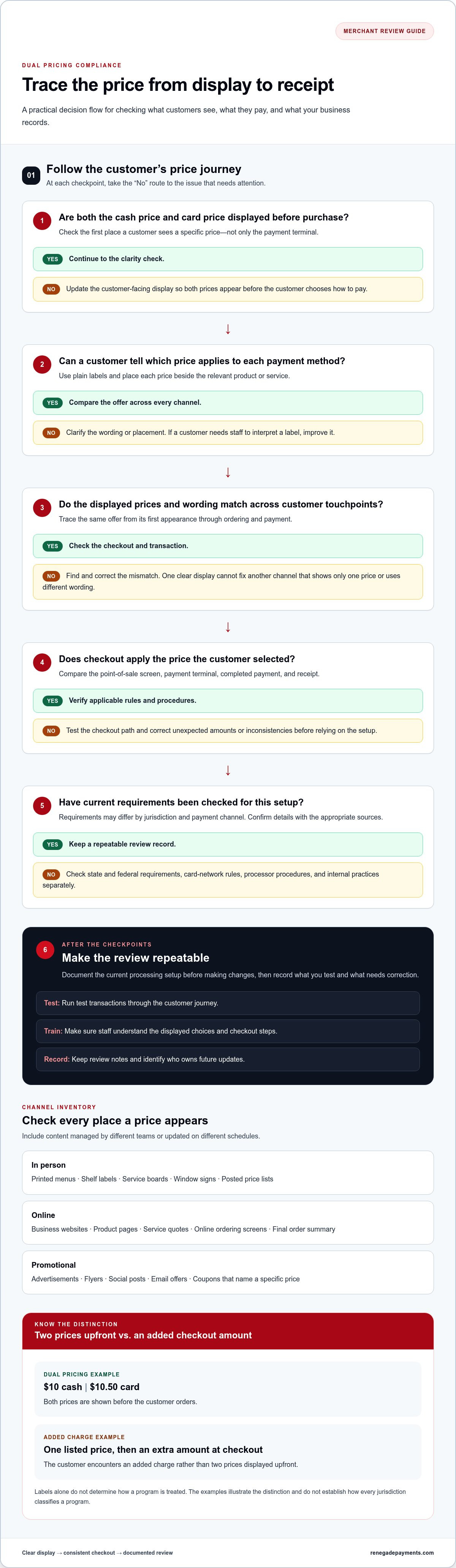
Compliant dual pricing presents clear cash and card prices before purchase, then applies the selected price consistently through checkout and payment. Use a practical test: can a customer identify both prices and understand which one applies before choosing how to pay?
What makes dual pricing different from a checkout surcharge?
The difference is what the customer sees and when. Dual pricing presents two prices upfront. A surcharge, by contrast, adds an amount to a listed price when a customer pays by card. The labels, setup, and applicable rules can differ, so calling a charge a “cash discount” or “card price” doesn’t by itself determine how it should be treated.
Illustrative example: A menu lists an item at $10 for cash and $10.50 for card before the customer orders. That is a two-price display. If the menu lists only $10 and an extra amount appears at checkout for card payment, the customer encountered an added charge instead. This example illustrates the distinction; it does not establish how every jurisdiction classifies a program. The broader term dual-track price system describes prices that vary under defined conditions, but its historical context is not a guide to current merchant rules. A comparison of dual pricing and cash discounting can help explain how those models differ in practice.
Which parts of the customer journey need to match?
Follow the price from the first place a customer sees it. That could be an advertisement, online listing, menu, shelf label, or service quote. Then trace the same offer through item selection, the point-of-sale screen, the payment terminal, the completed payment, and the receipt. A mismatch at any step can make an earlier disclosure unclear.
For example, an online listing may show both prices while an in-store sign shows only one. Or a sign may explain the choices, but the terminal may display an unexpected amount before payment. A clear initial disclosure can still be undermined if a later screen shows a different price.
Review the experience from the customer’s perspective. Can they identify both prices before choosing? Does the amount presented for payment match their choice? Does the receipt reflect the completed transaction? These are the key points to examine before reviewing applicable rules and checkout procedures.
Dual Pricing Compliance Starts With Clear, Consistent Price Disclosures
A disclosure works only if customers can find and understand it before committing to a purchase. For dual pricing compliance, review every customer-facing place where a price appears, not just the main sign or payment terminal. One clear display cannot fix another channel that shows only one price or uses different wording.
Use plain, direct labels. Identify which amount applies to cash and which applies to card. Place both prices beside the relevant product or service, with enough context that customers don’t have to guess, ask staff, or reach checkout to learn what they’ll pay. A terminal prompt can confirm a choice, but it shouldn’t be the first place customers discover a second price.
Where should merchants review the two prices?
List every channel where customers encounter a specific price, including physical displays, digital listings, and temporary promotions. Requirements can vary by channel and jurisdiction, so verify current rules against authoritative sources rather than assuming one disclosure format works everywhere.
- In person: Printed menus, shelf labels, service boards, window signs, and posted price lists.
- Online: Business websites, product pages, service quotes, and online ordering screens, including the final order summary.
- Promotional: Advertisements, flyers, social posts, email offers, and coupons that name a specific price.
Include materials created by different teams or updated on different schedules. A seasonal promotion, for example, may retain an old price after the main menu changes. Record where each price appears and who controls that content. This inventory helps reveal gaps before they lead to customer confusion or disputes.
How can a merchant test whether disclosures are clear?
Ask someone unfamiliar with the pricing setup to review the displays as a customer would. Before checkout, can they point to the cash price and card price and explain which applies to each payment method? If they need staff to interpret a label, improve its wording or placement.
Next, compare the wording and amounts across the customer journey. Check that labels mean the same thing on a menu, website, ordering screen, and payment screen. The terminal should not introduce a new amount or obscure which option the customer selected. Keep a short log of what you tested, what was unclear, and what needs correction.
- Note the channel and item or service involved.
- Describe the confusing wording, placement, or mismatch.
- Assign someone to update it.
- Recheck the corrected display against the checkout amount.
Check every listed price against the amount shown at checkout. Make this comparison part of routine reviews, especially after changing prices, promotions, or payment screens. Merchants reviewing processing costs alongside pricing choices can use a processing statement review to better understand current charges before making changes.
Check State, Federal, and Card-Network Rules Before Applying Dual Pricing
A clear display is only one part of the review. Before applying dual pricing, identify the rules that govern your business instead of relying on a broad claim that the model is allowed. Requirements may come from legislation, a payment network, or your processor’s operating procedures. These sources have different roles, and one does not replace the others.
For sound dual pricing compliance, start with where you sell and how customers pay. Check relevant state statutes and official regulator guidance for each jurisdiction where your business operates. Then review current network rules for the card brands you accept, including Visa, American Express, and Discover as applicable. Finally, document processor procedures separately. They may shape how your system is configured, but they are not legislation or card-network rules.
Which rule sources should a merchant check?
Use primary sources wherever possible: enacted laws, official agency publications, and current card-network merchant materials. Record the document or page, its publication or revision date, and the date your team reviewed it. If a source doesn’t clearly answer a question, record the gap for follow-up rather than treating silence as approval.
| Rule source | Question to verify | Source date | Responsible reviewer |
|---|---|---|---|
| State statute or regulator guidance | What requirements apply to this business location and sales channel? | Publication or revision date; date checked | Compliance lead or legal reviewer |
| Federal law or agency guidance | Does a federal rule apply to the pricing model or payment method? | Publication or revision date; date checked | Legal or compliance reviewer |
| Card-network merchant rules | What disclosure, acceptance, or transaction procedures apply to accepted brands? | Current document version and date checked | Payments or operations lead |
| Processor procedures | How must the point-of-sale system and account be configured? | Procedure version and date confirmed | Payments or operations lead |
Assign a reviewer to each row. Verify state-specific and 2026 claims against current authoritative sources before relying on them. Laws, network materials, and processor instructions can change on different timelines. Save the source and review date so the next reviewer can see what was checked.
How do merchants avoid confusing dual pricing with other fee programs?
Look beyond the program’s label and inspect the customer journey. Compare the advertised prices with the amount shown at checkout and how that amount is calculated. A surcharge, convenience fee, and dual price can describe different transaction structures and may have different requirements. The program’s name alone does not determine its treatment.
Review each model separately. A comparison of dual pricing and cash discounting can help clarify the distinctions, but verify the rules that apply to your locations, payment channels, and accepted card brands before launch.
Use This Dual Pricing Compliance Checklist Before Launch and During Reviews
A pricing setup needs more than a clear sign. Build a repeatable process that checks the rules, the customer experience, and the transaction trail. This dual pricing compliance checklist turns those checks into assigned tasks instead of assumptions that someone else has handled them.
What should merchants verify before launch?
Work through these steps in order and keep evidence as you go. That creates a record of what the business reviewed and changed.
- Verify the rules. Check current laws, official guidance, card-network materials, and processor procedures that apply to your locations and payment channels. Save source links, review dates, and decisions.
- Approve the customer-facing language. Confirm that price labels clearly identify each payment option. Check placement and coverage wherever customers encounter a price, including promotions and online ordering.
- Review the checkout setup. Confirm that the point-of-sale system presents the intended options and applies the selected price without adding an unexplained amount later.
- Run test purchases. Test relevant payment methods from selection through payment. Compare the advertised amount, checkout display, transaction record, and receipt. Keep the results with your review notes.
- Train staff. Give employees a short, consistent explanation of the available prices and how customers select one. Tell them not to improvise legal claims or promise how a rule applies.
- Name an owner. Assign one person to track open issues, coordinate corrections, and confirm that fixes reach every affected channel.
What belongs in a recurring compliance review?
Don’t wait for a complaint to uncover a mismatch. Review the setup when a relevant law, network rule, processor procedure, pricing display, or sales channel changes. Set a schedule that fits the business, and document the reason for any unscheduled review.
- Sample receipts and transaction records, then compare them with the price shown before purchase.
- Record the issue, affected channel, correction, review date, and person responsible for follow-through.
- Retest the customer path after a fix. Close the issue only when the corrected display and transaction agree.
- Keep prior versions of key disclosures and review notes so changes have a clear history.
Keep security work separate. PCI DSS concerns payment-card data security; it does not replace the review of price disclosures or determine whether a pricing model meets applicable requirements. Track security controls separately from pricing decisions, and don’t treat completion of one as proof of the other.
Document your current setup before making changes. Renegade Payments can review existing processing statements to help clarify current charges and available pricing approaches. Request a processing statement review.
Make Dual Pricing Compliance Part of a Clearer Processing Review
Before changing a price, sign, or checkout setting, capture how the system works today. Save current customer-facing price displays, checkout examples, receipts, and processing statements. This gives you a baseline to compare against after a change. Without it, it can be difficult to tell whether a fix resolved a mismatch or moved it elsewhere.
A processing statement review answers a different question from a legal review. It can help show what your business pays for processing and how charges appear across statement line items. It cannot determine whether your pricing disclosures comply with every applicable law or card-network rule. Keep the reviews separate, then use what each reveals to make informed decisions.
What can a merchant statement review help clarify?
Statement line items can be difficult to interpret in isolation. Reviewing them together helps organize current processing costs and gives you a clearer starting point for comparing pricing approaches. Renegade Payments’ complimentary savings analysis reviews existing processing statements to identify costs and show potential savings under available approaches, including transparent interchange-plus and dual pricing. It does not promise a particular result or replace legal advice.
Use the review to understand the financial side of your setup. Use current legal and network sources, or qualified legal counsel, to assess the rules that apply. Keeping these roles separate helps prevent a cost analysis from being mistaken for a compliance sign-off.
How should a merchant move forward without guesswork?
Bring the current picture together before deciding what to change. Gather existing processing statements, examples of price displays across sales channels, and checkout or receipt examples. Add notes about confusing customer questions, price discrepancies, or recent system changes. A focused review is more useful when it starts with real records rather than assumptions.
Use the findings to identify the next questions. A statement may prompt you to clarify a charge, compare available pricing approaches, or investigate whether checkout amounts match the prices customers saw. A disclosure review may reveal a separate wording or placement issue. Record each open question, the person responsible, and the evidence needed to close it.
Keep a decision trail. Note what you reviewed, what you learned, what remains unresolved, and which changes you made. That record supports a more disciplined dual pricing compliance review without confusing payment-cost analysis with a legal conclusion.
If you’re ready to assess current processing costs and compare available pricing approaches, request Renegade Payments’ complimentary savings analysis. Use the findings as a starting point for your pricing review, then verify applicable requirements before changing your setup.
Make Your Next Pricing Decision With Clearer Numbers
Before changing prices or checkout settings, create a baseline you can compare against later. Keep records that show how your current setup works, then make one change at a time. This makes it easier to spot unintended differences and decide what needs a closer look.
Strong dual pricing compliance is not a one-time box to check. Treat each pricing change as a reason to review the customer experience, transaction trail, and current requirements that apply to your business. Keep legal questions separate from processing-cost analysis, and use the right evidence for each decision.
A statement review can help clarify processing charges and show potential savings under available pricing approaches. Renegade Payments offers dual pricing and interchange-plus payment processing, along with a complimentary analysis of existing statements. Have your processing statements reviewed to get a clearer starting point for your next decision.
Clear records and better visibility can help you make your next pricing decision with confidence.
Frequently Asked Questions
Can dual pricing apply to debit cards?
It depends on the applicable rules and how your payment setup handles debit transactions. Don’t assume debit follows the same treatment as credit. Check current card-network requirements, processor procedures, and relevant law before enabling a debit option. Then test each accepted payment type from selection through receipt. Confirm customers can understand the displayed prices and that the final amount matches the option selected.
Can a merchant use dual pricing for online orders?
It may be possible, but review the full online purchase flow before launch. Check a product page, cart, payment screen, and order confirmation as one customer journey. For example, if a customer selects a payment option in the cart, later screens should not show a conflicting total or unclear price label. Verify current rules for your program and jurisdiction, then test a complete order.
What happens if a sign shows a different price from the checkout screen?
A mismatch can confuse customers and weaken trust, but the specific consequences depend on applicable requirements and circumstances. Correct the discrepancy promptly, and consider pausing the affected display or offer until the prices align. Check related channels for the same outdated amount, such as a menu or online listing. Keep a dated note of what differed, what you corrected, and when you verified the fix.
Do receipts need to show both cash and card prices?
There isn’t one receipt format merchants should assume applies everywhere. Requirements can depend on the pricing setup, processor configuration, network rules, and applicable law. Review a sample receipt to confirm it accurately reflects the completed transaction and the customer’s selected payment option. Compare it with the price shown before payment. Include different transaction types in routine testing, especially after receipt or checkout settings change.
Can a merchant combine dual pricing with a coupon or promotion?
A promotion can make the final price harder to follow if its terms don’t explain how the offer interacts with each payment option. Before publishing it, calculate and display the payable amounts clearly for a representative purchase. Test the offer from advertisement through checkout and receipt. Verify current requirements and processor procedures for the promotion, and correct any screen that leaves customers guessing about the amount due.
How often should a business review its dual pricing setup?
Review it before launch and whenever prices, checkout technology, sales channels, or relevant rules change. A recurring review can also catch staff workarounds, outdated displays, and settings that drift from the approved setup. Don’t assume there is one universal interval without authoritative support. Keep dated records of sources checked, test transactions, findings, and corrections. That review trail makes dual pricing compliance easier to manage over time.
Frequently Asked Questions
Clear, straightforward answers about payment processing rules, rates, and terms.
Get your free savings
analysis in 24 hours
Upload a recent processing statement and we'll show you exactly how much you can save. No commitment, no pressure, no sales pitch.