Why Are My Processing Fees So High? Find the Real Drivers
Asking why are my processing fees so high? Unpack hidden interchange markups, analyze your merchant statement, and discover practical ways to lower card costs.
Published

What if the biggest number on your processing statement isn’t the part you can negotiate? If you’re asking, “why are my processing fees so high,” the answer often comes down to more than your processor’s markup. Your customers’ card types, how they pay, and account charges can all shape the total. A dense statement can make those costs hard to separate.
Before considering a change, break down the statement. This article explains how to distinguish interchange and card-network assessments from processor markup and other charges, and how to identify which costs may be negotiable. It also covers how card mix and in-person versus online transactions can affect your fees.
Use your statement data to compare practical options. Interchange-plus separates underlying card costs from a fixed processor markup. Dual pricing presents distinct cash and card prices at checkout. Neither model guarantees savings for every business. A complimentary statement review can help reveal your actual fee mix and potential savings, so you can weigh a change using evidence instead of guesswork.
Key Takeaways
- “Why are my processing fees so high?” Start by tracing the total to its underlying charges instead of judging one headline rate.
- Compare statements over similar periods, calculate fees against sales, and account for refunds or changes in transaction activity.
- Flat-rate, tiered, interchange-plus, and dual-pricing models present costs differently. Compare visibility and trade-offs, not just labels.
- Use statement data to decide whether clearer markup, a different pricing structure, or a checkout-pricing review deserves attention.
- A statement review can help identify your fee mix and assess potential savings before you consider a change.
Table of Contents
Why Are My Processing Fees So High? Start With the Full Picture
A high processing statement is frustrating. The total tells you what left your account, but not why. It may reflect more card sales, a change in the cards customers used, a higher processor markup, or charges listed elsewhere on the statement. Without a breakdown, comparing one month with another can lead to the wrong conclusion.
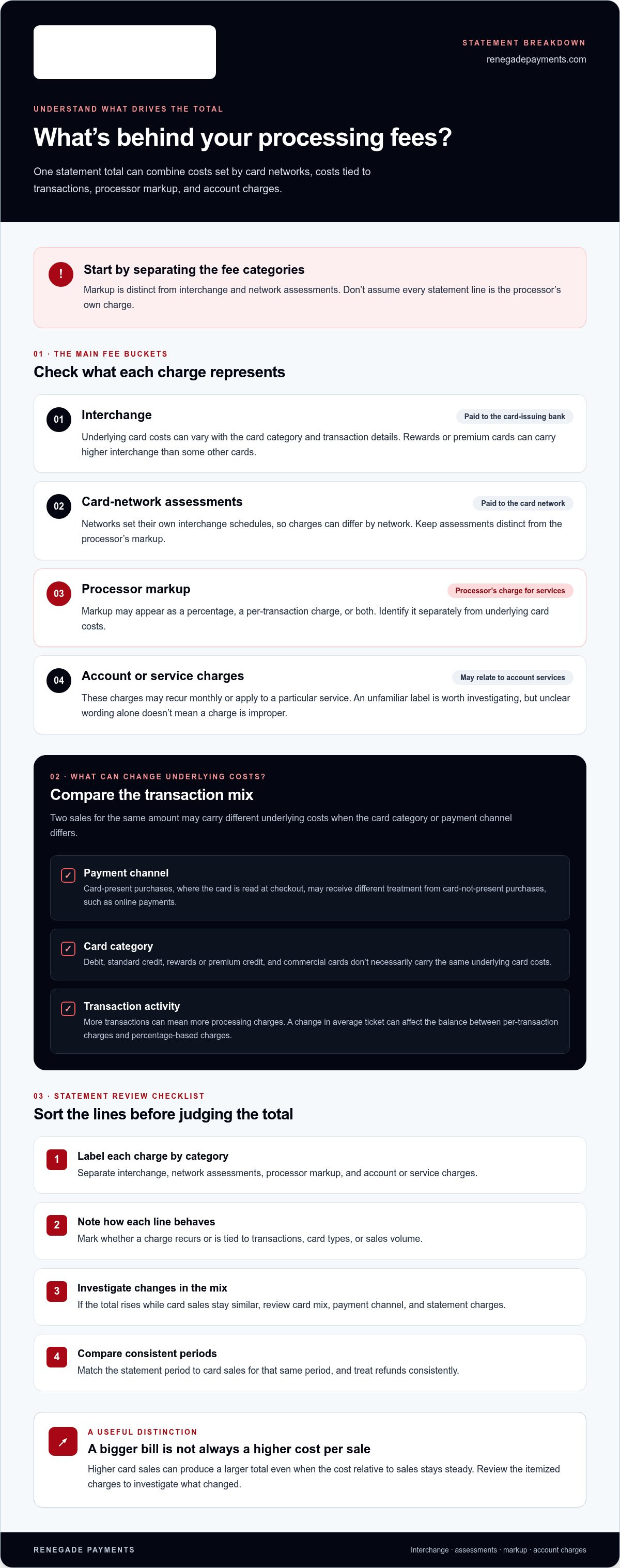
Processing fees aren’t one universal rate. They can include interchange paid to the card-issuing bank, assessment fees paid to the card network, the processor’s markup, and account or service charges. A payment processor helps route and handle transactions, but the full cost reflects several parties and parts of the payment process. That’s why it’s important to look past the headline number.
Sales volume alone can’t tell you whether your costs are unusually high. Higher card sales can produce a larger bill even if your cost relative to sales stays steady. To assess the rate, compare fees with card sales over the same period, then investigate what changed. The total answers “how much?” The effective rate answers “how much relative to card sales?” Neither identifies the cause on its own.
What does a high effective processing rate mean?
Your effective rate is total processing fees divided by card sales for the same statement period. It’s a diagnostic measure, not a complete explanation of the charges. Tracking it over time can reveal a change, but it won’t show which fee line drove the result or whether the cause was your pricing, transactions, or card mix.
Keep comparisons consistent. Match the statement period to the card sales recorded for that period, and treat refunds the same way each time. Comparing a partial month with a full month, or using sales figures that treat refunds differently, can distort the result. Use the rate as a starting point for investigation, not a verdict on your processor.
Why the same business can see different monthly totals
Monthly costs move with transaction activity. More transactions can mean more processing charges. A change in average ticket can affect the balance between per-transaction charges and percentage-based charges. Payment channel matters too: in-person and online transactions may have different underlying costs. Card mix can also make a difference. Debit, standard credit, and rewards or premium cards don’t necessarily carry the same underlying card costs.
Separate a bigger bill from a higher cost per sale. If card sales and transaction count both rise, the total may rise without much change in the effective rate. If the total rises while card sales stay similar, investigate changes in card mix, payment channel, or statement charges. These patterns point to different causes, so compare like periods and review the itemized statement before deciding a rate is excessive.
Start with the facts on the statement. Record card sales, total fees, transaction count, and any changes in refunds or sales activity. Use the effective rate to flag a change, then review itemized charges to investigate it. That’s how you turn “why are my processing fees so high” from a frustrating guess into a question you can answer with evidence.
Which Parts of Your Processing Fees Can Push the Total Up?
To answer “why are my processing fees so high,” break the statement into its parts. A single total can hide costs set by card networks, costs tied to the cards customers use, processor markup, and account charges. These categories work differently. Treating them as one fee makes it harder to find the real driver.
A processing statement can combine interchange, card-network assessments, processor markup, and account or service charges. Interchange goes to the bank that issued the card. Assessments go to the card network. The processor’s markup covers its processing services. Other charges may relate to account services. Forbes Advisor’s breakdown of credit card processing fees also separates these core cost categories. Markup is distinct from interchange and assessments, so don’t assume every line reflects the processor’s own charge.
How card type and payment method affect costs
Underlying card costs depend partly on the transaction and the card. A card-present purchase, where the card is read at checkout, may receive different treatment from a card-not-present purchase, such as an online payment. The transaction channel is one reason two sales for the same amount may carry different underlying costs.
Card category matters too. Rewards and premium credit cards can carry higher interchange than some other cards. Commercial cards may follow different rate categories as well. Card networks set their own interchange schedules, so charges can differ by network. If your customer mix shifts toward online, rewards, or commercial card payments, underlying costs may change even if your processor’s markup stays the same.
Which charges may come from the processor?
Look for the processor’s markup and separate account or service charges. Markup may appear as a percentage, a per-transaction charge, or both. Account charges may recur monthly or apply to a particular service. Billing labels and formats vary, so an unfamiliar line deserves investigation, not an instant verdict. A charge isn’t automatically improper just because its description is unclear.
Separate recurring charges from transaction-based costs. A recurring account fee can remain on the bill when card sales are low. Transaction costs generally move with payment activity, card types, or sales volume. Mark each line by category, then note whether it recurs or is tied to transactions. This makes it easier to see whether the pressure comes from the cards your customers use, processor markup, or other account charges.
Among the core transaction-cost components, the processor’s markup is the part you can negotiate. A statement review can help distinguish that markup from underlying card costs and identify potential savings without assuming a change will deliver them. Use a complimentary processing statement review to examine your actual fee mix before weighing your next move.
How Do Pricing Models Change What You Pay?
If you’re asking, “why are my processing fees so high,” look beyond the total and examine how your pricing model presents costs. A flat rate may be easy to follow but bundle components together. Tiered pricing sorts transactions into categories. Interchange-plus separates underlying card costs from the processor’s markup. Dual pricing presents distinct cash and card prices at checkout. Each structure affects what you can see and how costs appear on your statement.
Use this comparison as a starting point, not a promise of lower costs. Your card mix, transaction channels, average ticket, and checkout setup all affect how a model works for your business.
| Pricing model | Cost visibility | How charges are presented | Key trade-off |
|---|---|---|---|
| Flat-rate | One rate is simple to read, but underlying costs may be bundled. | A set percentage, often with a per-transaction charge. | Easy to understand; less detail about individual cost components. |
| Tiered | Visibility depends on how clearly each transaction category is explained. | Transactions are grouped into pricing tiers. | Can be difficult to predict which tier a transaction will enter. |
| Interchange-plus | Separates card costs from processor markup. | Interchange and network costs pass through, plus a clear, fixed markup. | More detail to review; totals can vary with card and transaction mix. |
| Dual pricing | Customers see distinct cash and card prices at checkout. | Prices are presented separately by payment method. | Requires a checkout setup that clearly communicates both prices. |
Interchange-plus: see the underlying card cost and markup
Interchange-plus passes through wholesale interchange costs and adds the processor’s clear, fixed markup. Separating the two makes it easier to distinguish underlying card costs from the processor’s charge and assess the markup directly. It improves visibility, but doesn’t guarantee savings. Learn how the structure works in this interchange-plus pricing guide.
Dual pricing: show cash and card prices at checkout
Dual pricing displays distinct cash and card prices to customers at checkout. By making the difference visible, this structure can help a merchant offset card processing expenses. Its fit depends on the business’s checkout experience and how clearly prices are presented. It’s a different approach from separating card costs and markup. See the dual pricing payment processing guide for more detail.
Compare models using the same statement period and actual transaction mix. Consider what the statement makes visible, how charges are grouped, and whether your checkout can support the pricing structure clearly. The right comparison isn’t just a headline rate. It’s the cost presentation that helps you understand what you pay and why.
How to Check Whether Your Processing Fees Are Actually Too High
A quoted rate or a large monthly total can raise questions, but neither proves what’s driving your costs. Your statement is better evidence because it shows charges billed against your actual processing activity. Use it to trace the total, separate cost categories, and decide what deserves a closer look before considering a change.
A practical first-pass review of your statement
Start with one complete statement period and the matching card-sales total. Don’t compare a partial month with a full one. Note refunds, sales changes, or unusual transaction activity that could affect the comparison. Then work through the statement in order:
- Total the fees. Use the charges billed for that statement period, and treat refunds consistently each time you compare.
- Compare fees with card sales. Calculate the effective rate for that exact period. Use it as a tracking measure, not proof that a particular charge is wrong.
- Group the charges. Sort transaction costs, including interchange and network assessments, from processor markup and recurring account or service charges.
- Flag changes and unclear labels. Record new or changed lines and descriptions you can’t confidently classify. Investigate them before treating them as errors.
This gives you a working map of the statement. Underlying interchange and network assessments reflect card and transaction factors, while processor markup is a separate part of the bill. Focus on what each line represents and whether the markup is clear. Don’t assume every unfamiliar charge is improper, or mistake a higher bill caused by increased activity for a higher cost per sale.
When a pricing comparison can help
A comparison becomes useful once you’ve organized real statement data. Use the same period, card-sales volume, transaction types, average ticket, card mix, and checkout practices to assess another pricing model. Changing the assumptions can make an option look better on paper without showing what it may mean for your business.
Compare how clearly each structure shows costs and how it fits your transactions. Interchange-plus separates underlying card costs from a fixed processor markup. Dual pricing presents distinct cash and card prices. They address different needs, and neither guarantees savings. Evaluate each structure against the way customers pay and your checkout process.
If you’re still asking, “why are my processing fees so high,” use a statement-based review to move from suspicion to evidence. A complimentary savings analysis can help identify your actual fee mix and show potential savings before you decide whether a pricing change makes sense.
What to Do Next When Your Processing Fees Stay High
If you’re still asking, “why are my processing fees so high,” use the statement to choose your next move. An unclear processor markup calls for a clearer pricing comparison. A change in card mix calls for a closer look at how your transactions affect costs. If you’re considering a different way to present cash and card prices, review how that would work at checkout. Don’t switch based on a headline rate alone. Match your response to the cost driver.
Match the next step to the source of the fees
If you can’t identify the markup, compare pricing structures that make the processor’s charge easier to see. Interchange-plus separates underlying card costs from a clear, fixed markup. If transaction patterns are driving your total, compare models using your actual card mix and payment channels. If dual pricing interests you, consider how distinct cash and card prices would work at checkout, and review this 2026 dual pricing compliance checklist.
These approaches address different needs. Interchange-plus gives you visibility into wholesale interchange costs and processor markup. Dual pricing presents separate cash and card prices and can help offset card processing expenses. Neither guarantees a lower total for every business. Your transaction activity, pricing setup, and customer payment patterns all matter.
Use your statement as the baseline. Keep the period and business activity consistent when comparing options. Look at total fees, transaction types, and recurring charges, then compare how each structure would present those costs. A lower-looking rate is not useful if it hides charges or doesn’t fit the way your customers pay. The goal is a clear, evidence-based comparison, not a promise built on assumptions.
Get a statement-based savings analysis
Renegade Payments reviews current merchant processing statements at no cost to identify costs and show potential savings. This statement-based analysis can help you understand your fee mix and compare processing approaches before deciding whether to change. It gives you a clearer basis for weighing interchange-plus and dual pricing against your business’s actual transactions.
Ready to replace guesswork with a closer look at your numbers? Request a complimentary savings analysis of your processing statement.
Make Your Next Processing Decision With Confidence
“Why are my processing fees so high?” shouldn’t stay an open question on your books. Base your next step on your actual numbers, not pressure to switch or a headline rate that hides the details. A clear comparison can help you decide whether your current setup fits the way your business accepts payments.
Renegade Payments reviews current merchant processing statements at no cost to identify charges and assess potential savings. If you’re weighing your options, interchange-plus separates wholesale interchange costs from a clear, fixed markup. Each approach serves a different need, and a statement-based review grounds the comparison in your own activity without promising a particular result.
Request a complimentary statement review and see what your processing fees reveal. Take the next step with evidence in hand and make a clearer, more confident decision for your business.
Frequently Asked Questions
Why do credit card processing fees change from month to month?
Processing fees change when the number or type of transactions changes, or when account charges appear or shift. For example, a month with more online sales, refunds, or premium-card purchases may produce a different fee total than a month with mostly in-person transactions. If you’re asking “why are my processing fees so high,” compare similar billing periods and note what changed in your sales activity before assuming the processor’s markup changed.
Are debit card processing fees usually different from credit card fees?
Yes, debit and credit transactions can have different underlying costs, but the exact difference depends on the card and how it’s used. A debit purchase in person may be treated differently from an online debit transaction, and debit cards don’t all follow one identical cost category. Check how your statement classifies debit transactions, then compare those charges with credit transactions processed through the same channel.
Can a processor charge fees when my business has no card sales?
Yes. Some charges can recur even when you process no card sales, depending on your account terms and services. A monthly account or service charge, for example, may appear independently of transaction volume. Review a zero-sales statement for recurring line items and compare them with your account documentation. Separate those charges from per-transaction costs to see which expenses continue during a quiet period.
Do refunds reverse the processing fees from the original transaction?
Not necessarily. A refund returns money to the customer, but the original processing fees may not be fully returned to your business. Refund handling depends on the processor’s pricing and the transaction’s fee components. Check how the refund and original sale appear on your statement, and compare them together rather than treating the refund as if it erased every original charge. This helps explain fee totals in periods with substantial returns.
How much should a business pay in processing fees?
There isn’t one fair amount for every business. Costs depend on factors such as sales volume, average transaction size, payment channels, card mix, pricing structure, and account charges. A useful comparison starts with your own statement and a matching sales period, then examines how each fee is calculated. Be wary of comparing your total with a headline rate that excludes other charges or assumes a different transaction mix.
Are interchange fees set by my processor?
No. Card networks establish interchange schedules, and the fees go to the banks that issue cards. Your processor applies the relevant costs to transactions and may add its own markup, but that markup is a separate charge. Review the itemized statement to distinguish the fee categories. This helps focus a pricing review on processor markup rather than underlying interchange.
Can switching pricing models reduce my processing fees?
It can change how charges are presented and may affect total costs, but a new model doesn’t guarantee savings. Compare the options using your actual transaction history, including card types, payment channels, and average ticket. For example, interchange-plus may make the processor’s markup easier to identify, while dual pricing presents separate cash and card prices. Judge each approach against your business’s payment patterns and checkout needs.
Frequently Asked Questions
Clear, straightforward answers about payment processing rules, rates, and terms.
Get your free savings
analysis in 24 hours
Upload a recent processing statement and we'll show you exactly how much you can save. No commitment, no pressure, no sales pitch.