What Is Interchange-Plus Pricing? A Guide for Merchants
Wondering what is interchange plus pricing? Learn how this transparent model separates processor markups from wholesale fees so you can audit your statements.
Published

A pricing label isn’t proof of transparency. If your statement doesn’t separate underlying costs from the processor’s markup, it can be hard to tell what you’re paying. So, what is interchange plus pricing, and how can you check whether the numbers on your statement add up?
Processing statements can list interchange fees, card network assessment fees, and processor-added charges under unfamiliar terms. Interchange-plus pricing can make those parts easier to identify, but only when the agreement and statement show them separately.
This guide explains the formula, who sets each fee, and what to look for when reviewing your processing costs. You’ll learn how to distinguish the processor’s markup from underlying charges, identify line items that need clarification, and decide whether interchange-plus suits your needs. The test is clear arithmetic, not the pricing label.
Key Takeaways
- Learn what is interchange plus pricing by separating a transaction’s underlying costs from the processor’s markup.
- See why card type, transaction details, and how a payment is accepted can affect interchange costs.
- Understand how transparent pricing can make fees easier to inspect, without guaranteeing a lower total.
- Use a statement review to trace transaction volume, interchange, markup, and other listed charges.
- Decide whether the model suits your need for cost visibility by comparing the agreement terms, not just the pricing label.
Table of Contents
- What Is Interchange-Plus Pricing? The Formula in Plain English
- What Makes Up an Interchange-Plus Processing Charge?
- Does Interchange-Plus Pricing Guarantee Lower Processing Costs?
- How Can You Check Interchange-Plus Pricing Against Your Statement?
- When Should a Business Consider Interchange-Plus Pricing?
What Is Interchange-Plus Pricing? The Formula in Plain English
Interchange-plus pricing is a payment processing model that passes through the interchange cost for each transaction and adds the processor’s stated markup. It shows the underlying card cost separately from the processor’s charge for processing.
The basic formula is:
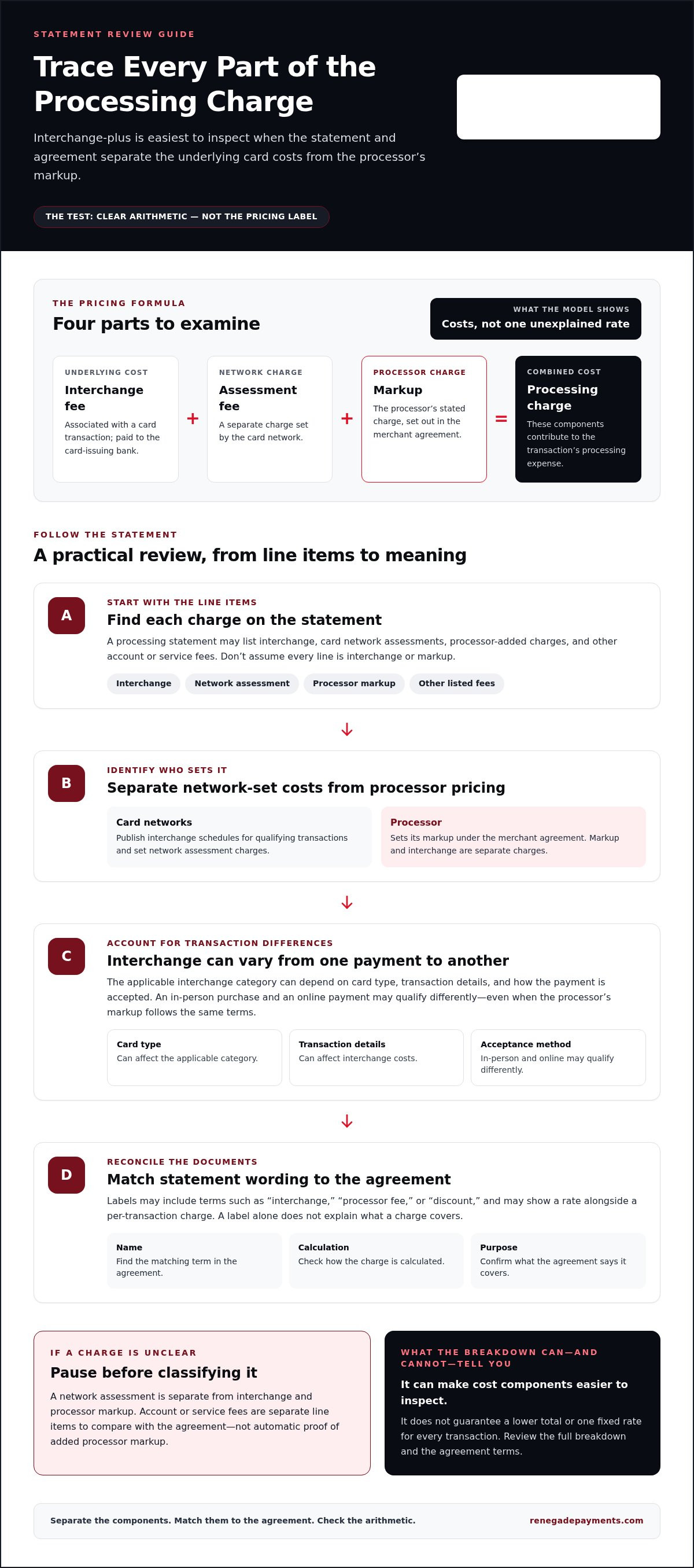
Interchange fee + card network assessment fee + processor markup = processing charge
Interchange is a fee associated with a card transaction and paid to the bank that issued the card. The card network assessment is a separate network charge. The processor’s markup is its charge for processing, as set out in the merchant agreement. Together, these costs contribute to the transaction’s processing expense. The interchange fee can vary depending on the card and transaction details.
This breakdown lets merchants see cost components instead of treating every processing charge as one unexplained rate. But the name of the model doesn’t reveal the total cost. Check how the agreement defines the markup and whether the statement lists each component separately.
What does the plus mean in interchange-plus pricing?
The “plus” is the processor’s stated markup added to interchange. Interchange is the underlying cost associated with a card transaction; the markup is the processor’s charge on top. In an interchange-plus arrangement, these are distinct parts of the pricing structure. The formula explains how costs are built, but it doesn’t promise one fixed total rate for every transaction.
The distinction matters because the interchange component can vary from one transaction to another, even if the processor’s markup follows the same terms. The formula also doesn’t show whether other charges appear in the agreement or statement. Review the full breakdown, not just the headline term.
Who sets interchange, and who sets the markup?
Card networks publish interchange schedules for qualifying transactions. Those schedules set the interchange categories and applicable costs. The processor sets its own markup under the merchant agreement. The processor’s markup and network-set interchange are separate charges, not one combined processor fee.
There isn’t one interchange rate for every payment. The rate can depend on card type, transaction details, and how the payment is accepted. For example, an in-person purchase and an online payment may qualify differently. A business can therefore see different interchange categories across its transactions, even under the same pricing model.
In short, what is interchange plus pricing? It’s a structure that separates the transaction’s interchange cost from the processor’s markup, with network assessment fees also contributing to the total. To understand what you’re paying, look for those distinct components in the agreement and statement. Clear arithmetic starts with knowing what each charge represents.
What Makes Up an Interchange-Plus Processing Charge?
A processing statement may show several charges for a single payment. Identify what each line represents and who sets it. An interchange-plus processing charge can include the transaction’s interchange cost, a card network assessment, the processor’s markup, and other fees listed in the agreement or statement. Don’t assume every line is interchange or processor markup.
Card type, transaction details, and acceptance method can affect which interchange category applies. A payment made in person, for example, may qualify differently from an online transaction. Interchange can vary across your sales even when the processor’s markup follows the same terms.
Interchange and processor markup are different charges
Interchange is the underlying cost associated with a card transaction. The processor markup is the processor’s stated charge on top of that cost. Documents may label these components differently, with terms such as “interchange,” “processor fee,” or “discount,” or show a rate alongside a per-transaction charge. Labels alone don’t explain what a charge covers. Compare the statement wording with the definitions in your agreement.
For another explanation of how interchange-plus pricing works, Chargebacks911’s Interchange-Plus Pricing Explained offers additional context. Use your own agreement and statement to identify the charges applied to your account.
The practical distinction is that interchange is tied to the transaction’s qualifying category, while markup is the processor’s charge under your pricing terms. If both appear together under a broad label, look for a clearer breakdown so you can distinguish them.
Which other charges may appear on a merchant statement?
Statements may also show network, account, or service fees. These are separate line items to identify, not automatic proof of added processor markup. Fee names and presentation can vary. A network assessment, for instance, is separate from both interchange and the processor’s markup, even though all may contribute to total processing costs.
Compare each listed charge with the agreement. Check its name, how it’s calculated, and whether the document explains its purpose. If a statement uses an unfamiliar label, find the matching term in the agreement and see how it fits into the total. This helps you avoid misclassifying a network or account fee as interchange or overlooking a separate processor charge.
- Interchange: the underlying transaction component.
- Network assessment: a separate card network charge.
- Processor markup: the processor’s stated addition.
- Other listed fees: account or service charges to compare with your agreement.
If the line items are difficult to reconcile, a complimentary processing statement review can help identify the components and assess potential savings. The review starts with the figures on your statement, not assumptions about what every processor charges.
Does Interchange-Plus Pricing Guarantee Lower Processing Costs?
No. A transparent pricing structure doesn’t automatically produce a lower processing bill. Interchange-plus can show how charges are built, but your total still depends on the transactions you process, the processor’s markup, and any other applicable charges. Don’t compare offers by the “interchange-plus” label alone. Check whether the agreement and statement let you understand and compare the full cost.
Businesses with different card and transaction mixes may have different costs under the same pricing structure. Even with a similar mix, the markup and additional charges can differ. Judge the numbers, not the label.
What interchange-plus makes easier to see
Separating interchange from the processor’s markup can help you identify which costs are tied to transactions and which are set by the processor. A single blended rate combines components into one figure, while interchange-plus presents them separately. That can make a statement easier to examine, provided its labels are clear and match the agreement.
For more context on the model and factors that can affect interchange, see Understanding Interchange-Plus Pricing. Disclosed components are useful only when you can match them to your own charges. A list of line items isn’t clear if you can’t tell what each one represents.
- Can you identify the processor’s markup in the agreement?
- Does the statement distinguish interchange from other charges?
- Can you match the listed fees to the terms you accepted?
When the model may feel less predictable
Interchange can vary by transaction type, card, and acceptance method. A month with more online payments, different card types, or a changed sales mix may produce a different total, even if the processor’s markup hasn’t changed. That variation may reflect the transactions being processed rather than a change in the markup.
Compare periods carefully. Look at transaction mix alongside charges, and distinguish changes in underlying costs from changes to the processor’s terms. Otherwise, a shifting total can be difficult to explain. For a different payment approach, a dual pricing payment processing guide can help you understand how that model is structured.
Interchange-plus may suit a business that values a visible breakdown and is prepared to review its statement. A blended rate may be easier to follow at a glance, but combines costs rather than displaying each component separately. Neither structure suits every business. Compare agreement terms, statement clarity, transaction patterns, and total charges before deciding which fits your needs.
How Can You Check Interchange-Plus Pricing Against Your Statement?
Don’t start with the statement’s final total. Trace the charges from your sales activity to the pricing terms in your agreement. To understand what is interchange plus pricing in practice, check whether you can identify and reconcile transaction costs, the processor’s markup, and other listed fees.
- Identify transaction volume. Note the statement period, total processed sales, and transaction count. These figures give you a starting point for comparing charges with your payment records.
- Find interchange. Look for interchange costs, which may appear in grouped totals or transaction-level details. Check that you can distinguish them from network and processor charges.
- Locate the markup. Compare the processor charges on the statement with the markup terms in your agreement. Note whether the agreement describes a percentage, a per-transaction amount, or another basis.
- Review additional fees. List other charges separately. Compare each name and description with the agreement rather than assuming it’s part of interchange or markup.
A simple illustrative transaction calculation
Use placeholders rather than a sample rate. Suppose a transaction has an interchange amount of I and a processor markup amount of M. The simplified calculation is:
- Interchange: I
- Processor markup: M
- Illustrative transaction charge: I + M
This is a calculation framework, not a complete statement of all possible costs. It excludes network assessments and other fees, which may appear separately. Replace the placeholders with amounts shown for an actual transaction, then compare the result with the corresponding statement entries. Don’t treat the illustration as a quoted rate or a prediction of your processing costs.
What to compare across your statement and agreement
Match the markup shown on the statement to the method and terms in your agreement. Then check whether separately listed network, account, or service charges are described there. Fee labels can vary, so compare descriptions and calculations, not just wording.
If you can’t reconcile the figures, note the unclear line items and relevant agreement terms. Reviewing the statement period, sales totals, transaction count, and individual charges together can help you pinpoint whether a difference comes from transaction activity, markup, or another fee. A deeper guide on how to read a merchant processing statement can also help you interpret unfamiliar labels.
Renegade Payments offers a complimentary statement savings analysis to identify processing costs and assess potential savings. Request a statement savings analysis to review your statement and pricing terms more closely.
When Should a Business Consider Interchange-Plus Pricing?
Interchange-plus may be worth considering if you want to see how processing charges are built and are willing to review the details. Knowing what is interchange plus pricing is only a starting point. Decide whether the agreement clearly explains the markup, the statement’s fees make sense, and the pricing structure fits your transaction mix and the way you manage expenses.
No pricing model is automatically right for every business. Evaluate terms and numbers you can verify, rather than relying on a label or a sales claim.
Questions to ask before evaluating the pricing model
Start with the written agreement and your actual statement. Ask yourself:
- Can you identify the processor’s markup? The agreement should explain how it’s applied so you can compare that term with the corresponding statement charges.
- Are additional charges described? Check whether each separately listed fee has a clear name and explanation in the agreement.
- Would a clearer breakdown help? Consider whether separating cost components would make it easier to track expenses or review changes between statement periods.
Your transaction mix matters, too. If payment types or acceptance methods vary, underlying costs may vary as well. Consider whether you’re comfortable reviewing those differences instead of expecting every period to produce an identical total.
Compare the full agreement with the way you take payments. A model label can’t tell you the complete cost. Look at how the markup is stated, which other charges apply, and whether the statement presents those terms clearly. If the documents don’t let you connect the written pricing to the billed charges, you don’t yet have a clear basis for evaluating the model.
Use a statement review to test the numbers
A statement review can help you examine your current costs, identify the charges, and assess whether the terms are clear. Renegade Payments offers complimentary merchant statement savings analyses for this purpose. Treat the review as an evaluation of your current processing costs, not a promise that fees will go down. The result depends on the details in your statement and agreement.
Use your actual figures to make the decision. Compare transaction activity and statement charges with the pricing terms, then consider whether the breakdown gives you the visibility you want. That evidence is more useful than assuming one pricing model always costs less.
If you want help examining your current statement, request a complimentary processing savings analysis.
Make Your Next Processing Decision With Clear Numbers
The next step isn’t to choose a pricing label. Use your processing records to decide what level of visibility you need and whether the terms make sense for your business. Now that you understand what is interchange plus pricing, you can assess the actual charges instead of relying on a sales claim.
Renegade Payments’ interchange-plus model separates wholesale interchange from a fixed processor markup, giving you distinct components to examine. A complimentary merchant statement savings analysis can help identify current processing costs and assess potential savings. It’s an evaluation, not a promise that your costs will fall. The value is clearer information to support your decision.
Put your statement and agreement to work. Request a complimentary processing savings analysis to better understand your payment costs.
Frequently Asked Questions
Is interchange-plus pricing always cheaper?
No. A pricing model can make charges easier to inspect without lowering the total. To compare offers, use the same statement period and actual transaction activity, and include all applicable charges, not just the processor’s quoted markup. A headline percentage may leave out per-transaction charges or separate account fees. Compare the full written terms with your business’s payment records before deciding which arrangement costs less.
Can interchange rates change from one transaction to another?
Yes. Different card types and transaction details can qualify for different interchange categories. For example, an in-person card payment and an online payment may have different underlying costs. If a statement total changes, check whether your sales shifted between payment channels or card types before assuming the processor changed its markup. Transaction-level details, where available, can help explain which payments contributed to the difference.
How much does interchange-plus payment processing cost?
There’s no single total that applies to every business. Knowing what is interchange plus pricing explains the structure, not your final bill. To assess your costs, gather a recent statement, your agreement, transaction volume, and transaction count. Then identify the charges applied to those sales. A headline percentage alone may not show per-transaction charges or separate account fees, so compare the full calculation rather than one figure.
Does interchange-plus pricing include monthly or account fees?
It can involve charges beyond transaction-based costs, depending on the agreement. Review your statement for fees billed monthly or tied to an account or service, then compare each entry with the agreement’s fee descriptions. Check whether a charge is recurring or appears only for a particular billing period. If its purpose isn’t clear, request an explanation in writing so you can compare the full terms.
What happens if a transaction is refunded under interchange-plus pricing?
A refund creates separate statement activity, but the exact fee treatment depends on the processor’s terms and applicable charges. Don’t assume the fees from the original sale are automatically returned. Match the refund entry to the original transaction, then compare both entries with the agreement and statement descriptions. If the amounts or labels are unclear, ask for a line-by-line explanation of how the refund and related fees were handled.
Is interchange-plus pricing a good fit for a small business?
It can suit a small business, but size alone doesn’t decide it. Consider whether you want to examine separate cost components and whether your team can use the statement details in its bookkeeping. A business accepting payments through different channels may have more transaction variation to review. Compare the written agreement with actual processing records, and treat a statement review as a way to understand costs, not a promise of savings.
Frequently Asked Questions
Clear, straightforward answers about payment processing rules, rates, and terms.
Get your free savings
analysis in 24 hours
Upload a recent processing statement and we'll show you exactly how much you can save. No commitment, no pressure, no sales pitch.