Interchange Plus Merchant Services: A Practical Buying Guide
Explore interchange plus merchant services with our practical buying guide. Learn how to compare processor markups, analyze statements, and cut payment costs.
Published

A transparent processing statement can still show a bill that doesn’t fit your business. Interchange plus merchant services separate wholesale card costs from the processor’s markup, making the charges easier to inspect. But clear line items don’t automatically mean lower costs. Your payment mix, transaction patterns, and account fees all affect the total.
When proposals use different fee labels, focus on the difference between wholesale costs and processor charges. This guide explains what to look for in an interchange-plus proposal, how to compare it with flat-rate pricing and dual pricing, and which details from your statements can make the comparison useful. It also covers why the model may suit one business but not another. Renegade Payments’ complimentary savings analysis reviews your existing processing statements to help ground the decision in your actual costs.
Key Takeaways
- Judge interchange-plus by your payment mix and operating needs, not by claims that one pricing model always wins.
- Review the markup, transaction charges, additional fees, and contract terms in each proposal.
- Compare interchange plus merchant services with flat-rate and dual pricing by looking at fee visibility and checkout impact.
- Use your processing statements to map costs and compare proposals using the same business details.
- Renegade Payments offers interchange-plus and dual pricing, with a complimentary statement review to help compare the approaches.
Table of Contents
- When interchange plus merchant services make sense for your business
- How to evaluate interchange-plus fees in a merchant-services proposal
- Interchange-plus vs. flat-rate and dual pricing: compare the trade-offs
- A practical interchange-plus merchant-services decision process
- Explore interchange-plus merchant services with Renegade Payments
When interchange plus merchant services make sense for your business
Choose a pricing model by testing it against your business, not by assuming there’s a default winner. With interchange plus merchant services, the processor passes through underlying transaction costs, including interchange and applicable network charges, then adds a stated processor markup. That separation can make the bill easier to inspect. It doesn’t make every transaction cost the same or prove that your total will be lower.
Itemization is most useful when you’ll act on it. If you review statements regularly, track payment costs internally, or need to explain changes to a finance team or business partner, separating cost components can make that work more practical. You can see the processor’s markup and compare it with underlying charges instead of trying to decode one blended rate. For more background, this interchange-plus pricing explainer breaks down how the model works.
Which merchants may value itemized processing costs?
Consider whether your team needs to investigate, report, or compare payment expenses. A business accepting payments both in person and online, for example, may want to understand how different transaction patterns affect its statements. A bookkeeper could use itemized costs to distinguish processor charges from underlying transaction expenses during routine reviews. The useful question isn’t how large the business is. It’s whether clearer line items help you make decisions you already need to make.
Build a simple review habit: compare statements over consistent periods, note changes in your payment mix, and track recurring charges separately from transaction-based costs. If you rarely review the numbers or value a simpler bill more than detailed cost visibility, itemization may offer less practical value. Fit depends on how you operate, not on a volume threshold.
What transparency does, and does not, tell you
Itemization can help you identify and compare fee components. Interchange varies with transaction characteristics, so a single quoted rate won’t describe every payment. The Interchange fee is one underlying cost in the model; the processor markup is separate. Seeing those pieces gives you a clearer structure to examine, but you still need to consider the transactions you process, other applicable fees, and contract terms.
Pricing visibility shows how charges are structured; it doesn’t guarantee savings. A proposal can be transparent and still produce a higher total for your payment mix or operating needs. Compare actual statements with the proposed pricing using consistent assumptions. Include the channels you use and the applicable fees, then judge the full bill, not just the markup. That’s how you assess whether the added clarity is useful and the economics work for your business.
How to evaluate interchange-plus fees in a merchant-services proposal
A proposal is useful only if you can trace how its charges contribute to the final bill. Don’t judge it by one headline markup or a polished summary. Break down the components, then compare them with your processing statements and the terms that govern the account. Labels and statement layouts can differ, so focus on what each charge means.
Which line items should merchants identify?
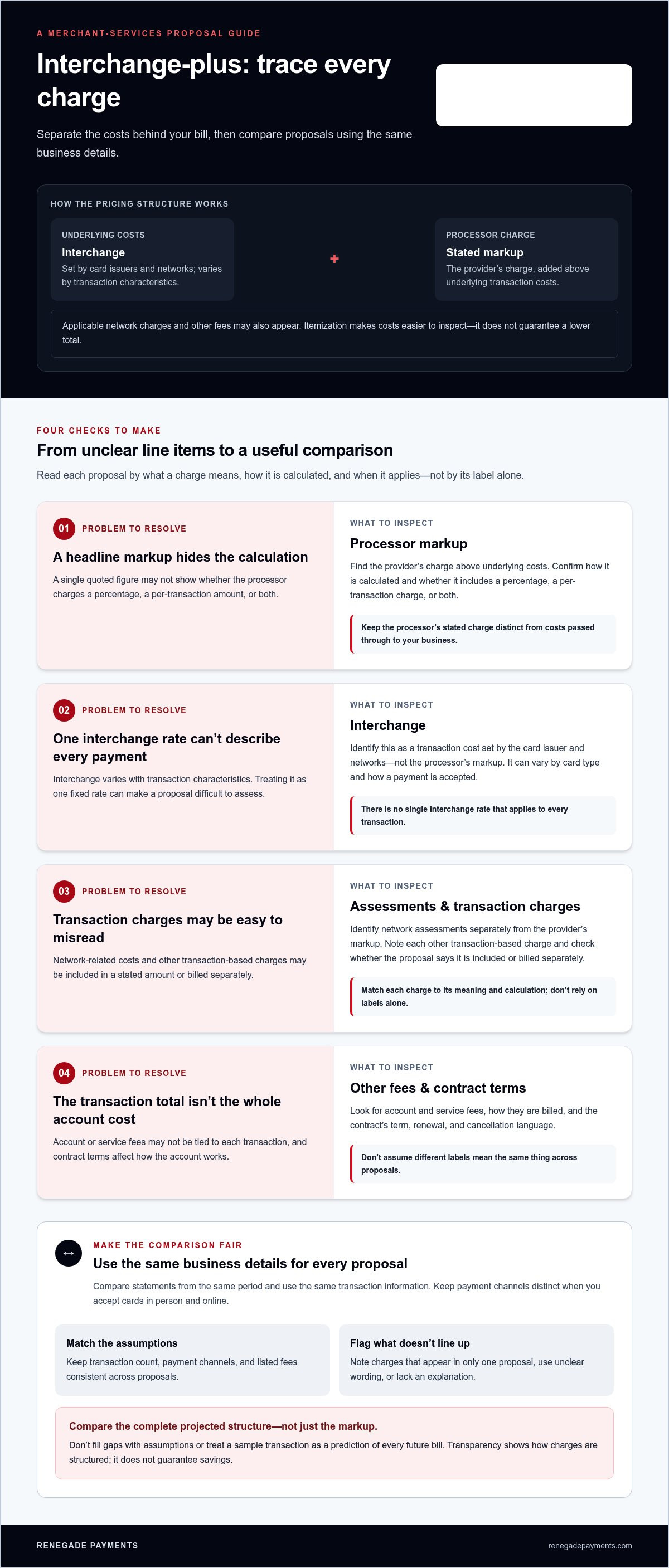
Start with these four checks. Mark any line item whose meaning or calculation isn’t clear.
- Processor markup: Find the provider’s charge above underlying transaction costs. The processor markup is the provider’s stated charge for processing, added above the underlying costs passed through to your business. Check how it’s calculated and whether it includes a percentage, a per-transaction charge, or both.
- Interchange: This is a transaction cost set by the card issuer and networks, not the processor’s markup. It can vary based on details such as card type and how the payment is accepted. There is no single interchange rate that applies to every transaction.
- Network assessments and transaction charges: Identify network-related costs separately from the provider’s markup. Note other transaction-based charges too, including whether the proposal says they’re included in a stated amount or billed separately.
- Other fees and contract terms: Look for account or service fees that aren’t tied to each transaction. Review how they’re billed, along with the contract’s term, renewal, and cancellation language. Don’t assume different labels mean the same thing across proposals.
These distinctions matter. A processor controls its stated markup, while interchange and network-related charges come from other parties. A proposal should show which is which rather than folding them into a vague “processing” line.
How to compare terms without false precision
Make the comparison fair before drawing conclusions. Use statements from the same period and include the same transaction information for each proposal. Keep payment channels distinct if you accept cards both in person and online. A different mix of card types, transaction methods, or sales channels can change underlying costs, so an isolated markup comparison can mislead.
Then match each proposal item to a charge on your current statement where possible. Flag costs that appear only in one proposal, use unclear wording, or lack an explanation. Record how each charge is calculated and when it applies. Don’t fill gaps with assumptions, and don’t treat a sample transaction as a prediction of every future bill.
Compare the complete projected structure, not just the processor’s stated markup. Keep assumptions consistent, including transaction count, payment channels, and listed fees. That gives you a grounded comparison without implying a universal rate or guaranteed savings. Renegade Payments’ complimentary processing statement review uses actual statements to identify costs and compare interchange-plus pricing with dual pricing.
Interchange-plus vs. flat-rate and dual pricing: compare the trade-offs
These models answer different questions. Interchange-plus shows how processing charges are built. Flat-rate pricing presents a blended rate. Dual pricing changes how cash and card prices appear at checkout. Don’t choose based on a label or headline rate. Compare the fee structure, customer experience, and your actual processing details.
| Model | Fee visibility | Checkout implications | What to review |
|---|---|---|---|
| Interchange-plus | Itemizes underlying transaction costs and the processor’s markup. | Doesn’t, by itself, set separate cash and card prices. | Markup, transaction mix, other fees, and account terms. |
| Flat-rate | Bundles costs into a blended rate, which can make the pricing presentation easier to scan. | Usually presents one card price; checkout setup depends on the business. | How the rate applies across payment types, plus any additional fees or terms. |
| Dual pricing | Focuses on the prices presented to customers, rather than itemizing processing costs in the same way. | Displays distinct cash and card prices at checkout. | How prices are shown and communicated, and whether the approach fits the customer experience. |
What does interchange-plus offer compared with flat-rate pricing?
Interchange-plus separates underlying transaction costs from the processor’s stated markup. Those underlying costs can vary across transactions, so this model isn’t one universal rate. Flat-rate pricing combines costs into a blended rate, which may be simpler to read at a glance but gives less detail about each component. One approach prioritizes visibility; the other prioritizes a consolidated rate presentation. Neither is automatically cheaper. Compare the full costs against the same processing activity.
How does dual pricing differ from interchange-plus?
Dual pricing is a checkout and pricing presentation: customers see separate cash and card prices. Interchange-plus is a way to calculate and display processing costs on the merchant’s account. They address different parts of the payment experience, so don’t treat them as interchangeable fee formulas. Your preference for a single displayed price or distinct cash and card prices should shape the comparison. For a closer look at how the model works, see this dual pricing payment processing guide.
To make the trade-offs concrete, compare proposals using your own statements. Match the time period and payment channels, then account for transaction mix, listed fees, contract terms, and checkout needs. A blended rate may be easier to scan, while itemized interchange plus merchant services may give you more detail to review. Dual pricing shifts attention to how customers encounter prices. The right choice depends on which information and payment experience matter most to your operation, not on a blanket promise that one model always wins.
A practical interchange-plus merchant-services decision process
Make the pricing decision a repeatable review, not a reaction to a headline rate. Interchange plus merchant services can make costs easier to examine, but the right choice depends on what your statements show and how your business accepts payments. Use the same records and assumptions to compare the full proposal, then weigh the cost structure against day-to-day requirements.
Prepare a useful comparison from existing records
Start with current merchant statements covering comparable processing periods. Gather the transaction details and payment channels represented in those statements, then compare them with the scope of each proposal. Don’t estimate missing values or treat different periods as equal. Record what the documents actually show.
- Gather statements. Use records that reflect your current processing, and note the period each statement covers.
- Map the fees. List each charge, its label, and whether it’s transaction-based or billed separately. Mark unclear items for explanation rather than guessing what they mean.
- Compare proposals. Review the processor markup, separately stated charges, and contract terms against the same transaction information and payment channels.
- Check operational fit. Note how you take payments, what checkout presentation you prefer, and what your team needs from the payment process. A pricing comparison that ignores these requirements is incomplete.
Decide what evidence would make the model worthwhile
Ask what you need the pricing structure to help you do. Separate line items may support routine statement reviews or internal cost tracking. But visibility matters only if you can use it, and it doesn’t replace comparing the full cost picture. Include listed charges and terms alongside the processor’s markup. Choose a model based on verified terms, not its label.
Then assess the practical side of a switch. Consider the payment channels you rely on, how checkout should work, and what your business needs from its payment setup. A model that looks attractive on a fee summary may not fit your operation. A more detailed pricing structure may be valuable if your team will use that detail to review costs and make decisions. Neither outcome is universal.
Keep a short record of your findings: the proposal’s stated charges, what remains unclear, how closely it matches your transaction mix, and any operational trade-offs. That gives you a clear basis for deciding whether to stay with your current approach or compare another one. Renegade Payments’ complimentary processing statement review grounds the comparison in your actual statements.
Explore interchange-plus merchant services with Renegade Payments
You can evaluate a proposal by looking at its fee structure, comparing it with your own processing, and weighing it against how your business accepts payments. Renegade Payments offers interchange-plus and dual pricing payment-processing services. The approaches address different priorities. Interchange-plus separates underlying costs from the processor’s markup. Dual pricing presents distinct cash and card prices at checkout. Consider your business’s actual needs when comparing them.
Ground the comparison in your existing merchant processing statements. Renegade Payments’ complimentary savings analysis reviews those statements to identify processing costs and assess potential savings under either approach. The findings are tied to the details in your records and the pricing being considered, not a blanket promise that every merchant will pay less. Your transaction mix, listed charges, and operating requirements still matter.
What happens in a Renegade Payments statement review?
The review starts with your current processing statements. These records provide a practical basis for identifying the costs reflected in your account and examining how another pricing approach might compare. A statement review can clarify the charges shown in the documents, but it isn’t a universal prediction of future bills. The relevant comparison depends on your processing activity and the proposal details being assessed.
Use the records that show how you process payments today. Keep the statement periods and payment channels in view, and note any line items that need explanation. This makes it easier to see what the current statements show and how interchange-plus or dual pricing could align with your priorities. The aim is a grounded review, not a promise based on an assumed savings figure.
Choose the next step that matches your priority
If you want to see the processor markup separated from underlying costs, focus on interchange-plus and how charges appear in the proposal. If your main concern is checkout pricing, consider dual pricing as a separate approach, with its distinct cash and card prices. Start with the outcome you need, then compare the model’s details with your statements and day-to-day payment operations.
- Prioritize fee visibility: Review how interchange-plus presents underlying costs and the processor markup.
- Prioritize checkout presentation: Consider whether distinct cash and card prices suit how you want to present prices to customers.
- Keep the decision grounded: Compare the full processing picture and operational fit rather than relying on a model name or a generalized claim.
The right choice is the one that fits your verified costs and business requirements. Renegade Payments’ complimentary savings analysis is based on your current processing statements.
Make your next pricing review count
Set a clear benchmark before evaluating interchange plus merchant services. Decide whether you care most about cost visibility, a checkout approach that suits your customers, or a processing structure your team can review with confidence. Then use your business records to test whether a proposal meets that standard.
You don’t need to rely on broad promises or a headline rate. Renegade Payments reviews existing merchant processing statements at no cost, giving you a practical basis to compare interchange-plus and dual pricing approaches. The goal is a better-informed decision, not a promised outcome. Let your own costs and operating priorities guide the choice.
Request a complimentary savings analysis to compare your current processing with the options that fit your priorities.
Frequently Asked Questions
Is interchange-plus pricing always cheaper than flat-rate pricing?
No. The total depends on your transactions, added fees, and account terms, so a lower-looking markup alone doesn’t prove the full bill will be lower. For a fair comparison, use one statement period and calculate what each model would charge for the same card sales and transaction mix. A flat-rate plan may better suit your priorities in some cases. Use actual records, not a general claim about which model costs less.
Can a small business use interchange-plus merchant services?
Yes. Business size alone doesn’t determine whether interchange-plus fits. A small retailer with a mix of in-person and online payments may value seeing how those transactions are charged, while a business with few, irregular sales may prefer a pricing structure that’s easier to budget. Compare expected account charges and transaction costs with your own statements. Choose based on your payment activity and review needs, not a volume rule or a one-size-fits-all recommendation.
How do I calculate my effective credit card processing rate?
Divide all processing fees for a statement period by the card sales volume for that same period, then multiply by 100. For example, if you’re reviewing one month, use that month’s fees and card sales, not fees from one period against sales from another. Decide consistently which processing-related charges to include, and note that the result is a blended historical measure. It doesn’t show how each individual transaction was priced.
What fees can appear in addition to interchange and processor markup?
Depending on the provider and account, a statement may list network assessments, per-transaction charges, monthly account or service fees, payment gateway charges, or fees related to disputes. Accounts can have different charges, and labels can vary. Review each fee’s amount, billing basis, and conditions in the statement and proposal. Identify unclear line items before using them in a cost comparison.
Does the type of card affect interchange costs?
Yes. Interchange can differ based on transaction details, including the card category and how the payment is accepted. For instance, a credit card payment made online may be treated differently from a debit card payment accepted in person. The exact treatment depends on applicable card-network and transaction rules. That’s why a proposal’s example rate can’t stand in for your whole payment mix. Review actual transaction records to understand what your business processes.
Is dual pricing the same as interchange-plus pricing?
No. They describe different parts of payment processing. Dual pricing presents separate cash and card prices to customers at checkout. Interchange-plus describes how processing charges are structured for the merchant. A business comparing them should consider both its cost records and the customer-facing price presentation it wants. Renegade Payments offers dual pricing alongside interchange-plus, but the two approaches aren’t the same fee calculation.
Can Renegade Payments review my current processing statement?
Yes. Renegade Payments provides a complimentary savings analysis that reviews existing merchant processing statements to identify costs and assess potential savings under interchange-plus or dual pricing. The review is based on the statement details and pricing approach being considered; it doesn’t guarantee a lower total cost for every business. Use current statements that reflect your payment activity for a practical comparison. Renegade Payments’ savings analysis is available through its website.
Frequently Asked Questions
Clear, straightforward answers about payment processing rules, rates, and terms.
Get your free savings
analysis in 24 hours
Upload a recent processing statement and we'll show you exactly how much you can save. No commitment, no pressure, no sales pitch.