How Does Credit Card Payment Processing Work? A Clear Guide
Ever wonder how does credit card payment processing work? Learn the complete steps from authorization to final bank payout and understand key merchant fees.
Published

An approved card payment doesn’t mean the money is already in your bank. So, how does credit card payment processing work? It begins with a request for authorization, then moves through several steps before funds reach your account. Checkout is only the start.
If the process feels like a jumble of processors, card networks, banks, and fees, you’re not alone. The terminology can obscure a simple distinction: approval means the transaction can proceed, but it doesn’t mean settlement or payout is complete.
This guide follows a card payment from checkout to a merchant bank account. You’ll see what the payment processor, card network, issuing bank, and acquiring bank each do, and why the money takes time to arrive. You’ll also learn where processing costs enter the transaction and how to compare sales records with deposits. Understanding those steps makes pricing models such as interchange-plus easier to evaluate and helps you review what you’re paying.
Key Takeaways
- Follow the payment messages from checkout through the banking system to understand how credit card processing works.
- Learn what the gateway, processor, card network, and banks each handle, so payment terminology is easier to decode.
- Separate authorization, capture, clearing, and settlement to understand why checkout and deposit happen at different points.
- Compare transaction records with payout details to reconcile sales and deposits and identify deductions.
- Compare pricing structures, including interchange-plus, which passes interchange through with a clear fixed markup.
Table of Contents
- What happens when a customer pays by credit card?
- Who handles a credit card payment from checkout to the banks?
- How does a credit card transaction move from authorization to settlement?
- Why an approved card payment may not mean money is in the merchant’s account
- What merchants can control after understanding credit card processing
What happens when a customer pays by credit card?
Credit card processing routes a payment request through systems that check whether the transaction can proceed, then coordinates the later movement of funds. It’s a chain of messages and money movement, not one instant transfer. Understanding how does credit card payment processing work starts with separating the checkout decision from the money that eventually reaches the merchant.
Picture a customer buying a $48 meal. They tap their card, the merchant’s system sends a payment request, and a response comes back: approved or declined. Approval lets the sale move forward. The transaction still has to pass through later processing steps before the merchant receives a payout.
Authorization approves a transaction; settlement and payout move the funds afterward.
What does credit card processing include?
Processing includes the payment information collected at checkout, the messages used to request and return an authorization decision, and the later activity that settles the transaction. Authorization checks whether the card can be used for the purchase. Settlement happens later, when transaction details are reconciled and funds move through the payment system.
A credit card lets its holder make purchases using credit provided by the card issuer. How the customer presents the card affects the checkout experience, but not the basic distinction between an approval and the later transfer of funds.
Why does a card payment pass through several systems?
No single participant handles the entire transaction. The merchant’s system submits the request, payment services route messages, the card network carries them between institutions, and the issuer decides whether to approve or decline. Later steps handle transaction records and funds movement. The payment doesn’t jump directly from the customer’s card to the merchant’s bank account.
The customer sees a quick checkout response because the approval decision is returned during the purchase. Other processing steps continue afterward. They determine when a transaction is finalized and included in a payout, not just whether the customer could complete the purchase.
Checkout can happen in person or online. For a card-present purchase, the customer presents a physical card or card-enabled device to the merchant’s terminal. Online, the customer enters card details through a checkout page. The information is submitted through different interfaces, but both transactions involve an authorization request and subsequent processing. The way a customer enters payment details doesn’t tell you when the merchant gets paid.
That distinction clears up much of the confusion: the checkout screen reports a decision, while the merchant’s account reflects a later stage. To understand the full payment flow, identify the people and systems behind each message, then follow the transaction from authorization toward settlement and payout.
Who handles a credit card payment from checkout to the banks?
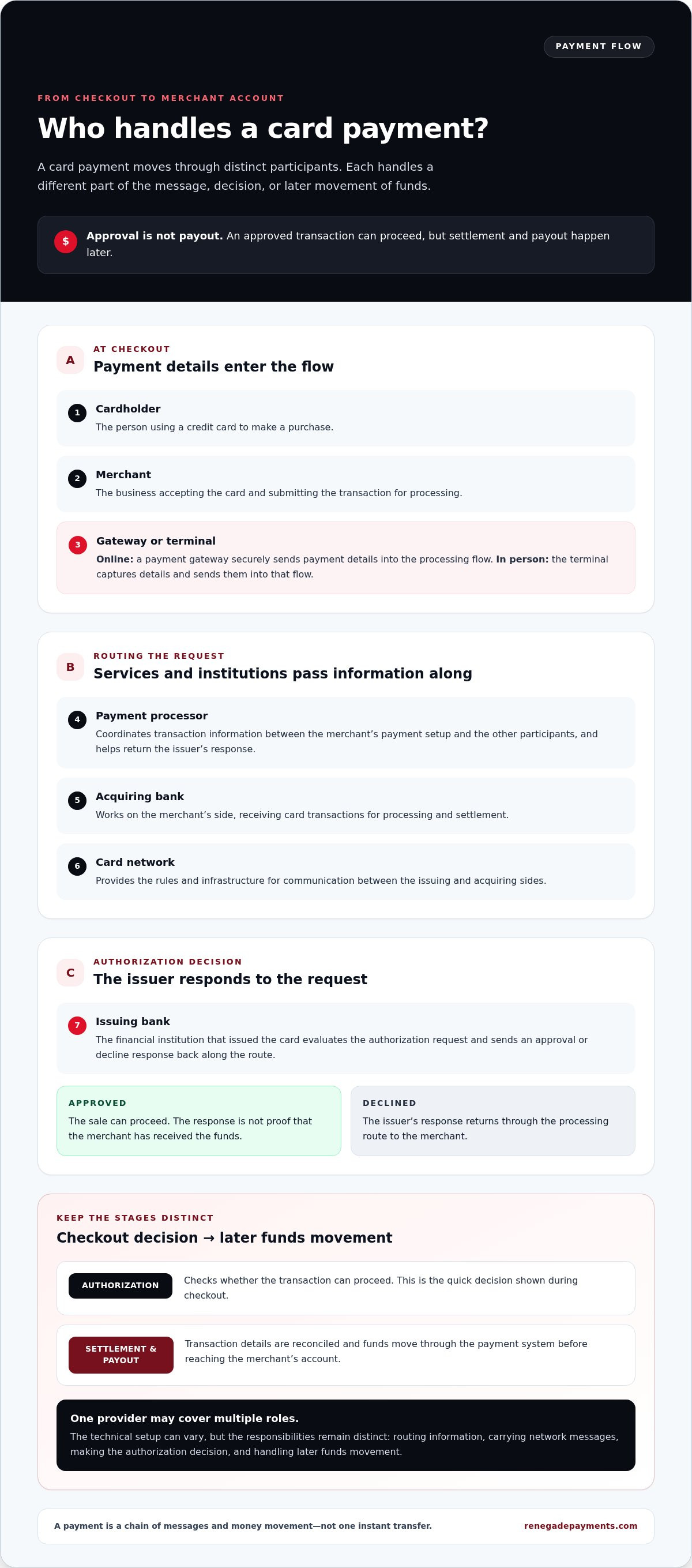
A card payment involves several parties, each with a distinct job. The customer sees one checkout screen. Behind it, payment information and authorization messages pass between the merchant’s tools, financial institutions, and the card network. One company may handle more than one role, but the responsibilities remain distinct.
- Cardholder: The person using a credit card to make a purchase.
- Merchant: The business accepting the card and submitting the transaction for processing.
- Payment gateway: Software that securely sends payment details from an online checkout into the payment processing flow.
- Payment processor: A service that coordinates transaction information between relevant payment participants.
- Acquiring bank: The financial institution on the merchant’s side that receives card transactions for processing and settlement.
- Card network: The network that provides rules and infrastructure for communication between the issuing and acquiring sides.
- Issuing bank: The financial institution that issued the card to the cardholder and responds to the authorization request.
A gateway submits payment details; a processor coordinates transaction information. These are distinct roles, even when a provider’s setup combines them. A gateway commonly supports online checkout. For an in-person purchase, the terminal captures payment details and sends them into the processing flow, which may not use an online gateway in the same way.
What does the payment processor do?
The processor helps route transaction information between the merchant’s payment setup and the institutions involved. When a customer submits an online order, for example, the gateway sends payment details into the processing flow. The processor coordinates their movement toward the acquiring side and helps return the issuer’s response to the merchant. Providers can combine roles, so the technical arrangement can vary.
What do the card network and banks do?
The card network connects the issuing and acquiring sides through its communication infrastructure and operating rules. It isn’t the checkout device or the customer’s bank. The issuing bank evaluates the authorization request for its cardholder and sends back a decision. The acquiring bank serves the merchant’s side of the transaction and handles card payment activity there.
In a typical online flow, the merchant’s checkout submits details through a gateway. The processor and acquiring side pass the request through the card network to the issuer. The issuer’s response travels back along the route to the merchant. In person, the terminal starts that exchange instead. The customer may get a quick answer, but that response is only one message in the larger process.
For a consumer-side view of card accounts and related rights, see the Consumer Financial Protection Bureau on Credit Cards. For merchants, understanding the roles also makes it easier to trace transaction records and identify what statement entries represent. Renegade Payments offers a processing statement savings analysis to help merchants review processing costs.
How does a credit card transaction move from authorization to settlement?
To understand how does credit card payment processing work after checkout, follow the transaction through its distinct stages. The customer’s approval response comes early. The merchant still needs to submit the transaction for processing, and financial institutions must exchange transaction details and move funds. Here’s the sequence.
- Checkout submission: The merchant’s terminal or online checkout collects payment details and sends a transaction request into the processing flow.
- Authorization: The request reaches the card issuer through the relevant payment participants. The issuer evaluates it and returns an approval or decline. An approval means the transaction can proceed; it doesn’t mean the merchant has received funds.
- Capture: The merchant submits an authorized transaction for processing. Depending on the merchant’s setup, capture may happen during checkout or later. Authorization and capture are related, but they are not the same action.
- Clearing: Transaction details are exchanged and reconciled among the relevant participants. This records what was submitted so the institutions can determine what is owed between them.
- Settlement: Funds move between financial institutions according to their arrangements. This movement between institutions doesn’t mean the merchant’s bank account will show a deposit immediately.
What happens during authorization and capture?
During authorization, the request travels through the payment flow to the issuer, which decides whether to approve or decline it. Approval confirms that the transaction can move forward at that point. It isn’t a final transfer to the merchant. Capture is the merchant’s submission of that approved transaction for processing. Depending on the transaction setup, approval and capture may happen at different times.
How do clearing and settlement complete the transaction?
After capture, clearing exchanges and reconciles transaction records among the participants. Those records provide the basis for settling what the institutions owe each other. Settlement is the movement of funds between financial institutions, not necessarily the merchant payout itself. Processing arrangements and payout schedules vary, so there isn’t one universal deposit timeline.
Keep the stages separate. A customer may see an approval at checkout before the transaction has been captured, cleared, settled, or paid out to the merchant. Even after settlement between institutions, the merchant’s deposit follows the applicable payout process. When matching sales records to deposits, a timing gap doesn’t by itself mean the checkout response was the deposit.
In plain terms, authorization is the issuer’s decision, capture submits the approved sale, clearing reconciles the transaction details, and settlement moves funds between institutions. Track each stage separately to see where a transaction stands without mistaking an approval message for money in the bank.
Why an approved card payment may not mean money is in the merchant’s account
A customer can see “approved” at checkout while the merchant’s bank balance hasn’t changed. That’s not a contradiction. Approval is a decision about whether the transaction can proceed. Settlement moves funds between financial institutions. Merchant payout is the later deposit to the business account. Keep those stages separate, and the gap is easier to understand.
| Stage | What it means | What the merchant should expect |
|---|---|---|
| Authorization | The issuer approves or declines the transaction request. | An approval, not a deposit. |
| Settlement | Financial institutions move funds between themselves for processed transactions. | Funds are moving through the system, but may not yet appear in the merchant’s account. |
| Merchant payout | The merchant’s payment arrangement sends funds to its bank account. | A deposit, which may reflect processing deductions or related charges. |
Approval confirms a transaction decision, not a completed bank payout. A customer might finish checkout and receive an approval before the merchant captures the transaction, before institutions settle it, and before the merchant’s payout is sent. The screen reports the checkout decision. The bank account reflects a later event.
What can affect when a merchant receives a payout?
Timing can depend on when the merchant captures authorized transactions, the processor’s arrangements, and the payout schedule. Those details differ, so there isn’t one universal number of hours or days to expect. If a deposit doesn’t match a day’s sales, compare transaction records with the merchant statement and bank deposit records. Check which transactions were captured and which are included in the payout.
For example, a sale approved near the end of a business day may not be captured with that day’s transactions, depending on the merchant’s setup. Clearing and settlement also happen before payout. A difference between checkout activity and a deposit may reflect timing or grouping, not a missing approval. Reconcile records by transaction and payout period instead of expecting every approval to appear as an immediate matching deposit.
Where do processing fees fit into the payment flow?
Processing has costs. Depending on the arrangement, merchant payment activity may show them as deductions from funds or as separate statement entries. That’s why a deposit may not equal the full value of approved sales. Review the statement alongside transaction and deposit records to see how the amounts connect. For a breakdown of fee categories, read the credit card processing fees guide.
To clarify the numbers, match each payout to the transactions it covers, then compare statement cost entries with those records. Renegade Payments offers a complimentary review of merchant processing statements to identify processing costs and potential savings. Request a complimentary processing statement review. Understanding how does credit card payment processing work means knowing not just whether a payment was approved, but where it sits between approval and deposit.
What merchants can control after understanding credit card processing
Once you understand how a card transaction moves, you can check what happens on your side. You can’t control every bank or network step. You can control how clearly you track sales, review processing costs, understand your pricing structure, and match deposits to records. That’s the practical value of knowing how does credit card payment processing work when managing day-to-day payment activity.
Which processing details should a merchant review?
Use this checklist to make the transaction flow visible in your records:
- Transaction activity: Compare completed sales with the transactions in your processing records. Look for missing or duplicated items, or transactions included in a different payout period.
- Statement clarity: Check whether processing costs are described in terms you can understand and connect to your payment activity.
- Pricing structure: Identify the pricing model applied to your transactions. Check whether the statement shows how costs are calculated.
- Payout reconciliation: Match deposits to the transactions and statement entries they cover. Account for timing differences and listed deductions instead of expecting deposits to mirror individual sales.
Keep the records together. Your transaction report shows what customers paid, the merchant statement shows processing activity and costs, and your bank records show deposits. Reviewing all three gives you a clearer picture than relying on a deposit total alone.
How can pricing clarity change the merchant’s view of processing?
A pricing structure should make it easier to connect processing costs to transactions. With interchange-plus, interchange passes through with a clear fixed markup. This separates the underlying interchange cost from the processor’s markup, making the structure easier to examine. Learn more about interchange-plus pricing for merchants.
Dual pricing takes a different approach. It presents distinct cash and card prices at checkout, so customers see the relevant price before paying. It’s a checkout pricing approach, not a universal fit for every business. Review how it works in this guide to dual pricing payment processing.
Whatever structure you use, clarity is the test. Can you identify the model, understand statement descriptions, and reconcile costs and payouts against transaction records? If not, the paperwork isn’t giving you a clear view of the money. Renegade Payments offers a complimentary processing savings analysis to help identify costs and potential savings in your statement. Request a complimentary processing savings analysis.
Turn payment clarity into a stronger next step
Knowing how does credit card payment processing work is useful. Putting that knowledge to work helps you make informed decisions about your payment setup. Start with a practical question: can you trace your processing costs from the statement back to your transactions and pricing structure?
If the answer is unclear, don’t settle for numbers you can’t explain. Renegade Payments reviews merchant processing statements at no cost and offers interchange-plus and dual pricing payment processing. A focused review can help you understand what your statement shows and consider whether a different pricing structure makes sense for your business.
Request your complimentary processing savings analysis to take the next step toward understanding your payment costs. With clearer information, you can make decisions based on what your business needs.
Frequently Asked Questions
Is authorization the same as settlement?
No. Authorization is the issuer’s decision about whether a transaction can proceed. Settlement is a later stage in which financial institutions account for and move funds between themselves. The distinction matters when checking a sale against a deposit: an approval message isn’t proof that settlement or merchant payout has happened. Track the transaction status and payout records separately to see where it stands.
Can a credit card payment be approved and still not appear in a merchant’s account?
Yes. An approved sale may not appear as a deposit because merchant records and bank accounts reflect different stages of the transaction. For example, a sale may be approved but not yet included in a captured batch or scheduled payout. That gap is one reason the question “how does credit card payment processing work” matters to daily reconciliation. Compare sales records with payout details before treating a timing difference as a missing payment.
What does a pending credit card transaction mean?
A pending transaction generally means the card issuer has recorded an authorization, but the charge hasn’t finished posting to the account. The final amount or status may change as the merchant completes the transaction, or the pending item may disappear if the sale isn’t completed. For instance, a restaurant may authorize a card before the final bill is settled. Check the account’s posted activity and contact the card issuer about a specific pending item.
Can a customer dispute a credit card payment after it has settled?
Yes. Settlement doesn’t prevent a cardholder from contacting their issuing bank to dispute a charge. A customer may question a transaction they don’t recognize, believe is incorrect, or say relates to goods or services they didn’t receive. The bank reviews the claim under its process and may request information. Merchants can support accurate records by retaining receipts, order details, and customer communications that help explain the transaction.
Does a merchant receive the full amount charged to the customer?
Not necessarily. The amount deposited may differ from gross sales because processing costs can appear in merchant payment activity, and deposits may group multiple transactions. For example, a payout covering several sales may also include deductions shown in the processing statement. Compare the deposit, statement, and transaction records for the same period to distinguish processing costs and payout timing from an unexplained discrepancy.
Is online credit card processing different from paying in person?
Yes, the customer submits card details differently. In person, they may tap, insert, or swipe a card or payment device at a terminal. Online, they enter payment details through a checkout page. The starting point and information capture differ, so the merchant’s tools and records may differ too. Both routes still involve the relevant payment participants, and an online checkout isn’t a direct bank transfer.
Why can a credit card payment be declined?
A payment can be declined for several reasons, and the issuer’s response may not give the merchant the full explanation. The card may have insufficient available credit, be expired, or have been entered incorrectly. The issuer may also block a transaction based on account settings or its review of the payment. A technical issue can interrupt authorization as well. Check the card details and ask the issuer about account-specific declines rather than guessing from the checkout message.
Frequently Asked Questions
Clear, straightforward answers about payment processing rules, rates, and terms.
Get your free savings
analysis in 24 hours
Upload a recent processing statement and we'll show you exactly how much you can save. No commitment, no pressure, no sales pitch.