Guide to Credit Card Processing Fees for Merchants 2026
Understand credit card processing fees with our complete merchant guide. Learn how interchange rates, pricing models, and your effective rate affect costs.
Published

What if the rate on your processing quote tells you less than the charges on your monthly statement? Credit card processing fees include several components, and a single headline rate can hide how each one affects your costs.
If your statement is packed with unfamiliar terms, you’re not alone. Interchange, card-network assessments, and processor markups all play different roles. Some costs depend on the card and how the customer pays. Others come from your processor’s pricing structure. To judge what you’re paying, you need to see those parts clearly.
This guide breaks down the main components of processing costs, explains how transaction details and pricing models affect your fees, and shows you how to calculate your effective rate using your own sales and statement figures. You’ll also learn how to compare interchange-plus pricing with dual pricing by looking at how each model works, not just its advertised rate. The goal is to make your processing costs easier to understand and your next decision more informed.
Key Takeaways
- Break down credit card processing fees into interchange, network assessments, and processor charges to see what each part represents.
- Compare transaction types and card details to understand why processing costs can differ from one sale to another.
- Calculate your effective rate by dividing total processing fees by total card-payment volume for the same statement period.
- Use actual statement figures to assess whether interchange-plus or dual pricing better fits your transaction patterns and business goals.
- A statement review can help reveal where your processing costs come from and identify potential savings.
Table of Contents
What Are Credit Card Processing Fees, and Who Gets Paid?
Credit card processing fees are charges a merchant pays to accept and process card payments. They cover the services and costs involved in authorizing a purchase, routing transaction information, and settling funds into the merchant’s account. The total may include charges set by different parties, not just the processor handling the payment.
That distinction matters. A single rate on a quote or statement may bundle underlying costs with the processor’s markup. It can look simple while obscuring who receives each part. To make sense of the charge, start with the roles behind a card transaction.
Which parties are involved in a card transaction?
A typical card payment connects several parties. Each has a different role in moving the transaction forward:
- Cardholder: The customer who uses a payment card linked to an account.
- Issuing bank: The financial institution that provides the cardholder’s account and issued the card.
- Merchant: The business accepting payment for a product or service.
- Acquiring bank and processor: The acquiring bank supports acceptance and settlement for the merchant. The processor handles the systems that send transaction details between the merchant and the payment network.
- Card network: The network routes transaction information between relevant parties and establishes processes for handling card transactions.
These roles help explain why a processing charge doesn’t necessarily go to one company. Interchange, for example, is associated with the card issuer and transaction details. Understanding Interchange Fees offers more background on how this charge fits into card payments.
Why does accepting a card create processing costs?
A card payment requires more than approving a purchase. The transaction must be checked for authorization, its information must reach the relevant parties, and funds must be settled through the payment system. Merchant services can also include the account and processing support needed to accept card payments. These functions create costs, but they don’t mean every transaction carries the same charges.
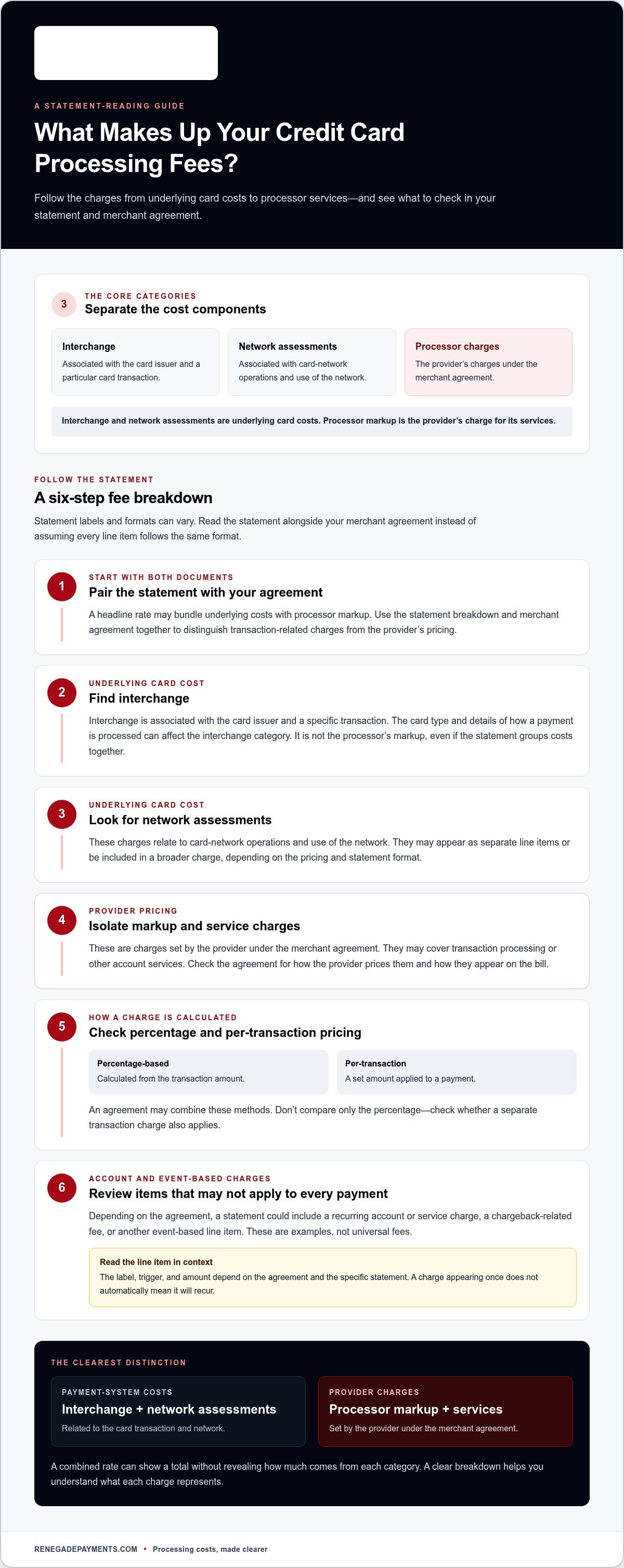
Separate the underlying payment costs from the processor’s markup. Interchange and network-related charges arise from the payment system and transaction details. The processor’s markup is the amount added for its processing service, as set by the merchant agreement. Some pricing presents these components separately; other pricing combines them into a rate or groups charges on a statement.
That’s why a headline rate alone can’t tell you who gets paid or what services the charge covers. Review the statement breakdown and merchant agreement together. Identify which items relate to the card transaction and which reflect the processor’s pricing. This gives you a clearer starting point for assessing the full cost of accepting cards.
What Charges Make Up Credit Card Processing Fees?
A processing statement can mix costs tied to individual card transactions with charges for account services or specific events. Grouping line items by what they pay for makes the bill easier to read and helps separate the cost of accepting a card from the provider’s price for its services.
Interchange, network assessments, and processor markup
Most transaction-related charges fit into three broad categories. Names and presentation can vary across statements, so use your merchant agreement and statement together rather than assuming every line follows the same format.
- Interchange: A charge associated with the card issuer and a particular card transaction. The card type and details of how the payment is processed can affect the interchange category applied. It’s not the processor’s markup, even when a statement groups costs together.
- Network assessments: Charges associated with card-network operations and use of the network. They may be listed separately or included in a broader charge, depending on the pricing and statement format.
- Processor markup and service charges: The provider’s charges under the merchant agreement. These may relate to transaction processing or other account services. The agreement sets out how the provider prices them and how they appear on your bill.
Interchange and network assessments are underlying card costs; the processor’s markup is the provider’s charge for its services under your agreement. Keeping that distinction clear matters when you compare pricing. A combined rate may show the total without revealing how much comes from each category. For more context on fee categories in practice, the U.S. Government Accountability Office’s Federal Payment Card Fee Analysis examines payment-card fees paid by federal entities.
Transaction charges versus account and event-based charges
Some charges are calculated per transaction. A percentage-based charge is calculated from the transaction amount, while a per-transaction charge is a set amount applied to a payment. An agreement may combine these methods or use other pricing structures. Don’t compare only the percentage: check whether a separate transaction charge also applies.
Other statement items may not apply to every payment. Depending on the merchant agreement, these could include a recurring account or service charge, a chargeback-related fee, or another event-based line item. These are examples, not universal fees. The label, trigger, and amount depend on the agreement and the specific statement. A charge appearing once doesn’t automatically mean it will recur, and a recurring charge may be separate from transaction processing.
Review each line by asking: Is it tied to a transaction, an ongoing account service, or a particular event? Then match it to the agreement. Renegade Payments reviews actual statement figures through its processing statement savings analysis, helping merchants identify what charges represent and assess potential savings under a different pricing approach.
Why Do Credit Card Processing Fees Vary Between Transactions?
Two payments for the same amount can produce different processing costs. The card, how the customer pays, and the terms of your merchant agreement can all shape the final charge. Separate transaction-level variables from your pricing model. One concerns the payment details; the other determines how charges are grouped and presented.
How card and transaction details can change the charge
A debit card, rewards credit card, and corporate card may fall into different cost categories. The payment channel matters too. In-person, online, and keyed payments are useful examples, but they don’t carry a guaranteed rate difference in every setup. How card details are captured and submitted can affect the transaction’s classification. Your processor’s configuration and merchant agreement also influence what appears on the bill.
Use the comparison below to pinpoint what to inspect. It’s a practical checklist, not a promise that a given factor always raises or lowers a charge.
Factor
Possible effect
What to inspect
Card type
May affect the transaction category and underlying card costs.
Card classifications and fee details on the statement.
Payment channel
In-person, online, or keyed entry may be processed differently.
How each payment is captured and the terms for that channel.
Transaction data
The information submitted can affect how the payment is categorized.
Whether required transaction details are captured and transmitted.
Merchant agreement
Sets the pricing method and processor charges applied.
Contract terms, statement labels, and any applicable service charges.
How pricing structures present costs differently
Pricing structures can make similar costs look different on paper. Flat-rate pricing typically presents a set rate structure, while tiered pricing groups transactions into categories with different pricing. Interchange-plus separates interchange from a fixed processor markup, making those components easier to distinguish. A simple quote may be convenient, but it doesn’t necessarily show every charge or explain how each payment is classified.
Compare the agreement and actual statements, not just the advertised rate. Check whether different channels or card types appear under separate categories, and note any processor charges beyond transaction pricing. For a closer look at how this model separates costs, see the interchange-plus pricing guide.
Keep the comparison grounded in your own payment mix. If one channel or card category accounts for a meaningful share of sales, examine its charges separately before judging the overall pricing structure.
How Can You Calculate Your Effective Credit Card Processing Cost?
A quote gives you a proposed price. Your statement shows what your business actually paid during a specific period. Calculate your effective processing cost to turn those charges into a single percentage you can track and compare. It’s a blended result for that period, not a rate you can automatically apply to every transaction or treat as your processor’s quoted rate.
A simple statement-based calculation
Use one statement period and match the fees to the card-payment volume from that same period. Then follow these steps:
- Choose a statement period. Use a complete month or another clearly defined period. Don’t mix a partial statement with a full period of sales.
- Total the processing fees. Add the charges you want included, such as transaction fees and processing-related account charges. Separate unrelated account activity, and note which categories you included.
- Find processed card volume. Use the card-payment volume for the same period, not total business revenue or the amount deposited after fees and other deductions.
- Divide fees by volume, then convert to a percentage.
Formula: Total processing fees ÷ processed card volume × 100 = effective processing cost as a percentage.
For example, use F for the processing fees you included and V for processed card volume: F ÷ V × 100. Keep the inputs consistent. If you include a recurring processing charge in the fee total, include it each time you calculate that period’s effective cost. If you exclude a charge, record that choice so the next comparison uses the same basis.
The result summarizes your actual costs for the selected period. It doesn’t guarantee that future costs will match. A different mix of cards, payment channels, or transaction activity can change the result.
How to compare the result fairly
One percentage is a useful starting point, not the whole story. Compare the same length of time, the same payment channels, and the same fee categories. Otherwise, a change in the calculation may look like a change in pricing. Review the merchant agreement alongside the statement to identify the processor markup and any recurring charges included in your total.
If you’re comparing statements or pricing proposals, write down what each total includes. Check whether both calculations use the same volume basis and treat account charges alike. That turns a headline percentage into a fairer comparison rather than a misleading shortcut.
Renegade Payments provides a complimentary savings analysis of existing processing statements, using actual figures to identify potential cost savings. Learn about a processing statement review and put your numbers under closer scrutiny.
How Can Merchants Manage Processing Fees Transparently?
There’s no single pricing approach that fits every business. The right next step depends on your transaction mix, the costs shown on your statements, and what matters most to your business. Start with figures you can verify, then compare pricing structures by how they work rather than by a headline promise.
Interchange-plus or dual pricing: which question should you ask?
These approaches handle pricing differently. Interchange-plus passes the wholesale interchange cost to the merchant alongside a clear, fixed processor markup. Dual pricing presents separate cash and card prices at checkout. One clarifies how processing costs are itemized; the other changes how prices are displayed for different payment methods.
Consider what you’re trying to make clearer. Do you want to see the processor markup apart from interchange? Or do you want customers to see distinct cash and card prices before paying? Your transaction patterns and checkout goals can help guide that choice. Explore this dual pricing payment processing guide for more detail on the approach.
Don’t treat dual pricing and surcharging as interchangeable terms. They can involve different network rules and legal requirements. Before adopting a model, verify the current card-network rules and applicable federal and state requirements for the specific approach and where your business operates. Avoid basing a decision on assumptions about what’s allowed.
Turn your statement review into a practical next step
Take the effective cost you calculated and compare it with the charges and pricing terms in your current merchant agreement. Check whether the statement’s line items match the agreement, which charges recur, and how costs relate to your actual transaction patterns. If a charge is unclear, identify the line item and its description instead of judging the entire account from one percentage.
Then assess the options against your goals. A business focused on separating processor markup from interchange may value interchange-plus. A business considering distinct prices at checkout may evaluate dual pricing, while accounting for customer experience and applicable requirements. Neither approach is an automatic fit. The point is to make the mechanics visible and compare them with your actual payment activity.
Renegade Payments reviews existing processing statements at no cost to identify potential savings. The analysis uses your actual statement figures and gives you a clearer basis for considering alternatives. It helps you make a more informed decision using your own payment activity.
Request a complimentary statement savings analysis to review your processing charges against your current agreement.
Make Your Next Processing Decision With Clarity
Your next move isn’t to chase the lowest-looking number. Decide what you need your payment pricing to make clear, then judge each option against your business goals. Keep your statement and agreement at the center of that decision. Clear records make it easier to spot what deserves attention and avoid choosing based on a headline alone.
Renegade Payments reviews current merchant statements at no cost to help identify potential savings. With interchange-plus pricing, interchange is separated from a fixed processor markup, giving you a clearer view of those components. The review uses your statement figures, so you can weigh possible next steps in light of your own payment activity.
Take control of your credit card processing fees by looking closely at the numbers behind them. Request a complimentary review of your processing statement and use what you learn to make your next decision with greater confidence.
Frequently Asked Questions
What are credit card processing fees?
Credit card processing fees are charges a business incurs when accepting and processing a card payment. A statement may combine costs associated with the card issuer and network, the processor’s markup, and other charges set by the merchant agreement. The mix can differ by transaction. To understand a specific line, compare its description and date with the agreement, then check whether similar charges appear elsewhere on the statement.
How are credit card processing fees calculated?
Merchants can estimate their effective processing cost by dividing the processing fees for a statement period by the card-payment volume for that same period. The result is a blended measure of actual costs for the period, not necessarily the rate shown in a quote. For a useful comparison, use the same volume basis and fee categories each time, and note any excluded charges so the calculation stays consistent.
Why do credit card processing fees vary by card?
Card type can affect the underlying costs assigned to a transaction, but it’s only one factor. An in-person payment may be handled differently from an online or keyed payment, depending on how its information is captured and processed. If a charge looks different, compare the transaction category and channel on your statement with your agreement. Don’t assume the difference comes from the card alone.
Are debit card processing fees the same as credit card fees?
Not necessarily. Debit payments may be categorized and priced differently from credit payments, depending on transaction details, the processor arrangement, and applicable rules. Don’t assume that a rate shown for a credit-card transaction also describes a debit purchase. Review how debit transactions appear on your statement and compare those entries with the pricing terms in your merchant agreement.
Can a business pass credit card processing fees to customers?
Whether a business can add or reflect payment costs in customer-facing prices depends on the pricing approach, transaction, card-network requirements, and applicable federal and state rules. Dual pricing and surcharging aren’t interchangeable. Before changing checkout prices or practices, verify current requirements for the specific program and your business. This general information isn’t legal advice or a substitute for checking applicable rules.
What is the difference between a processing fee and an interchange fee?
Interchange is one component of the cost associated with a card issuer and a particular transaction. The broader processing charge may also include network assessments, the processor’s markup, and other agreement-based items. So an interchange amount by itself doesn’t necessarily show the full cost of accepting a payment. Check whether your statement lists interchange separately or groups it with other charges, then use your agreement to interpret the entries.
Do credit card processing fees include chargeback fees?
A chargeback-related fee may appear on a merchant statement, but it’s tied to a particular event rather than every successfully processed payment. Whether it applies and how it’s assessed depends on the merchant agreement and the chargeback. To keep routine processing costs clear, track chargeback entries separately from ordinary transaction charges. Then review the agreement to understand the fee’s description and the conditions under which it may be applied.
Frequently Asked Questions
Clear, straightforward answers about payment processing rules, rates, and terms.
Get your free savings
analysis in 24 hours
Upload a recent processing statement and we'll show you exactly how much you can save. No commitment, no pressure, no sales pitch.