Credit Card Processing Savings Analysis: Find and Verify Real Savings in 2026
Perform a credit card processing savings analysis to uncover hidden fees, compare interchange-plus rates, and verify real merchant savings for your business.
Published

What if a lower processing rate in a sales pitch costs your business more once every fee is counted? A credit card processing savings analysis should start with your own statement, not a headline rate. Statement line items can hide the real baseline, and bundled pricing can make a processor’s markup difficult to identify.
It makes sense to question the comparison. Switching payment processors takes time, and a promised rate means little if it leaves out transaction costs, account fees, or pricing assumptions. Before you decide, separate underlying card costs from the processor’s markup and compare the full costs using the same processing activity.
This guide shows you how to use your statement to establish what you pay, compare that baseline with alternatives such as interchange-plus and dual pricing, and assess whether a change could improve your bottom line. Renegade Payments provides a complimentary review of current merchant statements to assess potential savings, not promise them. A useful comparison spells out what you pay now, what could change, and whether the figures support a switch.
Key Takeaways
- Gather readable processing statements and flag charges you want explained before starting a review.
- A credit card processing savings analysis is most useful when it compares matching periods and actual transaction activity.
- Use one worksheet to compare current costs with proposed costs and calculate the estimated difference.
- Compare how dual pricing and interchange-plus affect the full cost picture, not just the advertised rate.
- A complimentary Renegade Payments statement review can assess potential savings based on your business’s actual processing costs.
Table of Contents
- What a credit card processing savings analysis should prove
- How to prepare your statement for a credit card processing savings analysis
- How to calculate and verify potential processing savings
- How to compare dual pricing and interchange-plus against current costs
- Request a Renegade Payments credit card processing savings analysis
What a credit card processing savings analysis should prove
A credible credit card processing savings analysis answers one practical question: based on your actual processing activity, would a different pricing model change your total costs? It uses your merchant statement to establish the current baseline, then compares that baseline with a clearly described alternative. The goal isn’t to make a lower advertised rate look attractive. It’s to find out whether the full comparison holds up for your business.
A rate alone doesn’t show the complete cost of accepting payments. If a comparison leaves out charges or uses different transaction assumptions, an alternative can appear cheaper than it is. The statement and the assumptions behind the comparison determine what the result means. An analysis can identify potential savings, but it can’t guarantee them.
What does a merchant statement savings analysis include?
Your current statement is the starting point because it records processing costs under your existing setup. A useful review looks at transaction activity, your pricing structure, and the charges listed on the statement. Business details can also help explain how those figures relate to the way you accept payments. Together, these inputs create a business-specific baseline for comparing alternatives.
Processors handle card transactions, as explained in Understanding Payment Processors. For a savings review, however, the key evidence is what your own records show. Check whether the proposed comparison covers the same kind of processing activity and accounts for the costs in your current baseline. Comparing a headline rate with your total statement cost is not a like-for-like comparison.
For example, a proposed rate might look lower because other listed charges aren’t included in the comparison. That alone doesn’t show that the alternative will cost less. A complete review makes the scope clear: which costs are included, what activity the comparison assumes, and which details could affect the result. With those assumptions visible, you can assess the figures rather than rely on a sales claim.
When should a business request a processing-cost review?
Consider a review when your statement is difficult to interpret, processing costs have changed, or you want a fresh comparison before making a processor decision. You don’t need to be committed to switching. A review can clarify your current costs and assess alternatives, including dual pricing or interchange-plus, so you can decide whether a change makes sense.
- Costs are unclear: You want to understand how the charges on your statement add up.
- Your situation has changed: You want to compare costs with your current processing activity.
- You’re considering alternatives: You want a business-specific comparison before deciding whether to move forward.
Renegade Payments reviews current merchant statements to identify processing costs and assess potential savings through dual pricing or interchange-plus. The review is complimentary, but its conclusion should come from the evidence, not a promise. A sound result explains what was compared and which assumptions shaped the estimate. That gives you a clearer basis for deciding whether to keep your current setup or consider a change.
How to prepare your statement for a credit card processing savings analysis
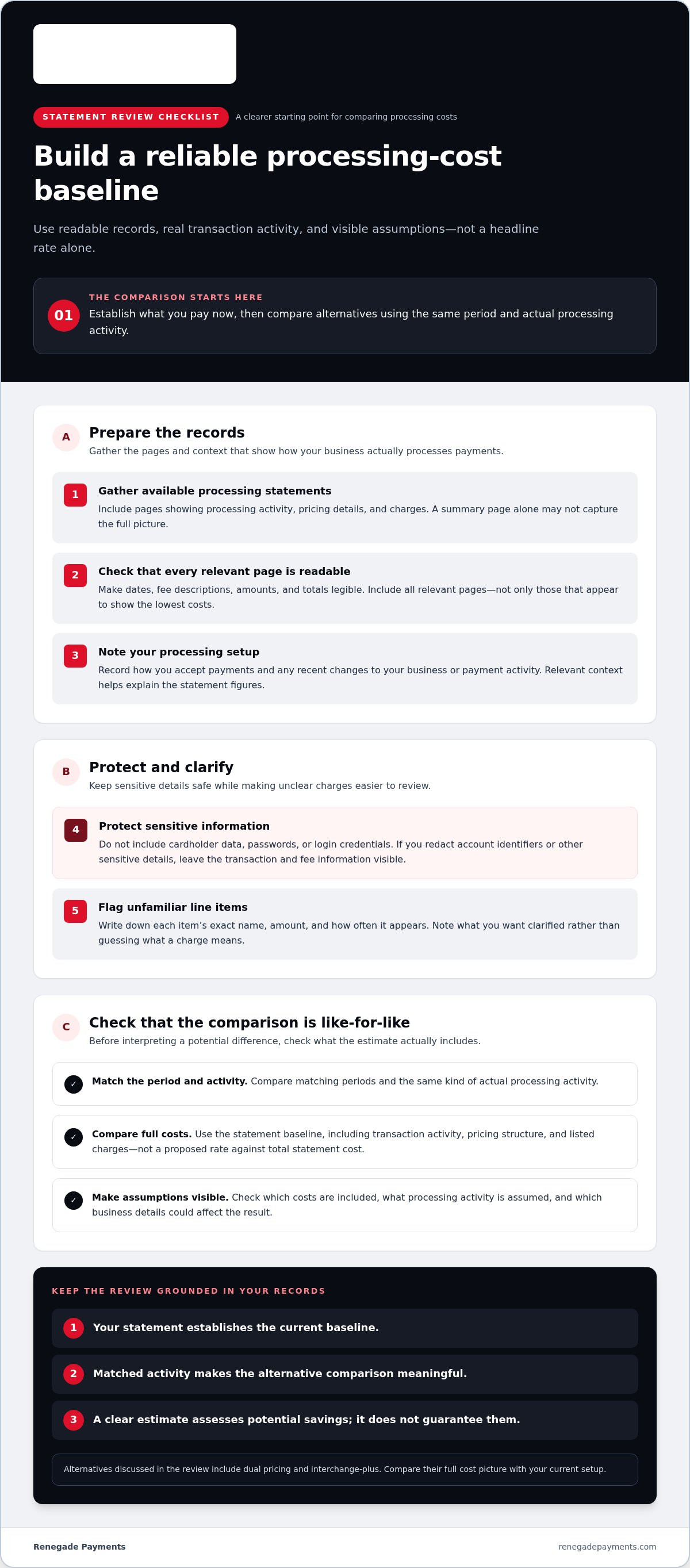
A useful review starts with records that show how your business actually processes payments. Gather statement pages and context that help explain your activity. Clear inputs keep the comparison grounded in your business instead of guesses or a rate taken out of context.
- Gather available processing statements. Include the pages showing processing activity, pricing details, and charges. A summary page alone may not capture the full picture.
- Check readability. Make sure dates, fee descriptions, amounts, and totals are legible. Include all relevant pages, not just those that appear to show the lowest costs.
- Note your processing setup. Write down relevant context, such as how you accept payments and any recent changes to your business or payment activity.
- Protect sensitive information. Don’t include cardholder data, passwords, or login credentials. If you redact account identifiers or other sensitive details, leave the transaction and fee information needed to understand the statement visible.
- List your questions. Flag unfamiliar charges and note what you want clarified instead of guessing what each line means.
Once your records are organized, you can request a complimentary savings analysis. Renegade Payments reviews merchant statements to identify processing costs and assess potential savings through dual pricing or interchange-plus. Since the review is based on the records provided, complete, readable inputs help make the comparison more useful.
Which records and business details help clarify the baseline?
Gather the statements you have available, along with business context that can help explain the activity shown. Transaction volume and patterns affect how representative a comparison is, so include any relevant changes in how or where you accept payments. Keep the figures tied to the same period as the statement, and share what you know rather than trying to guess which details matter most.
How to handle unclear statement line items
Mark each unfamiliar item and record its exact name, amount, and how often it appears. Keep listed processing charges separate from unrelated business expenses so the review stays focused on payment acceptance costs. For help recognizing statement terms and finding details, use the how to read a merchant processing statement guide. Bring unresolved questions into the review instead of treating an unclear label as a confirmed fee type.
Before sharing your records, check that the statement pages are complete and legible, sensitive information is limited to what’s necessary, and each question is easy to match to a specific line item. A clear submission makes it easier to assess your actual costs and compare alternatives without hiding gaps behind assumptions.
How to calculate and verify potential processing savings
A savings claim is useful only if you can trace it back to your records. Build a simple worksheet with two columns: current processing costs and proposed processing costs. Use the same activity period for both, then compare equivalent charges. The result is an estimate to examine, not a promise of what you’ll pay after a change.
Create a like-for-like cost baseline
Start with the statement figures for the period you’re comparing. Record the processing activity and relevant listed charges that make up your current cost. Then use the same period and transaction assumptions for the proposed pricing. If one side covers more activity or more charges than the other, the comparison won’t be fair.
Set up worksheet rows for each item being compared. Tie each figure to its source, and label assumptions clearly so they aren’t mistaken for documented amounts.
- Current scenario: Statement period, transaction activity, pricing structure, and included charges.
- Proposed scenario: Matching period and activity, proposed pricing components, and included charges.
- Open assumptions: Any estimate or condition that isn’t directly shown in your records.
Use this formula:
Current comparable costs − proposed comparable costs = estimated difference
A positive difference means the proposed scenario estimates lower costs for that comparison. It doesn’t establish what you’ll actually save in the future. Processing activity and other conditions can change, so keep the result labeled as an estimate.
Check the proposal before accepting its savings claim
Review the proposed pricing components, not just the headline rate. Confirm which charges are included and identify the assumptions used to calculate the estimate. Compare those assumptions with your statement and actual transaction profile. If the proposal uses activity that doesn’t reflect your business, the comparison needs equivalent inputs before its result is useful.
Credible savings estimates depend on comparing equivalent activity and charges.
Keep the worksheet transparent. Mark statement figures as documented and label proposed figures according to their source. If a charge or assumption is missing, list it as an open item instead of filling the gap with a guess. That way, you can see what the estimate includes and where uncertainty remains.
Before using the result to make a processor decision, check that:
- The current and proposed scenarios cover the same activity period.
- The transaction assumptions reflect your business’s processing pattern.
- Relevant listed charges appear in the comparison, not only the advertised rate.
- Estimates and assumptions are clearly separated from statement figures.
A careful credit card processing savings analysis shows its working. It connects the current baseline to a clearly described alternative, states the estimated difference, and explains the assumptions behind it. That gives you a practical basis for deciding whether the proposal deserves a closer look, without confusing projected savings with realized results.
How to compare dual pricing and interchange-plus against current costs
Compare each option with your current statement using the same transaction activity and period. A lower quoted rate doesn’t show how the full cost changes. Instead, look at how each pricing structure fits your checkout and how its estimated costs compare with the charges you actually see.
Use this table to organize the comparison. Leave the figures blank until they’re supported by your statement or a clearly described proposal.
| Pricing approach | What to compare | Your business figures |
|---|---|---|
| Current pricing | Statement costs, pricing structure, and transaction activity | __________ |
| Dual pricing | Cash and card prices, checkout fit, and estimated processing-cost effect | __________ |
| Interchange-plus | Wholesale interchange costs, fixed processor markup, and other applicable charges | __________ |
What to evaluate in a dual pricing comparison
Dual pricing presents distinct cash and card prices at checkout. A comparison should show how that setup could offset processing costs and how it would affect the customer experience. Consider how prices are displayed and assess the potential cost effect using your statement and transaction pattern. Learn more in this dual pricing guide. For implementation considerations, use the dual pricing compliance checklist.
What to evaluate in an interchange-plus comparison
Interchange-plus separates wholesale interchange costs from the processor’s fixed markup. This makes the components visible instead of treating one bundled rate as the whole story. Compare those proposed components with your current statement costs, not with an isolated rate. The interchange-plus pricing guide explains the model, and the interchange-plus buying guide covers provider-selection considerations.
For either option, keep the assumptions visible. Check that the estimate reflects your transaction profile and identifies the charges it includes. A comparison that leaves out relevant costs or assumes a different activity pattern can distort the result. A credit card processing savings analysis should make it clear what changed between your current setup and each alternative.
Renegade Payments reviews existing statements and assesses potential savings through dual pricing or interchange-plus. Request a statement review to compare these approaches with your business’s actual processing costs.
Request a Renegade Payments credit card processing savings analysis
If you want your actual processing costs assessed against alternatives, a review can give you a clearer basis for deciding what to do next. Renegade Payments examines existing merchant statements to identify current processing costs and assess potential savings through dual pricing or interchange-plus. The credit card processing savings analysis uses your statement as evidence. It doesn’t guarantee that either option will lower your costs.
A review isn’t a commitment to switch processors. It shows how the pricing approaches compare with the costs in your records. Even if the alternatives don’t fit your transaction activity or checkout needs, the analysis can help you understand your current baseline more clearly.
What happens after you request the review?
Your statement provides the basis for identifying current processing costs. Renegade Payments then assesses potential savings under dual pricing or interchange-plus using the business-specific information available in the review. The value lies in seeing how each alternative compares with your current setup, not in relying on a general rate or unsupported savings claim.
As you consider the findings, look for a clear connection between the statement and the comparison. Which current costs were included? Which proposed pricing components were considered? What assumptions affect the estimate? When those inputs are visible, it’s easier to understand what the analysis does and doesn’t show.
Make the decision using evidence, not pressure
Put the analysis beside the original statement. Check that the comparison reflects your business’s processing activity and that estimates are clearly distinguished from documented figures. Then weigh potential cost changes against practical needs, including how the pricing would fit your checkout experience and day-to-day operations. A projected difference is a reason to examine the option, not proof of future savings.
Before making a decision, make sure you can explain the comparison in plain terms:
- What costs from the existing statement were used?
- Which alternative pricing model was assessed?
- What assumptions shaped the estimate?
- How might the option affect your checkout and operating needs?
If an answer is unclear, resolve that uncertainty before acting. You don’t need to switch just because an alternative is presented, and you shouldn’t accept a savings claim that hides its inputs. Choose a path only when you understand the comparison and how it applies to your business. That keeps the decision in your hands.
Renegade Payments provides a complimentary review of current merchant processing statements. Request your complimentary savings analysis to assess your actual costs against dual pricing or interchange-plus and see what the evidence suggests for your business.
Make your next processing decision with confidence
Your next step doesn’t have to be a switch. It can be a clearer view of the choices in front of you. Use a credit card processing savings analysis to move from uncertainty to an informed decision, then choose the approach that fits your business rather than chasing a rate that looks good on paper.
Renegade Payments provides complimentary merchant statement savings analyses and assesses potential savings through dual pricing or interchange-plus. The result is specific to the statement reviewed, not a promise of future savings. Use the evidence to decide what makes sense for your business.
Request your complimentary savings analysis to take your next step with clarity.
Frequently Asked Questions
What is a credit card processing savings analysis?
A credit card processing savings analysis evaluates your current payment-processing costs against an alternative using your business’s information. It helps you see whether a different pricing approach may change your costs, based on the activity and charges considered. For example, a business reviewing interchange-plus can examine how its wholesale interchange costs and processor markup compare with its current pricing. The result is an estimate, not a guarantee of future savings.
How do I request a credit card processing savings analysis?
Request a review from Renegade Payments and provide your merchant processing statement so your current costs can be assessed. Include context that could help explain your payment activity, such as a recent change in how your business accepts payments. Before sharing records, remove sensitive information that isn’t needed for the review, but keep relevant processing figures readable. You can request the analysis through the Renegade Payments website.
Is a credit card processing savings analysis really free?
Yes. Renegade Payments provides a complimentary savings analysis of merchant processing statements. The review assesses current processing costs and potential savings through dual pricing or interchange-plus. Complimentary means there’s no charge for the analysis itself; it doesn’t mean a particular pricing model will reduce your costs. Use the findings to understand the comparison and decide whether an alternative fits your business before making a processing change.
What information do I need for a merchant processing savings analysis?
Start with a readable merchant processing statement that shows processing activity and charges. Business context can also help explain the figures, especially if your payment methods or transaction patterns have changed. Don’t send cardholder data, passwords, or account login details. If you redact sensitive identifiers, preserve the information needed to understand the charges. The goal is to provide useful records without exposing private data unnecessarily.
Can a savings analysis prove how much my business will save?
No analysis can prove an exact future result because future activity may differ from the assumptions used in the comparison. It can estimate potential savings using the statement and proposed pricing inputs. Treat the estimate as a projection, not money already saved. Before relying on it, check that both scenarios include the same transaction activity and relevant costs, and note any assumptions that could affect the result.
Do I have to switch processors after a savings analysis?
No. Requesting or reviewing an analysis doesn’t require you to change processors. Use the findings to understand your current costs and evaluate whether an alternative suits your business. For instance, dual pricing may affect how customers see prices at checkout, while interchange-plus presents processing costs through separate components. Consider those operating details alongside the cost comparison, then decide when the trade-offs are clear.
How often should a business review credit card processing costs?
There’s no single review schedule that fits every business. Revisit your costs when a meaningful change makes the current comparison less useful, such as a shift in transaction patterns, payment channels, or pricing terms. You can also review costs when preparing to assess a processor decision. Keep statements and notes about relevant business changes together, so you have a clear record to compare when questions arise.
Frequently Asked Questions
Clear, straightforward answers about payment processing rules, rates, and terms.
Get your free savings
analysis in 24 hours
Upload a recent processing statement and we'll show you exactly how much you can save. No commitment, no pressure, no sales pitch.