Zero Cost Credit Card Processing for Merchants
See how zero cost credit card processing shifts fees, which contract charges may remain, and how to compare surcharges, dual pricing, and processor costs.
Published

Zero cost doesn't mean processing costs disappear. Zero cost credit card processing shifts the card acceptance cost away from the merchant through a surcharge or dual-pricing model, but contract fees for items such as equipment, platform access, or PCI compliance may still apply. The real question is who pays, and what charges remain.
If you’re tired of switching processors to escape confusing fees, the frustration is understandable. A new provider won’t solve the problem if the pricing remains unclear or the model doesn’t fit how your customers pay.
This guide explains how these pricing models work, which costs may remain with your business, and what to compare before choosing a setup. Focus on the actual pricing, checkout display, and statement charges rather than a broad sales claim.
Key Takeaways
- Separate the promise of “zero cost” from the processor’s full contract: equipment, platform, and PCI charges may still apply.
- Understand how cash discounts differ from surcharges, and how local rules can affect which approach fits your business.
- Trace who pays each processing cost at checkout, then compare that setup with your current statement.
- Use a savings analysis to spot hidden charges and assess whether dual pricing or interchange-plus better fits your payment setup.
Table of Contents
Q: Are there any additional costs involved in no fee credit card processing?
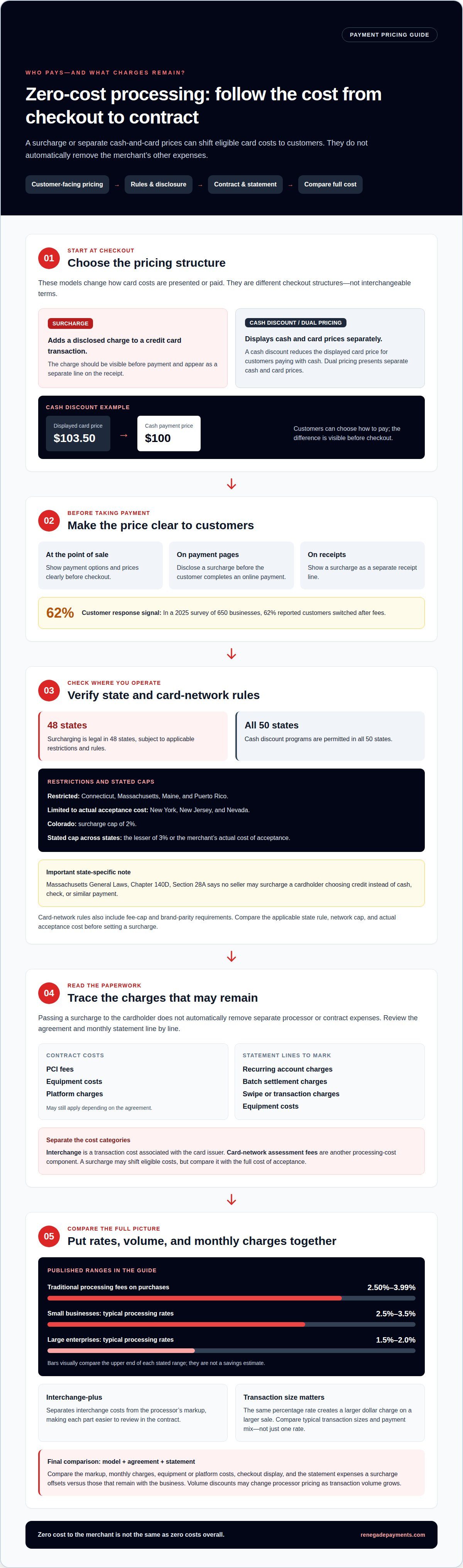
Yes. A no-fee setup can still leave merchants paying PCI fees, equipment costs, or platform charges under the contract. Rules also depend on the payment model and location: surcharging is legal in 48 states, while cash discount programs are permitted in all 50 states. According to Connecticut, Maine, and Massachusetts state governments, Massachusetts General Laws, Chapter 140D, Section 28A says no seller may surcharge a cardholder choosing credit instead of cash, check, or similar payment.
Cash Discount Program Structure
A cash discount program displays a card price and reduces it for customers paying with cash. For example, a $103.50 item price becomes $100 for a cash payment. The customer can choose how to pay, while the displayed prices make the difference visible before checkout.
Review the contract and checkout display together. Confirm that payment options, receipts, and online payment pages show the prices clearly. Dual pricing also presents separate cash and card prices, but the key decision is how each price appears to customers at the point of sale.
Fee Types and Pricing Distinctions
A processing fee is the broader cost of accepting payments. A surcharge adds a charge to a credit card transaction. A convenience fee applies to a payment made through a particular channel, while a cash discount reduces the price for customers paying with cash. These terms describe different checkout structures, not interchangeable approaches.
Interchange-plus pricing separates interchange costs from the processor’s markup, making each part easier to review in the contract. Volume discounts may change processor pricing as transaction volume grows. Compare the markup, monthly charges, and any equipment or platform costs, rather than judging a program by its headline claim.
State and Card Network Surcharge Rules
State rules vary. Surcharging is restricted in Connecticut, Massachusetts, Maine, and Puerto Rico; New York, New Jersey, and Nevada limit surcharges to the merchant’s actual cost of acceptance. Colorado caps surcharges at 2%. Across states, the stated cap is the lesser of 3% or the merchant’s actual acceptance cost.
Card network rules also set fee-cap and brand-parity requirements. A surcharge should appear as a separate receipt line, and payment pages should disclose it before checkout. Compare the state rule, network cap, and actual acceptance cost before setting a surcharge. Cash discounting and dual pricing use different checkout structures.
How surcharge programs pass processing fees to customers
A surcharge passes a disclosed charge to card customers; some may switch methods. In a 2025 survey of 650 businesses, 62% reported customers switched after fees.
Interchange and Card Network Fees
Interchange is a transaction cost associated with the card issuer. Card-network assessment fees are another component of processing costs. A surcharge may shift eligible costs to the customer, but compare the arrangement with your full cost of acceptance.
Processor, PCI, and Equipment Fees
Passing a surcharge to the cardholder doesn’t automatically remove separate processor charges. Depending on the contract, PCI fees, equipment costs, and platform charges may remain. Review the monthly statement line by line. Mark recurring account charges, batch settlement charges, swipe or transaction charges, and equipment costs. Then identify which expenses the surcharge offsets and which remain with the business.
Comparing Traditional Processing Fees
Traditional credit card processing fees on purchases are listed at 2.50% to 3.99%. A surcharge changes who pays eligible costs, while interchange-plus separates interchange from the processor’s markup. Compare that breakdown with your current statement using interchange-plus pricing.
Risks and Customer Reactions
Customer friction is one risk: an unexpected charge at checkout can change how someone pays. Make the surcharge visible before payment, including on online payment pages. Show it as a separate line on the receipt. Card network rules also include fee caps and brand parity, so compare the displayed charge with those requirements before processing card transactions.
What is free credit card processing or zero-fee models?
Zero-fee processing shifts card costs to customers through surcharging or displayed cash and card prices; it doesn’t erase every merchant expense. U.S. processors may support these models, and setup means choosing a method, configuring checkout software, and reviewing the contract.
How Zero-Fee Processing Passes on Card Costs
With surcharging, a permitted charge is added to a credit card payment and disclosed to the customer. Dual pricing displays separate cash and card prices before checkout. These are different methods, so match the checkout display and receipt to the model. Neither automatically eliminates every separate business expense.
To set up zero cost credit card processing, choose the pricing model, configure the checkout display and software, then review contract charges. Test how both payment options appear before using the setup with customers.
Transaction Size and Processing Costs
Transaction size affects the dollar amount of a percentage-based processing cost: the same rate produces a larger charge on a larger sale. Compare your typical transaction sizes and payment mix rather than relying on one rate alone.
Small businesses typically pay credit card processing rates of 2.5% to 3.5%, while large enterprises pay 1.5% to 2.0%. A zero-fee model changes who bears eligible card costs; it doesn’t make transaction size irrelevant to the customer’s total.
Contract and Equipment Costs
Read the contract for recurring expenses that sit outside the customer-facing pricing model. No-fee processing may still involve PCI fees, equipment costs, and platform charges, depending on the agreement. Merchants generally pay a monthly membership fee for no-fee processing capability, so include that charge when assessing the model’s effect on operating costs.
Compare the proposed terms with your current setup. A display that shifts eligible card costs to customers doesn’t automatically remove separate expenses. List each charge, note whether it recurs, and distinguish it from transaction-based costs. That gives you a clearer comparison before adopting a new pricing model.
Meaning of zero cost credit card processing
Zero-cost credit card processing describes a pricing setup that shifts eligible card acceptance costs away from the merchant. The costs still exist; the checkout method determines how they’re handled.
Zero-Cost Processing Definition
The phrase describes who bears eligible payment processing costs, not processing without expenses. A merchant may use surcharging, cash discounting, or dual pricing, but each presents costs differently. Separate equipment, software, or processor charges may still apply, so review the actual pricing terms.
Assess the setup by tracing one transaction through three records: the displayed price, the customer’s receipt, and the merchant’s settlement statement. If the customer sees one price but pays another, the checkout explanation should make the difference clear. Also identify which expenses remain with the business instead of assuming the model eliminates every cost.
For a practical review, compare your current processing with the proposed checkout display and pricing terms. Focus on customer choices, the amounts shown before payment, and the charges deducted from settlement. That comparison reveals whether “zero cost” applies to the full arrangement or only one part.
United States Legality
Yes, zero-cost credit card processing is legal at the federal level in the United States, but legality varies by state. The method matters: surcharge programs are legal in 48 states, while cash discount programs are permitted in all 50 states.
Before using a surcharge setup, distinguish it from displaying separate prices or offering a cash discount. State restrictions and card-network requirements affect how surcharges may be applied. For example, Massachusetts law prohibits a seller from imposing a surcharge on a cardholder who chooses credit instead of cash, check, or similar payment. Surcharges also cannot be applied to debit or prepaid cards.
Make the decision concrete: identify the state where you accept card payments, name the pricing method, then compare the checkout display and receipt with its requirements. This ties the legal question to the actual transaction, not a broad “zero-cost” label.
Review your payment processing setup against the pricing method and customer experience you want.
Renegade Payments: Dual Pricing
Renegade Payments offers Dual Pricing for merchants who want to present card and cash prices clearly at checkout. Turn to this option when you’re weighing how payment costs appear to customers and want pricing that fits your transactions.
A Free Savings Analysis reviews your current merchant statements to identify processing costs and charges to examine. If you prefer a different pricing structure, Interchange-Plus separates interchange from the processor’s markup, helping make those components easier to understand. Compare both approaches against your payment mix, customer experience, and contract terms before deciding.
Ready to understand your statement and compare pricing options? Contact Renegade Payments to discuss Dual Pricing, a Free Savings Analysis, or Interchange-Plus.
Make Your Next Processing Decision With Clear Numbers
Before changing providers, decide what you need your payment setup to do: make customer pricing clearer, help you understand statement charges, or show how processing costs are structured. That gives you a better basis for evaluating zero cost credit card processing than a headline promise.
Renegade Payments offers Dual Pricing, a Free Savings Analysis, and Interchange-Plus. A statement review can help identify the charges you want to understand; then compare pricing approaches with your checkout and business needs. The aim is clarity before making a decision, not another switch prompted by vague claims.
Bring your questions and focus on the details that shape your decision. Contact Renegade Payments to discuss your options and take the next step with a clearer view of your payment processing.
Frequently Asked Questions
How Do No-Fee Credit Card Payments Work?
No-fee card payments change how card acceptance costs are allocated, not whether payment processing has a cost. At checkout, the system applies the selected pricing method, calculates the amount due, and records the transaction. To assess the result, compare the displayed price with the amount authorized, then reconcile the processor’s settlement against your business records.
How does it work?
The checkout system applies the pricing setup selected by the merchant when a customer pays. With dual pricing, for example, the customer sees cash and card prices before choosing a payment method. Staff should follow the same steps each time so the displayed price, payment amount, and receipt match. Clear records also make customer questions and end-of-day reconciliation easier.
Q: What limitations exist when implementing no fee credit card processing?
The method’s limits depend on the pricing model and payment channel. Available pricing options may depend on the sales channel, so confirm the setup supports how you take payments. A surcharge program must not add a surcharge to debit or prepaid cards, and state restrictions affect where surcharging is allowed. Map each sales channel and payment type before selecting a setup, then make sure staff can apply it consistently.
What Are the Biggest Myths About Zero-Fee Processing?
A common myth is that “zero-fee” means every processing-related expense vanishes. The label describes a pricing arrangement, not every line in a merchant’s operating costs. Another misconception is that one checkout method fits every sales channel. Test the setup against real customer journeys, including in-person and online purchases, and review how each transaction appears on receipts and settlement records.
What does surcharge-free mean?
Surcharge-free means a customer isn’t charged an added surcharge for using a credit card. It doesn’t establish whether the merchant pays processing costs through another pricing structure. For a practical check, compare the posted price, checkout total, and receipt. If all show the same amount without a separate card surcharge, the customer wasn’t charged one on that transaction.
How do surcharging, cash discounts, and dual pricing differ?
At checkout, look at what changes: surcharging adds a separate charge to an eligible credit card payment; a cash discount lowers the price for cash payment; dual pricing displays distinct cash and card prices. Check whether the customer sees one price plus an added charge or two prices before paying. That visible difference helps identify the pricing method.
Frequently Asked Questions
Clear, straightforward answers about payment processing rules, rates, and terms.
Get your free savings
analysis in 24 hours
Upload a recent processing statement and we'll show you exactly how much you can save. No commitment, no pressure, no sales pitch.