What Is an Interchange Fee? A Clear Guide for Merchants
Wondering what is interchange fee and why it impacts your business? Learn how card processing costs work, decipher your statements, and lower merchant fees.
Published

Your processor’s advertised rate isn’t the whole cost of accepting cards. If you’ve looked at a statement full of unfamiliar fee labels and wondered, “what is interchange fee, and why am I paying it?”, the confusion is understandable. Interchange is a wholesale card cost, not the processor’s entire fee.
When a customer pays by card, the merchant’s acquiring side pays interchange to the bank that issued the card. That cost is passed on to your business as part of processing. Card networks set interchange schedules, while the processor adds its own markup. These are separate charges, even when a pricing plan bundles them together.
This guide explains how interchange fits into a card transaction, why its category can vary based on the card, how it’s used, and the information submitted with the sale. You’ll also learn what to look for on your processing statement and how interchange-plus pricing makes the processor’s markup easier to see. With those details in view, you can compare your costs instead of relying on an advertised rate alone.
Key Takeaways
- Understand “what is interchange fee” and how this cost moves through a card transaction.
- Learn why card type, payment method, business category, and transaction data can affect interchange.
- Use a step-by-step review to find fee categories and determine whether your statement itemizes or bundles costs.
- Compare pricing structures and distinguish interchange from network fees and processor markup.
- See how interchange-plus pricing makes processor markup clearer without eliminating interchange.
Table of Contents
What Is an Interchange Fee? Start With the Cost Behind a Card Payment
An interchange fee is a transaction-related charge paid by the merchant’s acquiring side to the bank that issued the customer’s card. Card networks set interchange schedules for different transaction types, so there isn’t one universal rate for every card payment. In practical terms, interchange is one defined cost within card acceptance, not the full amount your business pays to process a sale.
The fee is tied to the movement of a card transaction between financial institutions. The interchange fee overview provides background on how these fees work and why they vary across payment systems. For merchants, the useful distinction is who receives interchange and how that charge differs from other processing costs.
Who receives interchange when a customer pays by card?
Several parties help move a card payment. You, the merchant, accept the card. Your acquiring bank, sometimes working with a payment processor, handles the transaction on your side. The card network carries transaction messages between institutions and applies its rules. The issuing bank provided the card to your customer and receives interchange.
For example, a customer buys a product in your store using a card issued by their bank. Your payment system sends the transaction for authorization. After the sale is processed, transaction information moves through the payment system for clearing and settlement. As funds settle between the relevant institutions, the merchant’s acquiring side pays interchange to the cardholder’s issuing bank. The exact operational steps can differ by provider and arrangement, but interchange flows to the issuer, not to the processor as its markup.
The issuer receives interchange as part of the card-payment system. It isn’t a separate fee the customer hands directly to their bank at checkout. Your business sees the cost through its payment processing charges.
Is interchange the same as a credit card processing fee?
No. “Processing fee” can refer to the total amount charged to a merchant, while interchange is only one component. A useful way to separate the costs is to identify who receives each one:
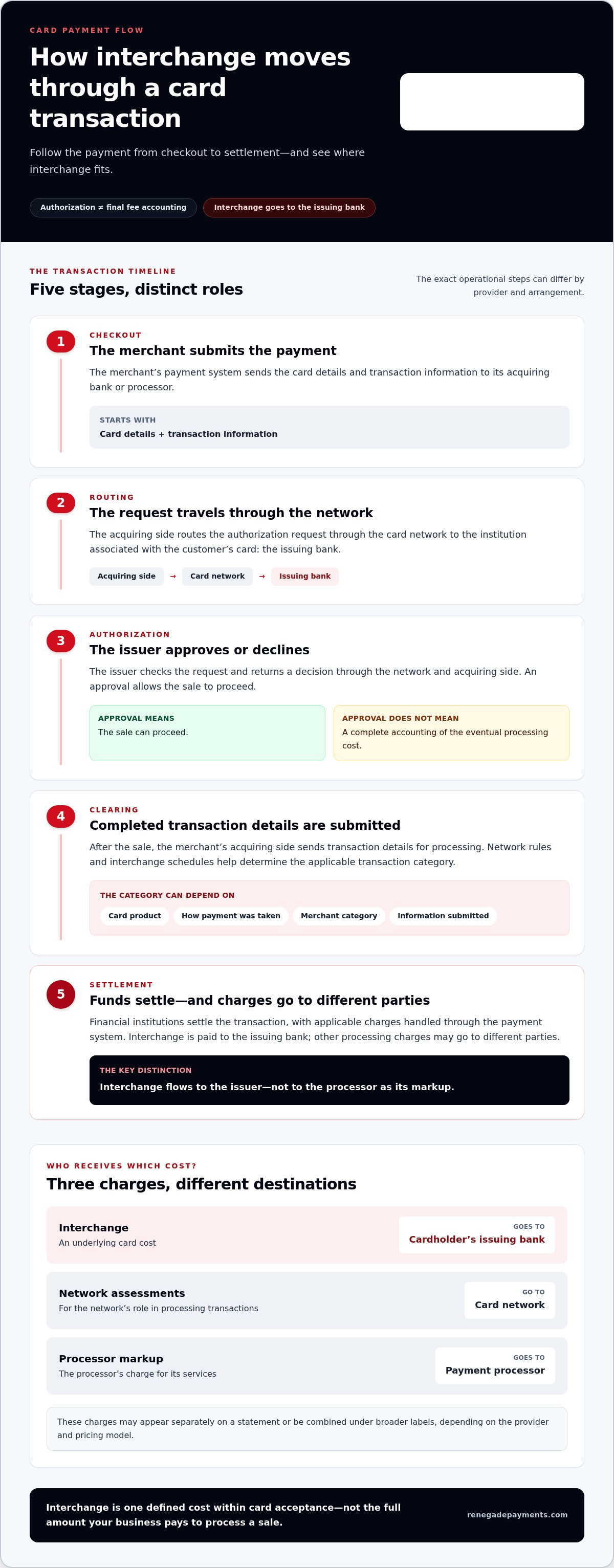
- Interchange goes to the cardholder’s issuing bank.
- Network assessments go to the card network for its role in processing transactions.
- Processor markup is the amount the payment processor charges for its services.
These charges may appear separately on a statement or be combined under broader labels. Their presentation depends on the provider and pricing model. A bundled rate can make the pieces harder to distinguish. Interchange-plus pricing passes through interchange with a fixed processor markup, making that markup more visible. It doesn’t remove interchange or network assessments.
Keep the distinction clear: interchange is an underlying card cost, not a synonym for every processing charge. That gives you a more useful starting point for understanding your statement and assessing what your payment provider adds on top.
How Interchange Moves Through a Card Transaction
A card payment passes through several parties before funds settle. Each has a distinct job, and authorization is only the first checkpoint. It tells the merchant whether the issuer approves the purchase. It doesn’t, by itself, show every fee that will apply once the transaction is completed and processed.
Interchange moves from the merchant’s acquiring side to the cardholder’s issuing bank as the payment goes through processing and settlement. Here’s the sequence:
- The merchant submits the payment. At checkout, the merchant’s payment system sends the card details and transaction information to its acquiring bank or processor.
- The request travels through the network. The acquiring side routes the authorization request through the card network to the institution associated with the customer’s card, the issuing bank.
- The issuer approves or declines. The issuer checks the request and returns a decision through the network and acquiring side. An approval allows the sale to proceed, but it isn’t a complete accounting of the eventual processing cost.
- The transaction is submitted for clearing. After the sale, the merchant’s acquiring side sends transaction details for processing. The payment network’s rules and interchange schedules help determine the applicable transaction category.
- Funds settle between the parties. The financial institutions settle the transaction, with applicable charges handled through the payment system. Interchange is paid to the issuing bank, while other processing charges may go to different parties.
What the issuer, network, and acquiring side each do
The issuer is the bank or financial institution tied to the customer’s card. It responds to authorization requests and receives interchange. The card network provides the rules and routing framework that connects the issuing and acquiring sides. It also establishes interchange schedules. The acquiring side enables the merchant to accept and process card payments, either directly or through a processor. These roles are distinct, even when one provider coordinates several parts of the service.
When the final interchange amount is determined
Authorization and clearing serve different purposes. Authorization checks whether a transaction can proceed. Clearing carries the completed transaction details needed to process it. The card product, how the payment was taken, the merchant category, and the information submitted can affect which interchange category applies. For some categories, more complete transaction data can matter.
That classification is separate from the processor’s markup. The applicable interchange category comes from network schedules and transaction details; the processor’s markup is its own charge under the merchant’s pricing arrangement. Don’t assume an approval message reveals the final interchange cost. The timing and statement labels can vary by provider and setup.
Understanding this flow gives you a practical answer to what is interchange fee: it’s a cost tied to a completed card transaction, not the authorization decision or the processor’s entire charge. To connect transaction activity with the fees on your statement, Renegade Payments offers a processing statement review.
Why Interchange Fees Vary From One Card Payment to Another
Interchange schedules don’t apply one flat charge to every sale. The applicable category can depend on the card product, how the customer pays, the merchant’s business category, and the transaction details sent for processing. Two purchases at the same business can therefore be classified differently, even if their sale amounts are similar.
Interchange depends on how a transaction is classified under the applicable card-network schedule. The merchant doesn’t set those schedules. Accurate payment handling and complete transaction data can help ensure a sale is submitted with the details needed for its proper classification.
How card type and transaction method can matter
Card products can fall into different categories. A debit card, a standard consumer credit card, a rewards card, and a commercial card may each be treated differently under network schedules. The exact categories and criteria depend on network rules, so a card’s label alone doesn’t establish its final interchange treatment.
The way a customer pays also matters. A card-present transaction, such as a sale made in person, has a different acceptance context from an online or phone order where the physical card isn’t presented. Keyed transactions can also have their own processing context. Card-not-present payments may have different interchange categories from in-person payments, but there isn’t one fixed difference that applies to every card, network, or transaction.
Consider two customers buying the same item from the same merchant. One taps a consumer card at the counter. The other pays online with a commercial card. The product sold is identical, but the card product and transaction method differ. Those details can place the payments in different categories under the relevant schedule.
Why complete transaction data matters
Transaction information helps networks and payment systems identify what kind of sale took place. The merchant category code, or MCC, identifies the merchant’s business type. Other details can also matter for certain transactions. For example, some eligible business-to-business payments may use additional Level 2 or Level 3 data. That information can affect the applicable category when the network’s criteria are met, but sending extra fields doesn’t guarantee a different rate.
Think of the information as an input, not a pricing lever. Merchants can provide accurate details and use systems that capture required data, but they can’t rewrite network schedules or choose any category they prefer. Missing or incomplete information may affect whether a transaction qualifies for a particular category. The processor’s markup remains a separate charge.
To make sense of variation, compare transactions by card product, acceptance method, merchant category, and submitted data. Look for patterns rather than assuming every difference signals an error. The question “what is interchange fee” has one core answer, but the category applied to each payment depends on its details and the schedule in force.
How to Read Interchange Costs on a Merchant Processing Statement
A processing statement is useful when you can connect its charges to your transaction activity. Don’t rely on a single label to explain the full cost. Providers may group fees differently, and the words on a statement don’t always tell you who receives a charge or how it was calculated.
Use this sequence to get a clearer picture:
- Locate the transaction activity. Find the statement period, card sales, transaction counts, and any breakdowns by card type or channel. Compare the same period across reports.
- Find the fee categories. Look for entries that refer to interchange, card brands or network assessments, and processor or transaction charges. Labels may differ by provider.
- Identify the pricing structure. Determine whether charges are itemized, grouped into broader categories, or presented through a combination of methods.
- Compare the totals. Review the fees alongside transaction volume and activity for that period. Note unclear labels, amounts that don’t reconcile with the statement detail, or charges you can’t identify.
What to look for in interchange-related line items
Search for terms that name interchange or describe card categories, then look for separate network assessments and processor charges. Match those entries against the transaction activity for the same statement period. If a label is vague, record the line item, amount, and period, then include it in a documented cost review. A specific question about a named charge is more useful than a guess about what it represents.
Keep the whole statement in view. A line item may describe a fee without showing its recipient, calculation, or connection to a specific transaction category. Compare category totals and overall processing charges, not just one line. “What is interchange fee” points to one part of the cost picture, but the statement’s layout determines how easily you can see it.
How pricing structure changes what the statement shows
With bundled pricing, interchange, network charges, and processor costs may appear within broader rates or categories. That can make it harder to separate underlying card costs from the processor’s charge. With interchange-plus pricing, interchange is passed through with a fixed processor markup, so the markup is more visible. Interchange still applies.
For a deeper explanation of how that structure works, consult an interchange-plus pricing guide. Then use the distinction as you review your statement: identify what’s itemized, what’s grouped, and what remains unclear. Renegade Payments provides a complimentary processing statement review to help you assess charges and understand your current processing costs.
What Merchants Can Do With Interchange Fee Knowledge
Understanding interchange won’t make network fees disappear. It will help you see what drives card costs and separate those charges from your processor’s markup. That clarity gives you a better basis for reviewing your statement, comparing pricing structures, and deciding whether your current setup is easy to understand.
Use this checklist to turn the details into action:
- Review your statements. Compare transaction activity and fees for the same statement period.
- Separate cost categories. Identify interchange, network assessments, and processor charges where they’re shown.
- Identify your pricing structure. Note whether costs are itemized, bundled, or presented through a mix of methods.
- Assess total costs. Look beyond an advertised rate and evaluate the full processing charges against your actual card activity.
Interchange-plus and dual pricing: two different approaches
Interchange-plus passes through the applicable interchange cost alongside a fixed processor markup. It can make that markup easier to identify, but it doesn’t eliminate interchange or other network fees. For a closer look at how the model works, see the interchange-plus pricing guide.
Dual pricing is different. It presents distinct cash and card prices at checkout, so customers see the applicable price before paying. It changes how prices are presented, rather than changing the interchange schedules set by card networks. The dual pricing payment processing guide explains that approach in more detail.
Neither structure should be judged by a headline alone. Compare how each presents costs, what charges remain, and how the full setup fits your business and checkout process. The useful question isn’t only “what is interchange fee?” It’s also whether you can tell how each part of your processing cost is calculated and presented.
Turn a statement review into a clear next step
Start with recent processing statements. Mark your current pricing structure, note the fee categories you can identify, and list any charges or labels that remain unclear. Keep transaction activity and fees from the same period together. That gives you a practical foundation for evaluating the complete cost, rather than drawing conclusions from one rate or line item.
Renegade Payments offers a complimentary savings analysis based on current processing statements. The analysis reviews existing processing costs and identifies potential savings under dual pricing or interchange-plus pricing. Use the findings to compare your current setup with those pricing structures and decide whether you want to make a change. Learn about a complimentary savings analysis.
Make Your Processing Costs Easier to Evaluate
Knowing what is interchange fee is useful when it helps you make a clearer business decision. Use the information to ask whether your statement explains its charges, whether your pricing structure makes the processor’s role visible, and whether the total cost fits your payment activity. You don’t need to guess from an advertised rate or accept labels you can’t interpret.
A practical next step is to review your current processing statement alongside your transaction activity. Renegade Payments provides a complimentary savings analysis of merchant statements to identify processing costs and potential savings under its pricing models.
Request a complimentary savings analysis of your processing statement to get a clearer basis for your next payment-processing decision.
Frequently Asked Questions
What is the difference between interchange and an assessment fee?
Interchange is associated with the bank that issued the customer’s card; an assessment is a separate network-related charge. Both may appear among your processing costs, but their labels and presentation vary by statement. A provider might list network assessments separately or group them under a broader fee heading. Check your statement details and merchant agreement before assuming a label identifies the recipient or calculation.
Can a merchant negotiate interchange fees?
Merchants generally don’t negotiate card-network interchange schedules directly. If you’re asking “what is interchange fee” in the context of negotiation, focus on costs you can evaluate: processor markup, pricing structure, and transaction practices such as submitting complete payment data. These factors don’t let you rewrite network schedules, but they can help you assess your overall processing setup. Specific exceptions and qualification criteria depend on current network rules.
Do debit card transactions have interchange fees?
Yes, debit transactions can involve interchange, but the applicable treatment depends on the card, transaction, issuer, and current rules. Don’t assume every debit payment follows the same fee treatment. For a regulatory question about a particular transaction or account, use current authoritative U.S. sources, such as Federal Reserve materials, rather than relying on an old rate table or a general statement about debit cards.
Why might two transactions from the same business have different interchange costs?
Two sales can fall into different interchange categories because of the card product, acceptance method, merchant category, or transaction data submitted. For example, an in-person payment and an online order may be classified differently under the applicable schedule. Compare transaction details from the same statement period before treating a difference as an error. Also separate interchange treatment from the processor’s markup, which is governed by your pricing arrangement.
Are interchange fees refunded when a customer receives a refund?
Not necessarily in the same way as the sale proceeds. Refund handling can depend on network rules, processor practices, and the merchant agreement, so don’t assume every fee from the original payment is returned with the refund. Match the refund to its original transaction in your records, then check how related charges appear on the statement. If the adjustment isn’t clear, document the transaction and compare it with the agreement’s refund terms.
Do business credit cards have different interchange treatment from consumer cards?
They can. A business or commercial card may be classified differently from a consumer card, but not every commercial card receives identical treatment. The applicable network schedule and transaction details determine the category. For example, both the card type and information submitted with a business purchase may matter. Review the transaction’s category and supporting data rather than assuming the word “business” alone explains its cost.
Can a processor change the interchange rate on a transaction?
A processor doesn’t set the card network’s interchange schedule, but transaction qualification and submitted data can affect the category applied under that schedule. The processor’s own markup is separate and follows your pricing arrangement. If a charge changes, compare the transaction details, statement line items, and merchant agreement to see which component moved. This helps distinguish a different interchange classification from a change in processor charges.
Frequently Asked Questions
Clear, straightforward answers about payment processing rules, rates, and terms.
Get your free savings
analysis in 24 hours
Upload a recent processing statement and we'll show you exactly how much you can save. No commitment, no pressure, no sales pitch.