Transparent payment processing: compare fees and contracts
Learn how transparent payment processing works. Compare hidden fees, contracts, and pricing models to understand statements and choose the right processor.
Published

A payment quote’s rate is only part of the cost. A payment processor handles card transactions and charges for processing them. Transparent payment processing makes the processor’s markup clear alongside interchange and assessment costs.
It’s reasonable to expect a clear answer from a payment statement. Yet fees can be spread across multiple line items, and contract terms can affect what you owe even when the quoted rate looks straightforward. Compare the full cost structure, not just one percentage.
This article explains what processors do, how common pricing models differ, and which fees and contract terms deserve attention. It also shows how to compare a quote with actual charges on processing statements, so you can see where the money goes and what the numbers reveal.
Key Takeaways
- Compare flat-rate, interchange-plus, and subscription pricing by how each separates processing costs and markup.
- Read contract terms for setup charges, cancellation fees, renewal conditions, and how to end service.
- Match payment processing to how customers pay online and in person, since transaction methods affect costs and operations.
- Use three consecutive monthly statements to distinguish recurring charges from one-time fees and compare actual costs with a quote.
- A free savings analysis and interchange-plus pricing can help make existing processing costs easier to understand.
Table of Contents
What is a payment processor?
A payment processor routes a credit card transaction between the merchant, card network, and merchant’s bank. Its pricing determines how interchange, assessments, and processor markup appear in your charges.
Common Pricing Models
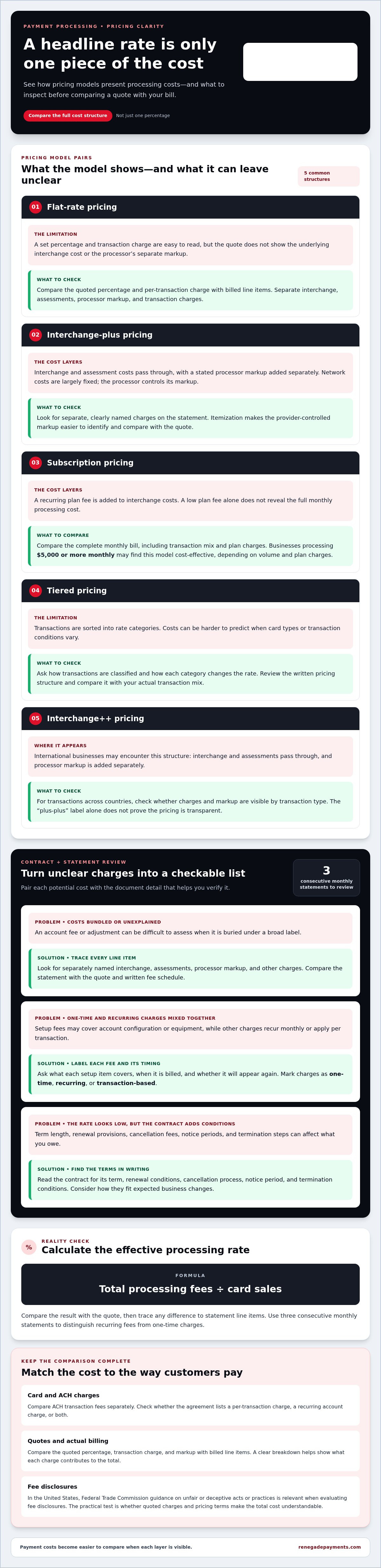
Flat-rate pricing applies a set percentage and transaction charge. Interchange-plus passes through interchange and assessment costs with a stated processor markup. Subscription pricing adds a recurring plan fee to interchange costs. Tiered pricing sorts transactions into categories, so rates can change by transaction type. The model matters because quotes can present the same sale in very different ways.
That flat rate is easy to read, but it doesn’t show the underlying interchange cost or the processor’s separate markup. Interchange-plus separates those layers, making the provider-controlled markup easier to identify. Card-network interchange and assessment costs are largely fixed; the processor controls its markup.
Subscription pricing separates the recurring plan charge from interchange costs. Businesses processing $5,000 or more monthly may find this model cost-effective, depending on transaction volume and plan charges. Compare the full monthly bill, not just the subscription amount. A low plan fee can’t show the total cost without the business’s transaction mix.
International businesses may encounter interchange++ pricing. The “plus-plus” structure means interchange and assessments are passed through, with processor markup added separately. For merchants handling transactions across countries, compare whether each charge and markup is visible by transaction type. The label alone doesn’t prove that pricing is transparent.
Tiered pricing sorts transactions into rate categories, which can make costs harder to predict when card types or transaction conditions vary. High-risk businesses should focus on the written pricing structure and how it classifies transactions. Interchange-plus can show the cost layers, but the contract and actual transaction mix still determine the bill.
Payment Fee Disclosure Rules
In the United States, Federal Trade Commission guidance on unfair or deceptive acts or practices is relevant when evaluating fee disclosures. The practical question for merchants is whether quoted charges and pricing terms are clear enough to understand the total cost.
Compare the quote with your processing statement to see whether disclosed charges match what you were billed. Separate interchange, assessments, processor markup, and per-transaction charges instead of relying on a single headline rate. A clear breakdown makes differences easier to spot and shows how each charge affects the total.
The processor handles transaction messages and settlement instructions, but not every cost is part of its markup. Interchange and assessments pass through the card network, while the processor sets its markup. That distinction matters when comparing a flat quote with an interchange-plus breakdown.
Transparent payment processing lets you trace charges from the pricing model to the statement. Compare the quoted percentage, transaction charge, and markup with the billed line items. If the quote groups costs into broad tiers, find out how transaction categories affect the rate before assessing the offer.
Contracts, cancellation fees, and setup fees
Interchange-plus statements can list interchange, assessments, and processor markup separately. Look for statements that name each charge instead of bundling costs under one label. Itemized statements help you compare contract terms with deductions and spot new charges. For example, an account fee is easier to question when it has a clear label than when it appears as an unexplained adjustment.
Read the contract for its term, renewal provisions, and cancellation process. A low quoted rate may matter less if the agreement commits your business or adds a fee when service ends. Find the notice period and termination conditions in writing, then consider how they fit expected business changes, such as changing sales channels or closing an account.
Setup fees may cover account configuration or equipment, while recurring fees appear on monthly statements. Separate one-time charges from ongoing costs before comparing offers. Ask what each setup item covers, when it is billed, and whether it will appear again. A contract that specifies the charge and billing timing makes it easier to check your first statement.
Hidden fees can make a quoted rate look lower than the actual cost. Calculate the effective processing rate by dividing total processing fees by card sales. Compare it with the quote, then trace any difference to statement line items.
Compare ACH transaction fees separately. Check whether the agreement lists a per-transaction charge, a recurring account charge, or both, then compare those terms with how your customers pay. Businesses accepting both credit card and ACH payments need clear records of the costs for each method.
“No charge” may refer to one specific fee, not the entire account. A provider might waive a setup charge while listing other monthly or transaction costs. Read the full fee schedule and match each item to the statement. Mark charges as recurring, one-time, or transaction-based to make omissions easier to catch.
Review three consecutive monthly processing statements to separate recurring fees from one-time charges. If the charges don’t match the written terms, note the line item and billing period. For a clearer look at pricing options, review payment processing costs alongside your current statements.
Interchange-plus statements can list interchange, assessments, and processor markup as separate charges.
Choosing a processor for online versus in-person sales
Your processor should suit the way customers pay at checkout. A neighborhood shop taking cards at a terminal has different needs from an online store using a payment gateway, and some businesses do both. Map each sales channel before comparing pricing models, or a quote may overlook keyed transactions, recurring billing, or in-person sales.
In-person card transactions typically start when a customer taps, inserts, or swipes a card at a terminal. The terminal sends transaction details through the processor and card networks. A café, for example, may need a quick checkout flow and clear terminal sales records. Match the proposed setup to the payment methods your customers actually use.
Online sales use a payment gateway to collect payment details at checkout and send transaction information to the processor. An application programming interface, or API, connects payment functions to a website or business software. For example, an online retailer can use an API to link checkout with its order system. This can reduce manual entry, but the merchant still needs clear records of transaction charges.
Pay attention to keyed transactions. Staff may enter card details when a customer pays by phone, while online customers enter details through a checkout page. Neither is the same as presenting a card at a terminal. Compare how the pricing model treats each method, and check that statements distinguish those transaction types.
Recurring billing brings its own channel requirements. A gym or subscription service needs a way to store payment authorization and charge customers on an agreed schedule. The processor’s tools should connect billing records with the merchant’s account records. Check how failed payments, customer updates, and cancellations work instead of assuming recurring charges behave like one-time checkout payments.
Security matters across both channels. Secure payment processing uses identification and authentication measures to protect customers’ personally identifiable information and reduce online payment security risks. PCI compliance is also a feature to look for in payment processors. Compare how the proposed online gateway and in-person terminal handle customer data, and how charges for each channel appear on statements.
Finally, compare settlement timing by channel. Credit card payments typically take 1-3 business days to settle, although some transactions settle as quickly as the next business day. A business selling online and in person should account for those deposits in its cash-flow records. Choose a setup that makes channel-specific sales, charges, and deposits easier to reconcile, rather than forcing staff to combine separate records manually.
Comparing processor quotes with actual charges
Compare provider quotes and actual statements against your transaction mix. Before switching, review your contract’s exit terms, compare a replacement offer, plan the account change, and reconcile the first statements.
Transparency in Provider Comparisons
Transparent pricing separates the parts of a processing bill, making provider comparisons more useful. A headline rate alone may hide the effect of transaction charges, processor markup, and recurring fees on the total.
Use three consecutive monthly statements to distinguish recurring charges from one-time fees. Compare those entries with each provider’s written quote. This gives you a consistent basis for comparison and makes differences easier to trace.
For example, a quote may show a percentage rate plus a per-transaction charge. Compare both with your actual transaction count and statement totals. Even a flexible pricing model should make its charges understandable.
Metrics for Comparing Processors
Useful comparison metrics connect quoted terms with what your business actually pays. Track the effective processing rate, recurring charges, per-transaction charges, and any one-time fees shown on statements.
Use the figures to see why the actual bill matters more than the quote alone.
Also compare transaction mix. A quote with a 30-cent charge per transaction has a different impact as transaction counts change. Review processing volume, transaction count, and recurring fees together, rather than judging one metric in isolation.
Keep comparisons consistent by using the same period, sales channels, and transaction categories for each offer. Three consecutive monthly statements can reveal recurring patterns. Mark one-time charges separately so they don’t distort the ongoing comparison.
Switching to a More Transparent Processor
Start a switch by understanding your current agreement. Review its cancellation terms, notice requirements, and any charges tied to ending service. Compare these with the proposed pricing and account setup before choosing a changeover date.
Next, map how payments reach your business. Include online checkout, in-person transactions, keyed payments, and recurring billing if you use them. Matching each channel to the new setup helps prevent gaps in payment acceptance during the transition.
Plan how staff will use the new process and how transactions will appear in your records. After the change, compare the first statements with the new quote. Track recurring charges and transaction fees separately, then reconcile deposits against sales. This gives you a practical way to check whether the new pricing matches the written terms.
Business owners’ understanding of payment processing
Payment systems touch daily sales, yet owners can miss how each charge affects margins. In 2025, roughly 70% of businesses were estimated to overpay because of hidden markups and opaque billing structures. The useful takeaway isn’t to memorize processor jargon. It’s to understand how sales, transaction types, and statement charges connect.
Calculate the effective processing rate by dividing total processing fees by card sales. This figure captures the overall cost for the period, but it doesn’t explain each charge. Pair it with an itemized statement.
Use the transaction mix to interpret the bill. A shop with many small credit card purchases may see per-transaction charges affect its total differently from a business with fewer, larger sales. U.S. merchants commonly pay between 2.5% and 3.5% per consumer credit card transaction in 2025. Treat that range as context, not a substitute for calculating your own charges.
Track the sales platform, too. A physical terminal, online checkout, and keyed transaction can produce different statement entries. Compare each channel’s sales with its related fees for the same period. If one platform’s charges rise while sales remain steady, investigate which line items changed. This turns a confusing statement into a useful operating record.
Settlement timing also affects cash planning. Credit card payments typically take 1-3 business days to settle, though some transactions settle as quickly as the next business day. A sale recorded today may not appear in the bank account immediately. Match transaction dates, deposits, and statement periods so timing differences don’t look like missing revenue.
Make the review straightforward. Each month, record card sales, total processing fees, the effective rate, and deposits received. Compare those figures with the previous month and note changes in sales volume or payment channels. You don’t need advanced accounting software; a consistent spreadsheet can reveal patterns that a headline rate hides.
Understanding the numbers gives owners a firmer basis for decisions. Compare actual charges with written terms, and connect each fee to a transaction or account service. If you want help interpreting current statements, review your payment processing costs.
Renegade Payments: Dual Pricing
Renegade Payments helps business owners examine processing costs and consider clearer pricing. Its Dual Pricing option offsets credit card processing fees at checkout. Its Free Savings Analysis reviews current merchant statements to identify hidden costs, giving you a clearer basis for comparing your existing charges with other pricing structures.
For businesses seeking a line-by-line view, Interchange-Plus passes through interchange and assessment costs with a clearly stated processor markup. This structure separates those costs instead of blending them into one rate. Dual Pricing offers a different approach, so the right option depends on how your business accepts payments and which cost structure you want to assess.
Visit Renegade Payments to discuss your payment processing needs.
Make Your Next Payment Decision With Clarity
Include payment costs in your regular business reviews. Assign someone to track changes in sales channels, transaction patterns, and processing statements. This makes payment acceptance a business decision you can revisit as your needs change. Clear records also help you explain the reasoning behind a new choice to your team.
Use transparent payment processing as a standard for your decision: the pricing structure should be understandable, and charges should be traceable. Renegade Payments offers a Free Savings Analysis, Dual Pricing for in-person payments, and Interchange-Plus. Choose the approach that fits how your business accepts payments and how you want costs presented.
Take the next step on your terms. Contact Renegade Payments today to discuss your payment processing needs. A clearer view starts with asking direct questions and expecting direct answers.
Frequently Asked Questions
What is transparent payment processing?
Transparent payment processing makes it possible to understand how a processor calculates charges and what each one covers. Merchants should be able to connect pricing terms with statement entries instead of relying on a headline rate. For example, a statement can distinguish processing markup from network costs and account charges. That clarity helps business owners assess whether billed costs match the agreed pricing structure.
What fees should transparent payment processors disclose?
Look for clear explanations of transaction rates, per-transaction charges, processor markup, and recurring account charges. The pricing should also explain any setup, statement, gateway, chargeback, or cancellation charges that apply. For example, if your business accepts online and in-person payments, the quote should identify charges for each channel. Match every named charge to a specific service or transaction type.
How do payment processing fees and interchange pricing work in the US?
Interchange is a card-network cost associated with processing a card payment. In an interchange-plus model, interchange and assessment costs pass through to the merchant, with a stated processor markup added. The final charge can vary by transaction and card type. For a useful comparison, separate these underlying costs from the processor-controlled markup, then compare each part with your agreement.
What are typical payment processing rates and monthly fees in the US?
U.S. merchants commonly pay between 2.5% and 3.5% per consumer credit card transaction in 2025. Monthly charges vary by pricing model and provider, so there’s no single monthly fee that describes every account. A flat rate, subscription arrangement, and interchange-plus quote can present costs differently. Compare the full statement total against card sales and account for recurring charges separately from transaction-based costs.
How can a business audit its payment processing fees?
Start with three consecutive monthly statements and match each charge to the contract or pricing schedule. Group entries by type, such as transaction costs, account charges, and one-time items. For each statement period, divide total processing fees by card sales to calculate the effective rate. If a charge lacks a clear category, record its amount and billing date to track whether it recurs.
What contract terms, cancellation fees, and rate increases should businesses watch for?
Review the agreement’s renewal language, cancellation process, notice requirements, and any fees triggered by ending service. Check whether the processor can change rates or add charges, and how it communicates those changes. For example, compare the current pricing schedule with any written amendment before accepting revised terms. Keep copies of the signed agreement and notices together so you can resolve discrepancies using the exact wording.
What are the risks of hidden fees and misleading payment processing claims?
Unclear charges can inflate processing costs and make budgets unreliable. A headline rate may not reflect recurring account charges, transaction fees, or other billed items. Misleading claims can also make provider comparisons unfair. Review the written offer alongside statements and assess claims against the actual pricing structure. Federal Trade Commission guidance on unfair or deceptive acts or practices is relevant when evaluating clear disclosures.
Which payment processors provide clear, itemized pricing and statements?
Interchange-plus statements can list interchange, assessments, and processor markup separately. Look for itemized statements that name each charge.
Frequently Asked Questions
Clear, straightforward answers about payment processing rules, rates, and terms.
Get your free savings
analysis in 24 hours
Upload a recent processing statement and we'll show you exactly how much you can save. No commitment, no pressure, no sales pitch.