How to Implement Dual Pricing Correctly in 2026
Learn how to implement dual pricing correctly in 2026. Set up your POS, train staff, show clear upfront cash and card prices, and eliminate checkout surprises.
Published

Dual pricing should never appear as a surprise at the register. If customers only learn the card price after choosing how to pay, the setup has already failed. The real question is how to implement dual pricing correctly so both prices are clear before checkout and the POS applies the price that matches the payment method.
It’s reasonable to worry about confusing signs, misconfigured terminals, or staff giving different explanations. Dual pricing isn’t a card fee added at the end. It presents cash and card prices upfront. That difference shapes the display, checkout flow, and customer conversation.
This guide lays out a practical rollout sequence for 2026. You’ll learn how to set and display both prices, configure and test the POS, prepare employees to explain the options, and review transactions so mistakes don’t become routine. You’ll also learn how to spot gaps between signage, register behavior, and receipts after launch. Reviewing your processing statement can help you compare your current costs with a proposed pricing approach. Start with clear prices, then test the full transaction from the customer’s point of view.
Key Takeaways
- Learn how to implement dual pricing correctly by making both cash and card prices clear before customers pay.
- Use an ordered POS rollout: map prices, configure checkout, test transactions, train staff, and monitor results.
- Compare dual pricing with interchange-plus based on customer presentation, processing costs, and day-to-day operating needs.
- Give staff a consistent, plain-language explanation and assign an owner and review date before launch.
- Use a processing statement review to compare current costs with a proposed pricing approach without assuming a fixed savings outcome.
Table of Contents
- Start dual pricing with a clear customer-facing price structure
- Configure POS pricing so the selected price carries through checkout
- Compare dual pricing with interchange-plus before choosing your setup
- Prepare staff and customers for a controlled dual-pricing launch
- Use a statement review to decide your next dual-pricing step
Start dual pricing with a clear customer-facing price structure
Before changing a terminal or adjusting a menu, decide exactly what customers will see. Dual pricing presents distinct cash and card prices before the customer pays. The amount shown for the chosen payment method should match the amount due. If a customer sees one price, decides to buy, then discovers a different amount at checkout, the display and transaction no longer tell the same story.
Dual pricing is a disclosed choice between cash and card prices shown before purchase, not an unexpected charge added after the customer decides to pay. That distinction is the foundation of a clear checkout. The broader idea of two prices for one item is described in the Dual-track price system, but a payment-processing setup also needs clear prices at the point of sale.
Keep the price choice visible and easy to understand. Customers shouldn’t have to decode a footnote, ask an employee to explain a last-minute adjustment, or guess which amount applies. Use consistent labels and presentation so customers can compare the prices and staff can apply them correctly.
Decide where customers will see both prices
Walk through the purchase from the customer’s point of view. List every place a price appears, then decide where both cash and card prices need to be visible before the customer commits. Use the same labels, order, and formatting across channels. A clear display in one place won’t help if another shows only one amount.
- Review menus, shelf labels, and service lists where customers compare options.
- Check quotes and websites so both prices are clear before purchase.
- Inspect checkout screens and other customer-facing displays for consistent wording.
- Use labels such as “Cash price” and “Card price” consistently, rather than switching between unclear terms.
For example, a quote should make both amounts easy to identify beside the same item or service. Don’t rely on a sign near the register to explain a price customers saw earlier somewhere else.
Set the business rules before changing the POS
Write the operating rules down before configuring checkout. Define the program’s scope and decide how staff should handle exceptions. Without clear ownership, prices can drift across channels and edge cases can lead to improvised decisions at the register.
- Specify which products, locations, and transaction types are covered.
- Set procedures for refunds, returns, voids, and price changes.
- Name an owner to maintain displayed prices and review exceptions.
Make the policy practical. State what staff should do when a transaction falls outside the normal rules, and how price updates reach every customer-facing display. This groundwork helps you implement dual pricing correctly before a POS setting turns a vague policy into a checkout mistake.
Configure POS pricing so the selected price carries through checkout
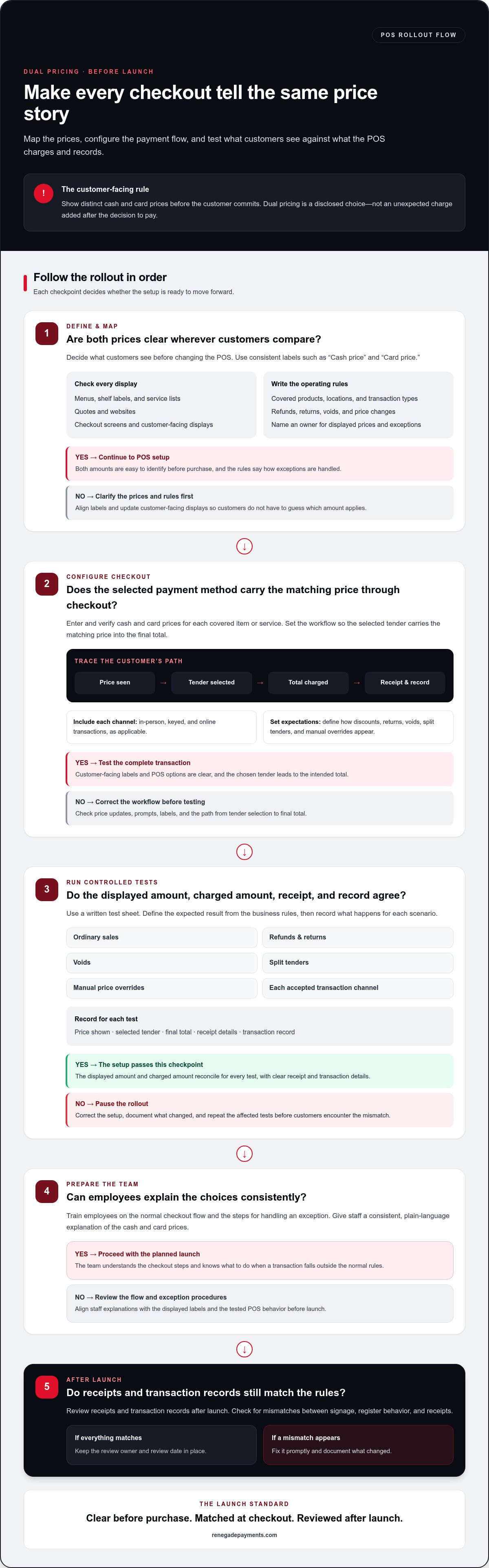
A clear price structure can still break down if the POS shows one amount and charges another. Treat setup as a workflow, not a switch. Follow the path from the price a customer sees to the tender they select, the total charged, and the details recorded on the receipt. Each step should agree.
Use this sequence before launch:
- Map the prices. Enter and verify the cash and card prices for each covered item or service. Check how updates will reach the POS and any connected customer-facing display.
- Configure checkout. Set the workflow so the selected tender carries the matching price into the final total. Make sure labels and prompts are clear to both the customer and employee.
- Test transactions. Run representative sales and exceptions. Compare the amount displayed, the amount charged, and the transaction record.
- Train staff. Show employees the normal checkout flow and the steps for handling an exception. Keep explanations consistent.
- Monitor results. Review receipts and transaction records after launch. Fix mismatches promptly and document what changed.
The amount displayed and the amount charged must reconcile for every test. If they don’t, pause the rollout and correct the setup before customers encounter it.
Map each checkout path before launch
Trace how a customer encounters the prices, selects a payment method, and completes payment. Map each channel your business accepts, such as in-person, keyed, or online transactions. Don’t assume one successful register test proves every path works. Record how discounts, returns, voids, split tenders, and manual price overrides should appear in the transaction record and receipt.
For example, test whether a partial return follows the original transaction’s pricing rules and whether a split tender is recorded clearly. Define the expected result first. That gives staff and the person configuring the POS a shared reference instead of leaving exceptions to guesswork.
Run controlled POS tests and document results
Use a written test sheet. For each scenario, record the price shown, selected tender, final total, receipt details, and transaction record. Include ordinary sales along with refunds, voids, split tenders, and overrides. Compare each result with the business rules set for the program.
- Check that customer-facing labels match the POS options.
- Verify that each tender produces the intended total.
- Review receipts and records for inconsistent prices or unclear descriptions.
- Log failures, corrections, and the person who approved the retest.
Don’t launch while a label, total, or staff prompt remains inconsistent. Retest the corrected path, then keep the results for future reviews. If you’re weighing whether this setup fits your processing costs, a dual-pricing setup review can help you assess the numbers alongside the checkout workflow.
Compare dual pricing with interchange-plus before choosing your setup
These models solve different problems. Dual pricing changes what customers see by presenting distinct cash and card prices. Interchange-plus changes how processing costs are structured: wholesale interchange is passed through alongside a fixed markup. One is a customer-facing pricing approach. The other is a processing pricing model.
That distinction matters. If you’re researching how to implement dual pricing correctly, compare both options against your actual processing profile and daily workflow. Don’t assume either model always costs less. Transaction mix, processing costs, customer expectations, and operational needs all shape the fit.
- Customer presentation: Dual pricing asks the business to display and explain two prices. Interchange-plus focuses on how processing costs appear in the merchant’s pricing structure.
- Fee structure: Dual pricing presents separate cash and card prices. Interchange-plus passes through wholesale interchange with a fixed markup.
- Operating needs: Dual pricing calls for consistent price displays and checkout handling. Interchange-plus may suit businesses that prioritize reviewing itemized processing costs and markup.
When a disclosed cash-and-card price structure may fit
Consider dual pricing if customers can readily understand the choice and your business can display both prices wherever they compare or select products and services. Review menus, quotes, and checkout workflows together. A structure that looks clear at the register but conflicts with earlier price information creates confusion. Staff also need to be ready to explain the options plainly and consistently.
When interchange-plus may suit the business better
Interchange-plus may align better with reporting priorities if you want wholesale interchange passed through alongside a fixed markup. Review your current merchant statement and compare its documented processing costs with the proposed structure. Use your own transaction and cost details, not a broad promise that one option will be cheaper. A separate guide to interchange-plus pricing can explain that model in greater depth.
Make the decision with evidence. Gather recent processing statements, note how your customers pay, and list the systems and staff routines each approach would affect. Then compare the practical trade-offs:
- Can your business keep cash and card prices consistent across all customer-facing points?
- Do you want customers to choose between displayed prices, or do you mainly want a clearly itemized processing-cost structure?
- Can your team support the selected approach without creating extra confusion at checkout?
There’s no universal winner. A statement review can put your current costs beside the pricing approach you’re considering, so you can judge implementation fit using real business data rather than assumptions.
Prepare staff and customers for a controlled dual-pricing launch
A reliable launch needs more than a working POS. Assign one person to own the rollout, brief staff before customers encounter the new prices, and set a review date. Start with a controlled launch so the team can spot unclear wording, checkout errors, or unexpected questions before small issues become routine.
Use this sequence:
- Name an owner. Give one person responsibility for launch decisions, issue tracking, and follow-up.
- Brief the team. Explain the approved price labels, checkout steps, and escalation path.
- Run transaction tests. Test the customer and employee experience before launch, including common exceptions.
- Review after launch. Set a date to check customer questions, errors, refunds, and transaction records.
This is how to implement dual pricing correctly in day-to-day operations: make the customer explanation, employee action, and transaction record line up. Keep a simple issue log with the date, problem, affected transaction type, resolution, and owner. That record helps distinguish an isolated mistake from a repeatable process gap.
Give employees a short, consistent explanation
Prepare a neutral script staff can use before a customer chooses how to pay. For example: “The cash price is [displayed amount], and the card price is [displayed amount]. Which would you like to use?” Train employees to state the displayed options plainly, without debating the policy or inventing explanations. Role-play busy checkout moments, customer questions, and exceptions so staff know when to pause and escalate.
Give employees a clear response for questions they can’t answer: direct the customer to the manager or designated owner. Staff should not make legal promises or speculate about how the program works. A short, approved explanation is easier to deliver consistently than a long script that invites improvisation.
Review compliance and operating records
Operational testing and compliance review are separate jobs. Test whether the POS and receipts follow your documented workflow. Separately review current state requirements and card-network rules for the business’s actual locations and transactions. Keep approved signage, POS settings, test results, staff guidance, and review notes together so the owner can trace what was approved and what changed.
Use a focused compliance review before launch and whenever the setup changes. Don’t treat a successful test transaction as proof that every compliance question is settled.
- Track customer questions and recurring points of confusion.
- Review checkout errors, refunds, and transaction records for patterns.
- Assign each issue to an owner and record the correction.
- Revisit the setup on the planned review date and after material changes.
A launch review can also include a closer look at the processing costs behind your pricing decision. Request a merchant statement savings analysis to compare documented costs with your chosen approach.
Use a statement review to decide your next dual-pricing step
Don’t choose a pricing approach based on a generic savings estimate. Start with your own merchant processing statements. They show current charges and help you compare the existing setup with a proposed model using documented costs, not assumptions. A review won’t promise a fixed result. It can help you identify questions about pricing, checkout setup, and transaction reporting before you make a change.
This is a useful final step in figuring out how to implement dual pricing correctly. First establish whether the model fits your customers and operations. Then examine the costs and records behind the decision. That way, your implementation plan rests on both a workable checkout process and a clearer view of current processing.
Gather the records needed for a useful comparison
Collect recent merchant statements and note the payment channels you use, such as in-person, keyed, or online transactions where applicable. List the pricing terms and processing-related line items shown in your records, including recurring charges. Keep the review grounded in what your business actually processes. Generic savings percentages and assumed transaction volumes can’t replace your own documented activity.
- Gather the statements you’ll use to understand current processing costs.
- Note the payment channels and transaction patterns relevant to your business.
- List current pricing terms, recurring charges, and processing-related line items.
- Record questions about charges or reporting that need clarification.
Keep the source documents with your comparison notes. If you later change a setting or pricing approach, the original statements provide a useful reference for assessing the decision.
Turn the review into an implementation decision
Compare dual pricing and interchange-plus against both your customer experience and your operating needs. Dual pricing presents separate cash and card prices. Interchange-plus passes wholesale interchange through alongside a fixed markup. Consider which structure you can explain clearly, maintain in your checkout procedures, and reflect consistently in transaction reporting.
Use the review to identify follow-up questions, not to force a predetermined answer. Do the documented costs support further evaluation of a different pricing model? Can your systems and staff carry out the preferred approach consistently? Do your reporting records let you understand how transactions are handled? Resolve these points before committing to a rollout.
Renegade Payments offers complimentary merchant statement savings analyses to help businesses compare current processing costs with available pricing approaches. Request a complimentary payment-processing savings analysis to assess your costs and implementation fit. The goal is a decision based on your records, checkout needs, and clear arithmetic, not a promised savings figure.
Make your next pricing decision with clear evidence
The next step isn’t to rush a pricing change. Decide what a better payment setup needs to accomplish for your business, then compare that goal with your actual processing records. Use the information you’ve gathered to identify what still needs an answer: customer communication, checkout fit, or how costs appear in your statements.
That’s the practical foundation for how to implement dual pricing correctly. Choose a structure you can explain clearly and maintain consistently, then keep reviewing it as your business and payment needs change. A careful decision is better than a quick switch based on assumptions.
Renegade Payments reviews merchant processing statements at no cost and offers both dual pricing and interchange-plus payment processing. Request a complimentary savings analysis to compare your documented processing costs and discuss which approach fits your operation.
Take the next step with your numbers in hand. Clear information puts you in control.
Frequently Asked Questions
Is dual pricing legal in every US state?
Don’t assume one rule applies everywhere. Requirements can vary by state, transaction type, and card-network rules, and they can change. Before launch, review current official requirements for the places and payment flows where your business operates. Keep this compliance review separate from POS testing: a successful test transaction doesn’t settle legal questions. This information isn’t a substitute for legal advice.
Can a business use dual pricing for debit card transactions?
It depends on the applicable state requirements, card-network rules, transaction details, and how the program is structured. Don’t treat debit and credit transactions as automatically interchangeable. Start by listing the payment types your business accepts, including the debit options customers may use. Then verify the current requirements that apply before configuring checkout. Document the approved treatment in staff guidance so employees don’t improvise or apply different pricing to similar transactions.
How much can a business save with dual pricing?
There’s no reliable universal savings figure. The result depends on current processing costs, transaction mix, customer payment choices, and program setup. A business with a different transaction profile may see a different result. Use actual merchant statements to compare documented costs with the proposed arrangement, and factor in operational and customer considerations. A statement review can clarify the numbers, but it can’t turn an estimate into a guaranteed saving.
What happens if a customer questions the two prices?
Staff should explain the displayed options calmly before the customer pays. For example, if a shopper asks why two amounts appear, employees can point to the clearly labeled prices and let the customer choose. They shouldn’t argue, improvise legal explanations, or wait until the terminal shows a different total. Give staff an escalation route for unusual questions, then track repeated confusion. If the same question keeps coming up, revisit the wording customers see.
Can dual pricing work with online sales?
Online sales may require a different workflow from in-person checkout. Review where shoppers see each price, how they select a payment method, and what the final order summary shows. Then verify current requirements for the transaction and channel before launch. Test a complete purchase and refund path, including the confirmation customers receive. Don’t assume a store POS setup automatically carries over to an online cart or makes its price presentation clear.
What should a merchant check before turning on dual pricing?
Check that customers can understand the prices before purchase, then verify that checkout applies the intended amount for each payment choice. Before launch, test a sale, refund, void, and a less common exception, such as a manual adjustment. Review current requirements for the relevant locations and transaction types separately. To understand how to implement dual pricing correctly, save the approved materials and test outcomes, then set a date to review live transaction records.
Frequently Asked Questions
Clear, straightforward answers about payment processing rules, rates, and terms.
Get your free savings
analysis in 24 hours
Upload a recent processing statement and we'll show you exactly how much you can save. No commitment, no pressure, no sales pitch.