Hidden Merchant Fees: Compare Costs and Calculate Your Rate
Learn how to find hidden merchant fees on your statement. Calculate your true effective processing rate and compare provider costs to save your business money.
Published

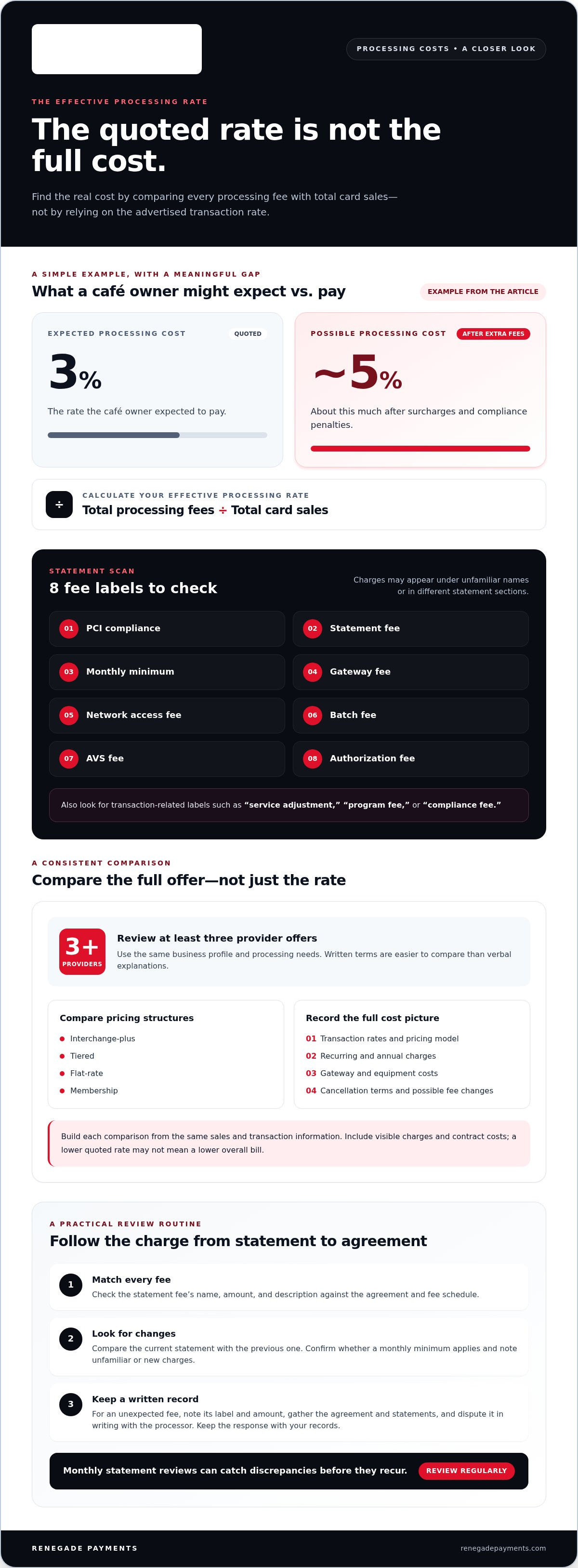
The effective processing rate shows what a headline rate can hide: divide total processing fees by total card sales. A café owner expecting a three percent processing fee could pay about five percent after surcharges and compliance penalties. Knowing how to find hidden merchant fees means checking every statement charge against total card sales, rather than relying on the advertised rate.
If your monthly statement is difficult to understand, the charges may be listed under unfamiliar labels or buried in contract terms. To see the full cost, look at what you paid, what each charge covers, and how fees affect every dollar in card sales.
This article covers common hidden fees, where they appear in statements and agreements, and how to compare offers by total cost. You’ll also learn to calculate your effective processing rate and see the real cost behind the quoted rate.
Key Takeaways
- Recognize fee labels that can disguise routine processing charges, and spot when a statement line deserves closer attention.
- Compare provider offers by their full cost structure, not just the advertised transaction rate.
- Review contract terms for fee changes, add-ons, minimums, and cancellation penalties that can affect your costs over time.
- Track how unexpected charges can eat into cash flow, especially as transaction volume grows.
- Renegade Payments offers a Free Savings Analysis, Interchange-Plus, and Dual Pricing for businesses assessing their processing costs.
Table of Contents
What Are Hidden Merchant Fees?
Hidden merchant fees are processing charges that are hard to spot in a quoted rate, statement, or contract. A café expecting a three percent processing cost could pay about five percent after surcharges and compliance penalties.
Common Processing Fee Types
Common fees beyond the transaction rate include PCI compliance, statement, and monthly minimum fees. Each recurring charge can increase your total cost, even when sales volume stays steady.
A PCI compliance fee may appear as a separate line, while a statement fee covers statement generation. A monthly minimum may apply when transactions fall below a set threshold. Statements may also list gateway, network access, batch, AVS, and authorization fees. Compare each charge with the agreement’s fee schedule, not just the rate in a sales quote.
Reasons for Hidden Fees
Processors charge separately for different parts of payment acceptance and account administration. As a result, a simple quoted rate can look lower than the cost shown on a full statement.
For example, a quoted transaction rate may exclude monthly account charges, compliance fees, or a minimum charge when transaction activity is low. Some agreements also allow fee changes with limited notice. Unfamiliar labels and charges spread across statement sections can make these costs easy to miss. The result is a gap between the rate a business remembers and the amount it actually pays.
Fee Disclosure Requirements
For U.S. merchants, the agreement and written fee schedule are key records for understanding disclosed charges. Request a schedule listing transaction rates, recurring and annual fees, PCI and gateway fees, equipment costs, and cancellation charges.
Read the agreement and fee schedule together, since a sales quote may not explain every charge or exception. If a clause mentions an adjustment, added fee, or pricing change, find the fee schedule that defines it. For unclear terms, ask for a specific example so you can compare the stated charge with a future statement.
Reading Statements for Extra Fees
Match each statement fee to its name, amount, and description in the agreement. Start with recurring charges, then check transaction-related items for unfamiliar labels such as “service adjustment,” “program fee,” or “compliance fee.” Confirm whether a monthly minimum applies and whether each charge matches the agreed terms.
Compare the current statement with the previous one to spot new charges or changes. If a fee seems unauthorized or unexpected, note its label and amount, gather the relevant agreement and statements, then dispute it in writing with the processor. Request an explanation tied to the contract and keep the response with your records. Monthly reviews can catch discrepancies before they recur.
Comparing provider offers and total costs
Compare the full agreement, not just the rate on a sales sheet. Reviewing offers from at least three providers can reveal differences in pricing models, recurring charges, and contract terms.
Comparing Provider Offers
A provider comparison puts rates, charges, and contract terms side by side. This matters because a low advertised rate may conceal costs elsewhere in the agreement.
Use the same business profile and processing needs to review each offer. Compare agreements from at least three providers and note where their terms align or differ. One offer, for example, may highlight a transaction rate while another lists recurring fees separately. A consistent comparison makes these differences easier to see.
Check whether pricing is fixed or can change during the contract, and review any cancellation or early termination fees. Record each provider’s answers alongside the relevant agreement language. Written terms are easier to compare than verbal explanations.
- List transaction rates and the pricing model.
- Record recurring and annual charges.
- Compare cancellation terms and possible fee changes.
- Flag any term that differs across agreements.
These notes help distinguish a clear offer from one that scatters key costs across several contract sections.
Comparing Provider Pricing
Provider pricing is the full set of charges for accepting card payments. Interchange-plus, tiered, flat-rate, and membership models can result in different processing costs.
Compare like with like. A flat-rate offer may show one rate, while interchange-plus separates interchange costs from the provider’s markup. Tiered pricing groups transactions into categories, and membership pricing uses a different structure. The model’s name alone doesn’t reveal the total cost. Check how it applies to your transactions and what recurring charges come with it.
Build a total-cost comparison using the same sales and transaction information for each offer. Include visible charges and contract costs, not just the advertised rate. Account for monthly or annual fees, gateway charges, equipment costs, and cancellation terms where listed. If one offer excludes a cost included in another, mark the difference rather than treating the offers as equal.
A lower quoted rate may not mean a lower overall bill. The deciding factors include the pricing model, transaction mix, recurring charges, and contract terms. Compare the total cost of ownership before choosing. For businesses weighing checkout pricing approaches, Dual Pricing is another model to understand alongside provider offers.
Compare the written agreements to spot differences and irregularities. If one provider’s fee schedule lists a charge that others omit, identify its purpose and basis in the contract. This gives you a clearer view of what each offer actually costs.
Complexity and fine print in merchant service agreements
Merchant agreements may place costs in adjustment clauses, add-on terms, and exceptions. Transaction rates, statement charges, and some recurring fees can be negotiated. Ask the processor in writing to reduce or waive each named charge, and keep a record of any revised terms.
Agreement Fine Print
Agreement fine print is the contract language that defines fees, exceptions, and changes to pricing. It matters because a clause can affect costs long after the initial quote.
Read the full agreement, including references to special circumstances and additional charges. Look for escalation clauses, minimum monthly revenue requirements, and terms allowing fee changes with limited notice. Check whether an early termination penalty applies if you cancel before the contract ends. A listed transaction rate, for example, may exclude an adjustment described elsewhere in the agreement.
Requesting a Written Fee Schedule
A written fee schedule lists the charges for payment processing. Compare it with the contract and later statements to understand how the terms apply.
Request a complete schedule listing transaction rates, recurring and annual fees, PCI and gateway fees, equipment costs, and cancellation charges. Match each charge to a contract term. If “service adjustment” or another complex label appears, request a specific example of when it applies. Keep the schedule with the agreement so you can check each statement line against it.
PCI Compliance Charges
PCI compliance charges relate to payment card compliance, while non-compliance fees may apply when you don’t meet requirements stated in the agreement. They are distinct costs: one is a compliance charge, the other a penalty.
Check the schedule and contract for both fee types, including their names, conditions, and billing frequency. A PCI fee doesn’t prove that every requirement has been met. Compare the statement label with the contract wording, and request a written explanation if the charge or its trigger is unclear. Keep the explanation with your account records.
Review the agreement clause by clause and connect it to the fee schedule. Mark every reference to “additional charges,” “special circumstances,” or fee adjustments, then match those terms to specific charges. This helps identify terms that could change your bill or apply only in certain situations.
- Circle each recurring, annual, and conditional fee in the schedule.
- Match each fee to its contract clause and stated trigger.
- Separate PCI compliance charges from non-compliance penalties.
- Request written examples for unclear or complicated terms.
To negotiate a charge, name the exact fee and request a waiver or reduction in writing. Ask for the revised schedule or agreement to show the change. A verbal promise gives you no clear record to use when checking future statements against the contract.
Effects of unexpected processing costs on small businesses
Unexpected processing costs draw from the same operating budget as inventory, payroll, and rent. For businesses with high transaction volume, extra processing costs can add up to hundreds or thousands of dollars each year. They can also reduce cash available for routine expenses and leave less room for seasonal slowdowns.
Several extra charges can add up quickly. A merchant’s additional processing expenses may total thousands of dollars over several months when recurring charges, transaction fees, and penalties appear alongside the expected rate. Comparing only the quoted rate can hide how the full set of charges affects actual outflow.
Cash-flow pressure grows when processing deductions vary from the budget. A business may plan around its usual card-processing expense, then find a new fee or adjustment on its next statement. That difference can prompt the owner to revisit spending plans or delay a purchase. Track statement totals against sales to see whether processing costs are rising, even when sales remain steady.
Payment terminal and point-of-sale equipment leases also deserve scrutiny. They may involve high total costs, long terms, and automatic renewals. A manageable monthly payment can obscure the full commitment, and missing the cancellation window may extend the expense.
Review equipment terms separately from transaction pricing. Find the lease duration, renewal language, equipment charges, and cancellation conditions in the agreement. Compare them with the equipment listed on the account and charges on your statements. This helps separate processing expenses from leased terminal or POS costs, which may have different contract terms.
- Compare statement totals across billing periods to spot rising costs.
- Separate transaction charges from recurring account and equipment expenses.
- Match each terminal or POS lease charge to its contract terms.
- Mark automatic renewal and cancellation language in the agreement.
These checks connect unexpected charges to practical business decisions. If processing expenses rise, identify whether the change came from transaction activity, an added fee, or an equipment lease. Reviewing the statement alone may not reveal a renewal clause, while reading the lease alone may not explain changing processing charges.
Use the full cost picture for planning. Include statement charges, contract costs, and equipment leases in the same review, but keep each category distinct. This shows how payment acceptance affects operating cash and which new charges need attention.
Calculating the effective processing rate
The effective processing rate shows what card acceptance costs across your actual sales. Calculate it by dividing total processing fees by total card sales, then express the result as a percentage. Compare that figure with the quoted rate to see what the headline rate leaves out.
Start with one statement period. Add the processing fees charged during that period, including transaction charges and related processing fees. Divide the total by card sales for the same period. Keep the time frame consistent: comparing one month of fees with sales from a different period distorts the result.
Formula: total processing fees ÷ total card sales × 100 = effective processing rate.
Use the total fees and card sales for the same statement period. The result is the share of card sales absorbed by processing. It differs from a quoted transaction rate, which may describe only one part of the bill. Compare the two figures to see how far the actual cost is from the advertised rate.
Build the numerator from the statement’s fee lines. Include charges tied to card acceptance, not unrelated operating expenses. If a label is unclear, compare it with the agreement and fee schedule before classifying the charge. Note the label and how you treated it, so your next review uses the same method.
Use card sales from the same period as the denominator. Don’t substitute total business revenue if it includes cash or other non-card sales. The effective rate answers a specific question: what share of card sales went to processing fees? Matching periods and consistent categories make comparisons more useful.
Calculate the rate for each statement period and compare the results over time. A higher rate can reflect added charges, changes in transaction activity, or a different mix of fees. The percentage alone won’t identify the cause. Check the statement lines and contract terms to find what changed.
- Use processing fees and card sales from matching periods.
- Keep the fee categories consistent across calculations.
- Compare the effective rate with the quoted rate.
- Trace changes in the result back to statement lines.
When the math exposes costs that need a closer review, a Free Savings Analysis can help examine current merchant statements for processing costs. Bring the effective-rate calculation into that review, so the discussion starts with your actual fees and card sales.
Renegade Payments: Dual Pricing
Renegade Payments reviews current merchant statements through a Free Savings Analysis. The analysis can uncover charges that deserve a closer look and give you a clearer basis for comparing your options.
For businesses looking to offset credit card processing fees at checkout, Dual Pricing is one approach. Interchange-Plus offers another way to understand costs, with pricing based on interchange and the provider’s markup. Start your comparison with your statement, agreement, and calculated costs, not a headline rate alone.
For a clearer view of your processing costs, contact Renegade Payments or visit renegadepayments.com.
Make Your Next Processing Decision With Clarity
Turn fee awareness into a standard for evaluating processing agreements before you accept or renew one. Keep your statement and contract together, and use them to judge whether each charge is clear, explained, and consistent with the terms you accepted. Knowing how to find hidden merchant fees gives you more control, but the goal is bigger than spotting an unfamiliar line. Choose a pricing arrangement you can understand and evaluate over time.
Renegade Payments offers a Free Savings Analysis of current merchant statements, alongside Interchange-Plus and Dual Pricing. A statement review can help identify processing costs, while the pricing models offer different ways to structure payment acceptance. Consider which approach fits your business, then compare its terms with your actual needs.
Make clarity the baseline for your next conversation. Contact Renegade Payments to discuss your processing costs and available options. You can take the next step with a clearer view of what you’re paying and what you want from a payment arrangement.
Frequently Asked Questions
What are common hidden merchant account fees?
Common fees include PCI compliance, statement generation, gateway access, batch processing, authorization, and chargeback charges. Some recur; others arise only after a transaction or account event. When learning how to find hidden merchant fees, identify each fee’s trigger and billing pattern. A chargeback fee may follow a disputed sale, while a statement charge can recur during a quiet sales period. Compare each fee with your account terms.
What is the difference between interchange, processor markup, and assessment fees?
Interchange is the underlying cost of processing a card transaction, processor markup is the payment provider’s added charge, and assessment fees are associated with card networks. On an interchange-plus statement, look for these components separately rather than treating the total as one rate. This breakdown shows which costs reflect the transaction, the provider, or the network.
How to calculate the effective rate for credit card processing?
Divide total processing fees for a statement period by card sales from that same period, then multiply by 100 to express the result as a percentage. For example, label fees as F and card sales as S: calculate F ÷ S × 100. Use card sales, not all business revenue. Keep the same fee categories each time, so a later comparison reflects actual changes rather than different bookkeeping choices.
How to compare merchant account pricing plans and fee schedules?
Compare each plan using the same sales profile, transaction mix, and contract period. For each fee schedule, separate per-transaction charges from recurring and conditional charges, then note which costs depend on equipment or account activity. Bundled charges deserve the same scrutiny as itemized ones. This side-by-side view makes exclusions and different pricing assumptions easier to spot.
How to spot hidden fees in a merchant services contract before signing?
To find hidden merchant fees before signing, search the contract for terms such as “additional charges,” “adjustments,” “exceptions,” and “minimum revenue.” Match each term to a fee schedule or clause explaining when it applies. Check closely for language allowing price changes, automatic renewal, or early cancellation penalties. If a clause leaves a charge unclear, request a specific written example before signing and keep it with the agreement.
What rules require payment processors to disclose merchant fees in the United States?
For U.S. merchants, the agreement and written fee schedule are key records for understanding disclosed charges. Request a schedule listing transaction rates, recurring and annual fees, PCI and gateway fees, equipment costs, and cancellation charges.
Frequently Asked Questions
Clear, straightforward answers about payment processing rules, rates, and terms.
Get your free savings
analysis in 24 hours
Upload a recent processing statement and we'll show you exactly how much you can save. No commitment, no pressure, no sales pitch.