Dual Pricing Merchant Services: A 2026 Buyer’s Guide
Explore dual pricing merchant services in this 2026 buyer's guide. Compare checkout impact, interchange-plus pricing, and true credit card processing savings.
Published
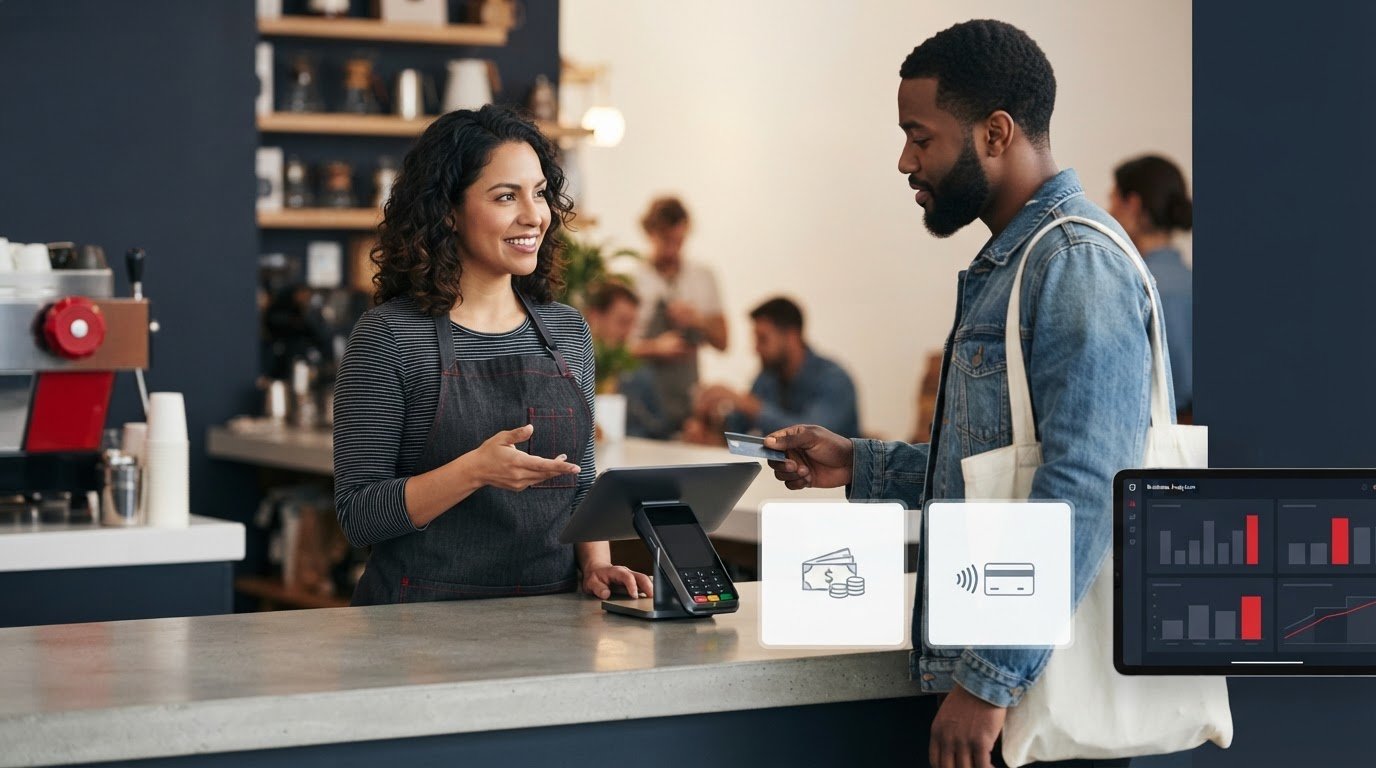
A lower processing quote means little if customers hesitate at checkout or the promised savings disappear in the fine print. Dual pricing merchant services show customers two prices, one for cash and one for card. That can help a business offset processing costs, but the setup needs to fit the way customers pay and make the prices clear before checkout.
Before choosing a model, review what your current statement actually costs, how customers may respond to separate prices, and whether a proposed savings estimate matches your transaction history. This guide offers a practical way to compare dual pricing with interchange-plus, assess the checkout experience, and review fees and terms.
Use your own processing statements to judge potential savings, not a sales promise. Renegade Payments offers a complimentary savings analysis that reviews your statement, identifies processing costs, and assesses potential savings. Use that analysis to consider whether dual pricing fits your business or transparent interchange-plus pricing better matches your needs.
Key Takeaways
- Assess customer payment habits, transaction mix, and checkout setup to judge whether dual pricing fits your business.
- Compare service details separately from the pricing model, including reporting, statement detail, support, and equipment or integrations.
- Use the comparison framework to weigh customer experience, statement visibility, fee treatment, and administrative demands across dual pricing merchant services and interchange-plus.
- Review recent statements and compare matching charge categories. Don’t assume every account cost will change under a new model.
- Evaluate potential savings alongside checkout fit, clear disclosures, and comparable service terms using a statement-based analysis.
Table of Contents
- Is dual pricing merchant services a fit for your business?
- What should dual pricing merchant services include beyond the pricing model?
- Dual pricing vs. interchange-plus: which merchant services model fits?
- How to verify dual pricing savings before switching merchant services
- Choose dual pricing merchant services with a statement-based review
Is dual pricing merchant services a fit for your business?
Start with the buying decision, not a savings promise. Review how customers pay, the types and sizes of your transactions, and whether your checkout can show two clear prices without slowing service. Dual pricing merchant services may suit one business and frustrate another, even when they process similar card volume. Customer habits and the fit with daily checkout routines can make the difference.
Consider transaction volume and average ticket size together, but treat them as context, not proof of savings. A business with frequent card payments has a different payment mix from one where cash is common. Neither profile guarantees a better result. Customers should be able to understand the cash and card prices before paying. Clear displays and consistent staff explanations help make the choice straightforward. For practical checkout considerations, connect the pricing decision to your checkout guide.
Which business conditions make dual pricing worth evaluating?
Map the payment flow from the first price a customer sees to the final receipt. Note which payment methods customers use, where prices appear, and whether staff can explain them in one plain sentence. Consider whether checkout is fast-paced, whether sales happen at a counter or remotely, and whether existing equipment can present both prices clearly. This review can reveal operational friction before you change your setup.
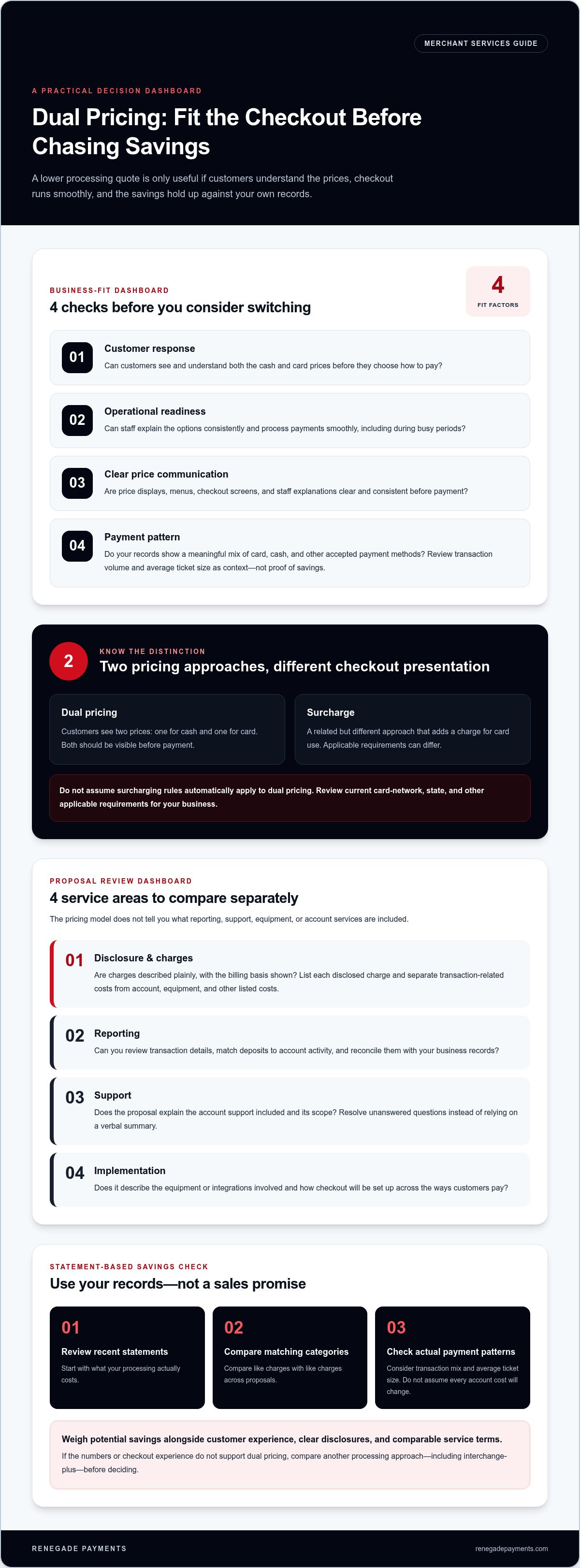
- Customer response: Can customers see and understand both prices before choosing how to pay?
- Operational readiness: Can staff explain the options and process transactions consistently, including during busy periods?
- Price communication: Are displays, menus, and checkout screens clear and consistent?
- Payment pattern: Do your records show a meaningful mix of card, cash, and other accepted payment methods?
What concerns should merchants resolve before choosing?
Customers are more likely to understand the choice when prices are visible upfront and staff use the same clear explanation each time. Avoid surprises at the register. Dual pricing presents cash and card prices before payment. A surcharge is a related but different approach that adds a charge for card use. For a general explanation of surcharges, see Surcharge (Wikipedia). The distinction matters because applicable requirements can differ.
Before adopting a pricing setup, review the current card-network, state, and other applicable requirements for your business. Don’t assume rules for surcharging automatically apply to dual pricing, or that a setup used elsewhere fits your checkout. Make clear disclosures and consistent price presentation part of the plan from the start.
Separate a possible cost offset from a guaranteed outcome. Results depend on your statement details and actual payment patterns, including transaction mix and average ticket size. Use recent processing records to assess the model rather than relying on a broad savings claim. If the numbers or customer experience don’t support the change, compare another processing approach before deciding.
What should dual pricing merchant services include beyond the pricing model?
A pricing model explains how transactions are charged. It doesn’t describe the reporting, support, equipment, or account services included in a proposal. Compare those items separately. A low-looking price is of little use if the statement is hard to understand or the service scope leaves basic questions unanswered.
For each proposal, list every disclosed charge alongside its description and billing basis. Separate transaction-related charges from account, equipment, or other listed costs. Don’t assume a charge disappears when the pricing model changes. Written details make it easier to compare offers without confusing unlike terms.
How can merchants compare provider proposals clearly?
Use the same checklist for every offer. Look for statement detail that helps you trace transaction activity and reconcile deposits with business records. Review what the proposal says about account support, equipment, and integrations. Note any unanswered questions about the contract or service scope and resolve them before deciding, rather than relying on a verbal summary.
| Area | What to compare |
|---|---|
| Disclosure | Are charges described plainly, with the billing basis shown? |
| Reporting | Can you review transaction details and match deposits to account activity? |
| Support | Does the proposal explain the account support included and its scope? |
| Implementation | Does it describe the equipment or integrations involved and how checkout will be set up? |
Which checkout and reporting details affect day-to-day use?
Review every way customers pay you. A price display that works at a staffed counter may not fit an online checkout or another sales channel. Check how both prices appear before payment and whether the transaction record and receipt remain clear. The setup should make the payment choice understandable to customers and manageable for staff.
Reporting should support routine checks, not create another reconciliation problem. Confirm that you can review payment activity in enough detail to compare transactions with deposits and your own records. A useful statement makes charges easier to identify. Vague summaries leave you guessing.
Evaluate dual pricing merchant services as a complete operating arrangement, not just a headline pricing approach. Renegade Payments’ complimentary savings analysis reviews existing merchant statements to identify processing costs and assess potential savings. It provides a grounded starting point for comparing proposals. Review your processing statement alongside the written offer, then judge potential savings against your own records.
Dual pricing vs. interchange-plus: which merchant services model fits?
These models address processing costs differently. Dual pricing presents customers with a cash price and a card price, making the payment choice visible at checkout. Interchange-plus passes the underlying interchange cost to the merchant alongside a clear, fixed processor markup. Merchants review itemized charges rather than showing separate customer-facing prices.
Neither model is automatically cheaper for every business. The comparison depends on your processing statement, transaction mix, and the complete terms of each proposal. Use the same records and cost categories for both options. Don’t compare a projected offset under dual pricing with only one line from an interchange-plus quote.
| Factor | Dual pricing | Interchange-plus |
|---|---|---|
| Customer experience | Customers see separate cash and card prices before paying. | Customers generally see the business’s listed price; the merchant reviews processing charges. |
| Statement visibility | Review the statement and the pricing setup together to understand costs and card-price treatment. | Interchange and the processor markup appear as separate components, supporting itemized review. |
| Fee treatment | Evaluate how the cash and card prices are presented and how transactions are recorded. | Interchange passes through alongside the processor’s stated markup; review any other disclosed charges separately. |
| Administrative demands | Maintain clear price displays and consistent explanations across checkout channels. | Review itemized charges and reconcile processing activity with deposits and business records. |
When might dual pricing better match a merchant’s priorities?
Consider dual pricing if showing customers their payment choices fits the way your business sells and processes transactions. The approach calls for clear communication: customers should understand the displayed prices, and staff should explain them consistently. Test the potential cost impact against actual processing records, including transaction volume and payment mix. A generic savings estimate cannot account for your specific business activity.
When might interchange-plus deserve a closer look?
Interchange-plus may suit merchants who want to see the underlying interchange cost and processor markup as distinct parts of processing charges. That visibility can support statement review, but it still takes attention to the full account charges and transaction details. Compare the written markup and other disclosed costs against your own processing history. For a deeper explanation of the model, use the existing interchange-plus guide.
For a fair comparison, gather statements covering the same period and examine the transactions that drive your costs. Card type, transaction method, average ticket, and payment volume can affect the result. Compare like with like, then weigh the numbers against customer experience and day-to-day work. The right fit is a model whose pricing you can explain, whose terms you can review, and whose projected impact is supported by your records.
How to verify dual pricing savings before switching merchant services
A savings estimate is useful only when you can trace it to real costs. Build the comparison from your own processing statements, then separate documented charges from assumptions about how a new setup may work. This prevents a projected offset from being mistaken for a guaranteed result.
- Gather representative statements. Collect recent records that reflect normal business activity and different transaction patterns. If payment volume changes by season or sales channel, include that variation in your review.
- Identify and group charges. Record processing totals, individual fee categories, and recurring account charges shown on the statements. Keep processing charges separate from other account costs, since not every line item will necessarily change under a new model.
- Compare like with like. Set documented current costs beside a written proposal. Keep the proposal’s assumptions separate from statement facts, and note which charges or operating conditions may differ.
What should a merchant statement review capture?
Capture enough detail to understand how processing costs relate to actual payment activity. Note transaction patterns, listed charges, and the periods covered. Before sharing statements for analysis, protect customer and account information. Remove details that aren’t needed for the review while retaining the cost and transaction information required to assess processing.
How should merchants judge a savings estimate?
Look for a plain explanation of the calculation inputs. The estimate should identify which statement figures it uses, what assumptions it makes about payment mix, and which existing charges it expects to change. Compare those inputs with actual statement figures and business records. If the estimate depends on a payment pattern you don’t see in your records, treat the result cautiously.
Keep the proposed setup’s charges and terms visible in the comparison. Don’t subtract a projected processing offset from current processing costs while ignoring other recurring account charges. Record any items the estimate excludes or treats differently. This gives you a clearer view of what the numbers do and don’t support.
Savings analysis and compliance review answer different questions. A statement review assesses costs and potential savings using your own records. A compliance review considers whether price presentation and transaction handling meet current card-network, state, and other applicable requirements. Complete both. A favorable estimate doesn’t establish compliance. Use the existing compliance checklist as a separate part of your decision process.
Renegade Payments’ complimentary savings analysis reviews existing merchant statements to identify processing costs and assess potential savings. Request a statement-based savings analysis to ground your comparison in your own processing records.
Choose dual pricing merchant services with a statement-based review
Make the decision based on evidence, not a headline promise. A sound comparison brings together checkout fit, clear customer disclosures, comparable service terms, and processing costs documented in your own statements. If a proposal looks better only because it leaves out charges or assumes a different payment mix, the comparison isn’t complete.
Dual pricing and interchange-plus address costs differently. One presents separate cash and card prices to customers. The other shows interchange alongside the processor’s markup. Weigh each against your priorities, including how customers pay, how prices will appear at checkout, and how clearly you can review the resulting charges. Don’t treat a possible cost offset as a guaranteed outcome.
What happens in a complimentary savings analysis?
Renegade Payments reviews existing merchant processing statements to identify processing costs and assess potential savings. The findings reflect the charges and activity visible in the records provided. The analysis can help you compare dual pricing with interchange-plus, but it doesn’t promise a particular result. Its purpose is to clarify current costs before you assess a proposed processing model.
What should merchants bring to the decision?
Gather current processing statements and a basic picture of how customers pay across your sales channels. Include the payment methods your business accepts and any meaningful differences between in-person, online, or other transaction activity. That context connects statement figures to the way your business operates instead of relying on assumptions that may not match your checkout.
- Check the customer experience: Can your checkout show the pricing clearly and consistently?
- Compare the written terms: Are the service scope and disclosed charges clear enough to evaluate?
- Review the records: Do the statements reflect your current processing costs and payment activity?
- Weigh both models: Does dual pricing or interchange-plus better fit your priorities for customer communication and pricing visibility?
Bring those details into the review, then use the findings to make a grounded choice. A statement analysis can identify costs and assess potential savings, but the outcome depends on the business and records being reviewed. Renegade Payments offers a complimentary savings analysis based on existing processing statements. Request a complimentary savings analysis and take the next step with your own processing data in hand.
Make your next processing decision with confidence
Don’t commit to a model just because the pitch sounds convincing. Compare it with your actual records and the way your customers pay. This gives you a practical basis for deciding whether dual pricing merchant services fit your checkout or interchange-plus better matches your preference for itemized pricing.
Renegade Payments offers a complimentary review of existing merchant processing statements. It identifies processing costs and assesses potential savings using the records provided. Use the analysis to examine the options with clearer numbers, not as a promise of a guaranteed result.
Request a complimentary savings analysis and take the next step with your processing costs in view. A clear comparison helps you make an informed choice.
Frequently Asked Questions
Is dual pricing merchant services a good fit for every business?
No. Dual pricing merchant services may fit a business where separate cash and card prices work naturally with the checkout, but customer habits and operating needs vary. For example, a business where customers expect one consistent listed price should carefully consider how separate prices may affect the experience. Review disclosures and terms, consider customer feedback after implementation, and check applicable requirements before making a decision.
Can dual pricing merchant services eliminate all credit card processing costs?
No. A dual pricing setup may offset some processing expenses, but it doesn’t guarantee that every processing or account cost will disappear. Charges depend on transaction activity and the terms of the specific proposal. For example, recurring account or equipment charges shown on a statement may be separate from transaction processing. Review each cost category rather than assuming a price display removes every expense.
How do I know whether a dual pricing proposal will save my business money?
Compare a written estimate with your own processing records and check the assumptions behind it. If a proposal assumes a different share of cash payments from the share your business actually sees, the projected result may not reflect your operations. Review which statement figures and charges the estimate uses. After a change, compare later statements with that baseline to see how actual activity and costs differ from the estimate.
Can a business accept both cash and card payments with dual pricing?
Yes. Dual pricing presents distinct prices for cash and card payments, so customers can choose between those options. Make the displayed prices easy to understand before payment, and train staff to explain them clearly at the register. Keep prices and explanations consistent across signs, menus, checkout screens, and receipts. Review the setup before launch so the customer experience is clear.
Does dual pricing work for online payments?
It may be considered for online payments, but don’t assume an in-person setup transfers directly to a website or invoice. Review the customer journey: where prices appear, how a customer chooses a payment method, and what the confirmation or receipt shows. Make sure the presentation is clear throughout the online flow and review applicable requirements for that setup before adopting it.
What should a newly formed business review before choosing merchant services?
A new business should assess proposed pricing and checkout needs even without processing history. Use realistic expectations for sales channels, payment methods, and transaction sizes, and label those figures as projections rather than proven results. Read disclosed charges and service terms carefully. Once processing statements become available, compare actual activity with the original assumptions and revise the assessment based on documented results.
Frequently Asked Questions
Clear, straightforward answers about payment processing rules, rates, and terms.
Get your free savings
analysis in 24 hours
Upload a recent processing statement and we'll show you exactly how much you can save. No commitment, no pressure, no sales pitch.