Credit Card Processing for Small Businesses: Compare Fees
Compare credit card payment processing for small business: pricing models, transaction fees, keyed and international payments, security, and tips to cut costs.
Published

Card processing involves a sequence of approvals, charges, and settlements that affects how much your business keeps from each sale. Credit card payment processing for a small business routes a customer’s payment through the processor, card network, and issuing bank before the funds reach your business. The pricing model determines how processing fees are calculated.
You should be able to see clear rates and understand every charge, but pricing structures can make merchant services difficult to compare. This guide explains how processing works, outlines common pricing models and factors that affect transaction costs, and covers keyed and international payments, security, fraud, and disputes. It also offers a practical way to compare options based on how you take payments and the terms that shape your total costs.
Key Takeaways
- Compare flat-rate, tiered, and interchange-plus pricing by how each calculates transaction costs, not just by its headline rate.
- Account for keyed and cross-border transactions separately, since the way a card payment is entered or routed can affect its cost.
- Understand how chargebacks work and review the security measures that help protect payment data and reduce fraud risk.
- Match merchant services to how your business accepts payments, then use a savings analysis to spot costs and assess whether dual pricing or interchange-plus fits.
Table of Contents
Chargebacks, disputes, security, and fraud prevention
A chargeback reverses a card payment after a customer disputes it with their bank. Your business may lose the sale amount while the dispute is handled. Keep the receipt, order details, refund terms, and proof of delivery together. For example, match an online order confirmation with its shipment record before responding to a dispute.
PCI DSS sets security requirements for businesses that accept card payments. Your processor can support PCI compliance, but you should also protect account logins, limit staff access, and keep payment software updated. Use a terminal or card reader that encrypts payment data and integrate it with trusted checkout software. Review the security tools included with each software subscription.
A Hiscox report found that 41% of US small businesses experienced a cyberattack in 2023. Reduce exposure by using strong, unique passwords and enabling multifactor authentication where available. For online transactions, choose a processor offering biometric 3D Secure authentication, strong encryption, and data tokenization. Tokenization replaces card details with a substitute value during processing.
- Save dated receipts, order records, and customer messages for dispute evidence.
- Restrict payment-system access to staff who need it, and remove access when roles change.
- Use separate review steps for unusual orders, such as mismatched billing and delivery details.
Compare how each payment method handles card data and where its fraud controls apply.
| Payment option | Data handling | Practical control |
|---|---|---|
| In-person terminal | Customer taps, inserts, or swipes a card | Keep terminal software updated |
| Card reader | Reader sends payment details to checkout software | Use a supported, encrypted connection |
| Online checkout | Customer enters card details remotely | Use 3D Secure and tokenization |
| Manually keyed payment | Staff enter card details | Limit access and retain transaction records |
Interchange affects processing costs, not dispute outcomes. Choose a payment method suited to your sales channel, then match its security controls to how card details enter your system.
What is credit card processing for small businesses?
A card transaction moves from checkout through authorization, processing, and settlement. Its cost depends on the pricing model, sales channel, and account terms.
Monthly Fees and Point-of-Sale Plans
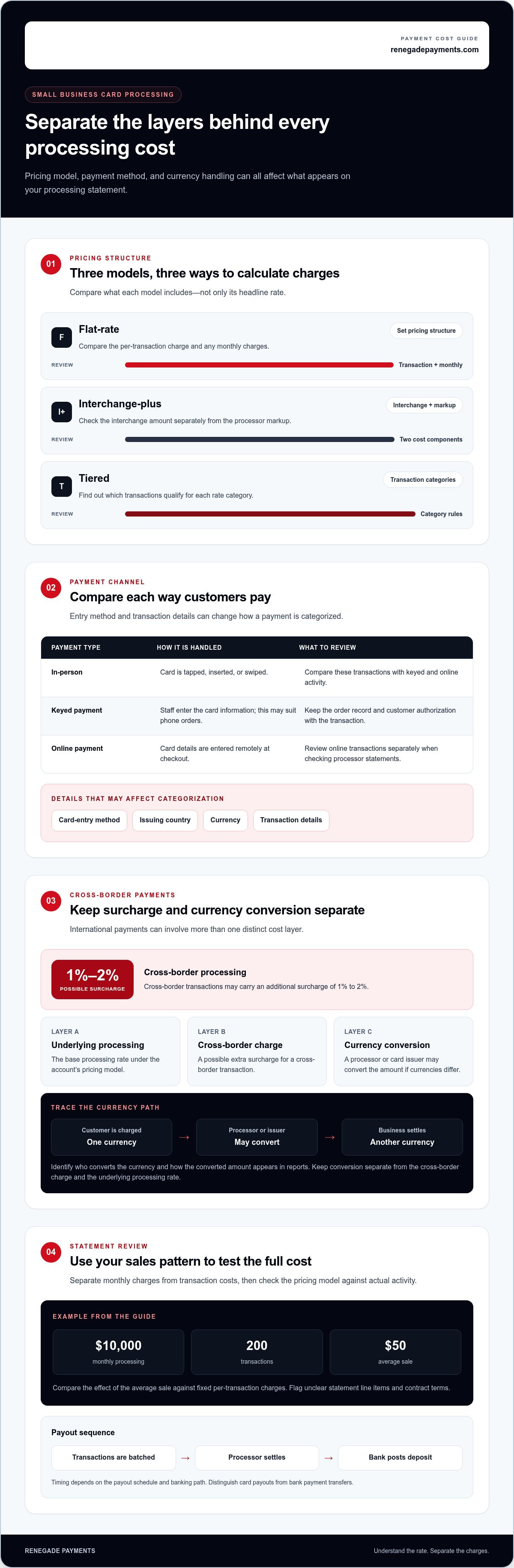
A point-of-sale plan can combine checkout software, sales records, and payment processing. Subscription charges recur, while transaction fees apply when a customer pays. Flat-rate pricing uses a set rate structure. Interchange-plus passes through interchange and adds a processor markup. Tiered pricing sorts transactions into rate categories.
Compare the structures by how clearly they show costs:
| Model | Rate basis | What to compare |
|---|---|---|
| Flat-rate | Set pricing structure | Per-transaction and monthly charges |
| Interchange-plus | Interchange plus markup | Interchange and processor markup |
| Tiered | Transaction categories | Which transactions qualify for each tier |
Payment Equipment and Setup Documents
For in-person sales, you may need a terminal or card reader, plus a POS system if you manage checkout through software. Equipment costs depend on the device, software plan, and whether you buy or rent. Online sales may use an integrated checkout instead of a physical reader.
To open an account, prepare your business identity and ownership details, contact information, bank account details, and estimates of sales volume and payment channels. The processor uses this information to set up your account and payout route.
Fee Reduction and Fund Deposits
To reduce processing fees, compare the full statement, not only the advertised rate. Separate monthly charges from transaction costs, then review the pricing model against your sales pattern. For example, a business processing $10,000 monthly across 200 transactions can compare the effect of its average $50 sale against fixed per-transaction charges. Flag unclear line items and contract terms before accepting them.
Card deposits arrive after transactions are batched, settled by the processor, and posted by the bank. Timing depends on the payout schedule and banking path, so distinguish card payouts from bank payment transfers.
Manually keyed and international card transaction rates
Keyed payments and cross-border sales can follow different processing rules from tapped, inserted, or swiped transactions. The card-entry method, issuing country, currency, and transaction details can affect how a payment is categorized. Compare each sales channel separately when reviewing processor statements.
With keyed payments, staff enter card information rather than using a device to read the card. This can suit phone orders, but changes how the payment is captured. Keep the order record and customer authorization with the transaction, and compare keyed-payment charges with your in-person and online activity.
International transactions can involve a difference between the cardholder’s currency and your settlement currency. A processor or card issuer may convert the amount, affecting the customer’s final charge or your business deposit. Before signing an agreement, identify who converts the currency and how the converted amount appears in reports. Payment providers handle international transactions differently.
Cross-border transactions may carry an additional surcharge of 1% to 2%. Separate that charge from currency conversion and the underlying processing rate. For example, a sale charged in one currency but settled in another may involve both cross-border processing and conversion. Don’t treat those line items as interchangeable.
Level 2 and Level 3 interchange optimization involves sending more transaction data for eligible commercial card payments. Instead of submitting only the amount and card details, the transaction can include additional purchase information. Better data can affect how the card network classifies an eligible payment. Confirm that your checkout software can connect to the processor and pass the needed fields.
Compare each channel by entry method, currency handling, data requirements, and statement labels. A square-shaped reader may suit a counter, while online payment software handles remote orders. The 2.6% figure sometimes used for in-person flat-rate processing is not a benchmark for keyed or international payments. Review your own transaction mix and contract terms before weighing providers.
Merchant services and payment processing
Merchant services connect checkout with the systems that authorize card payments and route funds. A setup may include a processor, payment gateway, point-of-sale tools, and transaction reporting. The processor handles payment information, while the gateway connects online checkout to processing. Compare the complete setup, not just one advertised rate. Credit card payment processing for small business operations should support the ways your customers actually pay.
Costs can combine transaction charges, monthly account or gateway fees, and other contract terms. Tiered pricing can show rates of 1.9% for qualified transactions, 2.5% for midqualified transactions, and 3.5% for nonqualified transactions. The key is understanding how transactions qualify, because the category affects the charge.
| Merchant service element | What it does | What to compare |
|---|---|---|
| Processor | Routes card transactions for authorization | Pricing model and transaction categories |
| Gateway | Connects online checkout to processing | Monthly access and transaction charges |
| POS system | Records in-person sales and payment details | Included tools and plan charges |
| Settlement | Routes proceeds toward the business account | Transfer method and stated timing |
Payment volume changes which costs matter most. A fixed monthly charge weighs differently for a low-volume shop than for a busy retailer. For small SaaS businesses, interchange-plus pricing may become advantageous once monthly recurring revenue exceeds about $50,000. Compare actual transaction types and revenue patterns, not a generic sales claim. Credit card payment processing for small business owners should make those costs easy to evaluate.
The 2023 Small Business Credit Survey reported that roughly four out of five small firms faced payment-related challenges. Clear terms help owners identify whether friction comes from processing costs, payout handling, or payment acceptance. Debit card transactions, online orders, and in-person sales each bring different operating needs.
- Match the service setup to where customers pay.
- Separate recurring account charges from per-transaction fees.
- Review category definitions, payout terms, and contract language together.
Compare transparent merchant processing options against your sales mix and service needs.
A point-of-sale system records in-person sales and payment details. Its cost depends on the tools included and the plan’s charges.
Renegade Payments: Dual Pricing
Renegade Payments helps business owners compare payment costs through Dual Pricing and Interchange-Plus. Dual Pricing presents pricing options at checkout, helping businesses offset credit card processing fees. Interchange-Plus separates interchange from the processor’s markup, making the pricing structure easier to review.
If your merchant statement includes charges that are hard to explain, Renegade Payments offers a Free Savings Analysis. It reviews your statements to identify processing costs and clarify where fees come from, giving you a practical basis for comparing your current setup with alternative pricing models.
Consider this next step when you want clearer fee details or need to assess whether Dual Pricing or Interchange-Plus fits your payment setup. Contact Renegade Payments or visit renegadepayments.com to discuss your processing needs.
Make Your Next Processing Decision With Clarity
Turn fee comparisons into a decision based on your own sales and statement details. Credit card payment processing for a small business should fit how customers pay and make charges understandable, rather than leave you sorting through unclear terms after signing.
Renegade Payments offers Dual Pricing for businesses looking to offset card processing fees at checkout, and Interchange-Plus for a transparent pricing structure. Its Free Savings Analysis reviews current merchant statements to uncover hidden processing costs. Use those options to examine what your current setup charges and whether a different model better fits your business.
Bring your questions about pricing structure and statement charges into the conversation. Contact Renegade Payments to discuss your processing needs and take the next step with greater clarity.
Frequently Asked Questions
Why do you need a merchant services provider?
A merchant services provider connects your business to the systems that accept and process card payments. It may also provide payment tools, transaction records, settlement reporting, and dispute support. For example, a retailer can use a provider’s setup to connect checkout devices and reconcile daily sales. The right arrangement depends on your sales channels, accounting workflow, and the support you need when transactions fail.
Quick Answer: What Is the Best Payment Processing for Small Business?
The right option fits your payment channels and makes its charges understandable. A business with mostly in-person sales may prioritize reliable checkout equipment and clear transaction reporting. An online seller may prioritize gateway integration and fraud controls. Compare the full statement and service terms, then assess costs against your average sale and transaction mix.
What is a merchant account?
A merchant account is used to receive and process card sales before transferring funds to your business bank account. It is separate from the bank account you use to manage operating cash. Some payment setups bundle merchant-account functions into one service, while others use separate systems. Review how transactions are recorded and how settlement information fits into your accounting workflow.
What's the best pricing model for small businesses: flat-rate, tiered, or interchange-plus?
No single pricing model suits every business. Flat-rate pricing is easier to forecast because its rate structure is straightforward. Tiered pricing sorts transactions into categories, so costs depend on how payments qualify. Interchange-plus separates interchange from the processor’s markup, making both components visible. Compare models using your card mix, average sale, sales channel, and statement details.
What are the best credit card payment processors for small businesses in the US?
No processor is right for every small business in the United States. A food truck needs a different setup from an online subscription business or a retail shop with several registers. Compare options by channel support, reporting, dispute tools, security, and pricing transparency. Then weigh the terms against your operating needs. A recognizable name alone does not show whether a service suits your transactions.
What fees do small business credit card processors charge, including transaction, monthly, and setup fees?
Common charges can include a percentage of each sale, a fixed transaction fee, and account, gateway, setup, or dispute fees. Compare the full fee schedule and identify which charges recur and which apply only in specific situations.
Frequently Asked Questions
Clear, straightforward answers about payment processing rules, rates, and terms.
Get your free savings
analysis in 24 hours
Upload a recent processing statement and we'll show you exactly how much you can save. No commitment, no pressure, no sales pitch.