Cash Discount vs. Dual Pricing: Compare Fees, Rules, and Tradeoffs
Compare cash discount vs dual pricing rules, fees, and tradeoffs. Learn how each payment model works to choose the best compliant setup for your business.
Published

In the cash discount vs dual pricing comparison, the key difference is what customers see before they pay. With dual pricing, they see a card price and a lower cash price upfront. With a cash discount, the business displays a price and reduces it when a customer pays with cash. A surcharge is different: it adds a charge for paying by card.
These terms are easy to mix up. All three can affect what customers pay, but their pricing structures and disclosure rules are different. This guide explains how each method works, what customers see, and how state and card-network rules affect the choice. You’ll find a side-by-side comparison and practical criteria for deciding which approach suits your business.
Key Takeaways
- Choose a pricing setup based on how customers pay and what they’ll see before checkout.
- Keep surcharges distinct from cash discounts and dual pricing; their rules and checkout displays differ.
- Make payment options and prices clear before the sale, then show the pricing accurately on receipts.
- For sales across state lines, account for local disclosure rules as well as card-network requirements.
- Use precise terms when describing your pricing model so customers understand the price they’ll pay.
Table of Contents
What Is Dual Pricing?
Cash discounts and dual pricing both offer customers a cash option, but present prices differently. Each must communicate payment options clearly before the purchase is complete. Card-network surcharge rules are separate: surcharges are limited by the merchant’s cost of acceptance and applicable caps, while Visa rules prohibit surcharges on debit and prepaid cards.
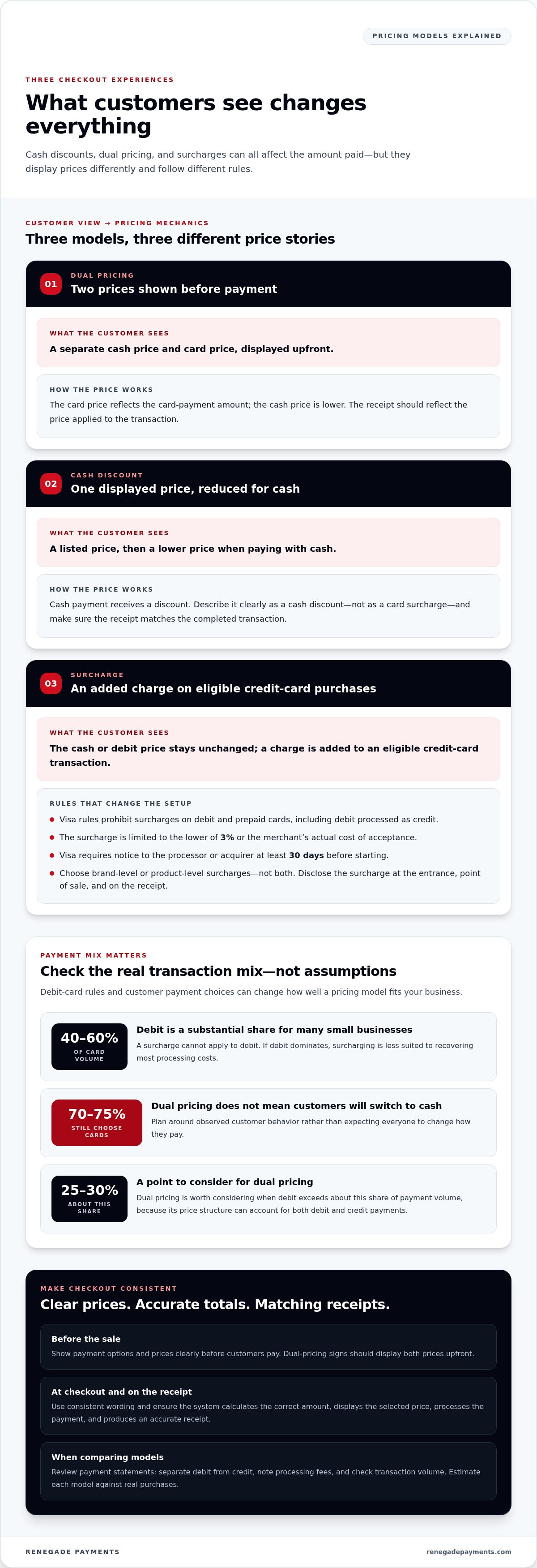
With dual pricing, customers see separate cash and card prices before choosing how to pay. A cash discount starts with one displayed price, then reduces it for cash payment. In both programs, the receipt should reflect the pricing applied to the transaction.
Payment mix matters. Debit cards account for 40-60% of card volume at many small businesses, and a surcharge cannot apply to debit. A business with 80% debit-card transactions shouldn’t expect surcharges to recover most processing costs. Dual pricing is worth considering when debit exceeds about 25-30% of payment volume, because the price structure can account for both debit and credit payments.
Customer behavior also affects the result. With dual pricing, 70-75% of customers still choose cards, so don’t build a plan that depends on everyone switching to cash. Compare payment statements to see the actual mix: separate debit from credit, note processing fees, and review transaction volume. Then estimate each model against real purchases, not assumptions about customer preferences.
Processing fees are addressed through the pricing structure, not eliminated. In dual pricing, the card price reflects the card-payment amount, while the cash price is lower. With a cash discount, the listed price is reduced for cash payment. Reviewing your statement can help show how each approach may affect your costs and customers’ totals.
Most businesses need a POS system or payment processor that supports dual pricing or cash discounts. The system must calculate the correct amount, display the selected price, process the payment, and produce an accurate receipt. Manual workarounds can leave the displayed price and completed purchase totals out of sync.
| Option | Price shown | Fee handling | Payment-mix fit |
|---|---|---|---|
| Dual pricing | Separate cash and card prices | Card price reflects card payment | Useful to evaluate when debit is a substantial share |
| Cash discount | Listed price, with a lower cash price | Cash payment receives a discount | Compare against actual cash and card activity |
| Surcharge | Card price includes an added charge | Subject to network limits; no debit surcharge under Visa rules | Less suited when debit dominates |
Choose by matching statement-level payment mix to how each program displays prices and handles fees.
Differences between surcharging, cash discounting, and dual pricing
The difference lies in what customers see before paying and how their payment choice changes the total. A cash discount lowers the listed price for cash. Dual pricing displays separate cash and card prices upfront. Surcharging adds a charge to an eligible credit-card transaction. Treating these terms as interchangeable can confuse customers, staff, and checkout records.
With a cash discount, the business displays one price, then reduces it for cash payment. Dual pricing shows both prices side by side before the purchase, so customers can choose with a clear understanding of the total. A surcharge leaves the cash or debit price unchanged, then adds a charge for an eligible credit-card transaction.
That distinction affects signage, margins, and receipts. Dual pricing signs should show both prices before customers pay. A cash discount should be clearly described as a discount, not a card surcharge. Visa requires surcharge disclosures at the store or website entrance, at the point of sale, and on the receipt. The receipt should show the charge clearly, not bury it in an unexplained total.
Can businesses charge different prices for debit and credit cards? Visa rules prohibit surcharges on debit or prepaid cards, even if a debit card is processed as credit. Credit-card surcharges are limited to the merchant’s actual cost of acceptance and applicable caps, so they cannot be used as an unrestricted price increase.
For surcharging, Visa requires merchants to notify their processor or acquirer at least 30 days before starting the program. Visa limits a surcharge to the lower of 3% or the merchant’s actual cost of acceptance. Merchants must choose either brand-level or product-level surcharges, not both. These steps make surcharging a different operational process from displaying cash and card prices.
Before launching a surcharge, identify the card brands you accept, calculate your cost of acceptance, notify your processor or acquirer, and prepare disclosures for the entrance, point of sale, and receipt. Keep the surcharge within the applicable limit. Missing signage or an excessive charge can create a compliance problem, while inconsistent wording can leave customers unsure of the total.
Choose the structure that matches the customer-facing price you can explain clearly and the rules you can administer consistently. If separate prices fit your checkout, explore a dual pricing setup that makes the payment choice visible before customers pay.
Multi-state compliance and competitive effects
For retailers operating across state lines, the checkout setup must meet applicable state laws and card-network rules. Clear prices, consistent staff procedures, and accurate receipts make checkout smoother for customers and compliance teams.
Operational Tradeoffs and Competitive Effects
A cash discount or dual-pricing program changes what customers see, while surcharging adds a charge to eligible credit-card purchases. In a multi-state retail operation, disclosure requirements may differ by location, so one sign or script may not work everywhere. Clear checkout displays help customers compare payment options before buying, even when setup and training must account for local rules.
Customer response is another factor in the decision. A visible price difference can influence whether shoppers pay by cash or card, while unclear pricing can slow checkout or undermine trust. Map the payment flow at each location, then align POS prompts, receipt wording, and employee explanations. Keep procedures consistent within each location, while accounting for differences in applicable state rules.
Cash Discount Compliance and Signage
A cash discount lowers the listed price for customers paying cash. Present it as a discount, not as a disguised card surcharge. Display payment options before the purchase is complete, and make the discount clear on the receipt. Businesses with several stores should review each entrance, point of sale, website, and receipt template against the rules that apply there.
That differs from surcharging, which has card-network limits and disclosure steps. Visa may assess fines starting at $5,000 if a merchant fails to display both prices and adds pricing that exceeds 3%. Clear signage is not decoration. It is part of the transaction customers see and the compliance record a business must maintain.
Dual pricing and cash discounts are generally legal in the United States when implemented correctly, but that does not erase local requirements. State laws can affect advertised prices, how mandatory charges appear, and what customers must see before checkout. California’s SB 478 took effect July 1, 2024, and requires mandatory fees to be included in advertised prices. Virginia’s SB 1212/HB 2515 took effect July 1, 2025, with an advertised-price requirement for mandatory fees or surcharges.
Build a compliance review around the actual transaction. Identify each state where the business sells, document its pricing method, and review signs, website listings, POS screens, and receipts for consistency. For credit card surcharging, include card-brand limits and processor notification requirements. Visa requires notice to the processor or acquirer at least 30 days before a surcharge program begins.
Enforcement can escalate. Visa’s first-offense fines start at $1,000 under its enforcement framework, while failures to display both prices and additions exceeding 3% may trigger penalties starting at $5,000. Repeat or egregious violations can reach $5,000 or $25,000 or more. Separate those situations in staff training, and correct the display or transaction setup when a review finds a mismatch.
State and federal price-disclosure considerations
Cash discounts and dual pricing are generally legal across the United States, but disclosure rules still matter. State laws can affect how advertised prices appear and how customers see payment options before a purchase.
Do cash discount or dual pricing laws vary by state? Both approaches are generally available in all 50 states, but state and local price-disclosure requirements can differ. Surcharge rules vary more sharply, so a pricing plan must account for the locations where customers pay.
For cash discounts, present the lower cash price as a discount rather than framing it as a surcharge. For dual pricing, show separate cash and card prices before purchase, including at the entrance and point of sale. Itemize both prices on receipts so customers can see which amount applied. The display, receipt, and advertised price should tell the same story.
Federal law draws a clear line around debit. The Dodd-Frank Wall Street Reform and Consumer Protection Act, enacted in 2010, prohibits surcharges on debit card transactions. Visa also prohibits surcharges on debit and prepaid cards, including debit cards run as credit. A business must not treat a debit transaction as eligible for a credit-card surcharge simply because of how it is processed.
Credit-card surcharging has separate limits. Visa caps a surcharge at the lower of 3% or the merchant’s actual cost of acceptance. Merchants must choose either brand-level or product-level surcharges, not both. These caps and rules apply to surcharges, not to a clearly presented cash discount or dual-pricing structure.
State restrictions can add another layer. Connecticut, Maine, and Massachusetts are identified as states where credit-card surcharging is prohibited; Puerto Rico is also identified as a place with a surcharge ban. Oklahoma allows surcharging from November 1, 2025, capped at 2% or the merchant’s cost of acceptance, whichever is less. These differences make a single nationwide surcharge policy risky.
New York’s Transparent Pricing Law is cited as New York General Business Law § 518-a. Non-transparent pricing can create compliance risks. That makes the advertised total especially important: customers should not discover a mandatory charge only after reaching checkout.
Before launch, list every state where the business sells, then review advertised prices, signs, checkout displays, and receipt language against applicable rules. Keep cash discounts distinct from credit-card surcharges, and make the amount customers will pay clear before they commit. A consistent disclosure process helps customers compare options and staff explain transactions.
Cash discount versus dual pricing terminology
Merchants often use “cash discount” and “dual pricing” as if they mean the same thing. The customer-facing difference is straightforward: a cash discount reduces a listed price for cash payment, while dual pricing displays separate cash and card prices before the purchase. A surcharge is different again: it adds a charge for an eligible card transaction. The label should match the checkout process customers actually experience.
Use the transaction flow to identify the pricing model. First, check the displayed price before payment. If one price appears and cash-paying customers receive a reduction, that is a cash discount. If the display shows a cash price and a card price side by side, that is dual pricing. If customers see an added card charge, that is surcharging. Don’t name one program and operate another.
The distinction matters because regulations do not treat every payment-related amount alike. Card-network surcharge limits apply to surcharges, and Visa prohibits surcharges on debit and prepaid cards. A cash discount is presented as a lower price for cash, while dual pricing shows two prices before customers choose. Clear signage, accurate POS settings, and matching receipts help ensure the stated model matches completed transactions.
Use these three checks when reviewing a program:
- Displayed price: Identify whether customers see one price, two payment-specific prices, or an added charge.
- Payment choice: Confirm whether paying with cash lowers the total, or whether the card price is shown separately upfront.
- Receipt wording: Compare the receipt with the sign and checkout display so the transaction uses consistent language.
Terminology also shapes customer expectations. Calling a charge a “discount” does not make it one if the customer encounters an added amount at checkout. Calling a cash price a “surcharge” can create the opposite confusion. Staff should be able to explain whether customers receive a cash reduction or choose between displayed payment prices. The receipt should support that explanation.
Use consistent wording across advertisements, signs, POS prompts, and receipts. Describe a discount program as a cash reduction. Make both prices in a dual-pricing display easy to compare before the purchase. A surcharge process must follow card-network limits and disclosure requirements. Clear language helps customers understand what they are paying and gives staff a practical way to answer questions.
Choose the name that accurately describes the price display and payment flow, then align every customer-facing touchpoint. To put separate payment prices into practice, explore dual pricing options.
Renegade Payments: Dual Pricing
Renegade Payments offers Dual Pricing for businesses considering separate cash and card prices at checkout. A Free Savings Analysis reviews your current merchant statements to identify processing costs and give you a clearer basis for comparison. Interchange-Plus is another option for businesses seeking transparent payment processing without customer-facing prices that change by payment method.
Use your transaction mix, current processing costs, and disclosure requirements to decide which approach suits your operation. Clear pricing should work for both your margins and your customers’ checkout experience.
Contact Renegade Payments to discuss Dual Pricing and compare it with your current processing setup.
Make Your Next Pricing Decision With Clarity
The cash discount vs dual pricing decision should reflect how your business serves customers, not just the wording on a sign. Treat it as an operating choice: consider the checkout experience you want, your payment setup, and how clearly your team can explain it. A model that looks simple on paper still needs to work in everyday transactions.
Renegade Payments offers Dual Pricing, a Free Savings Analysis of current merchant statements, and Interchange-Plus. These options give business owners different ways to evaluate checkout pricing and payment processing. Start with the question that matters most to your operation, then compare the options with your needs. Clear terms help you make a better-informed decision.
Contact Renegade Payments to discuss your payment processing priorities. Take the next step with a pricing approach you can explain confidently to customers.
Frequently Asked Questions
What Is a Cash Discount?
A cash discount reduces the amount a customer owes when paying with cash. The business sets the pricing structure, and the customer receives the reduction at checkout. For example, a store might show the original amount and the lower cash total on its register display. The receipt should make the discount clear so the customer can match the amount paid to the displayed price.
How much can I actually save?
Your actual savings depend on current processing costs, payment mix, transaction volume, and how customers respond to the pricing change. Compare a recent merchant statement with the expected costs of the proposed setup. Include transactions that remain on cards and cash purchases that avoid card processing. A statement-based comparison gives you a practical estimate based on your business, rather than a generic promise.
What’s the Difference?
The practical difference is how each method changes the customer’s total and records the transaction. A cash discount records a reduction for a cash purchase. Dual pricing records the price associated with the payment method selected. A surcharge records an added charge on an eligible credit-card transaction. These distinctions help staff answer questions and owners categorize transactions accurately.
Which Option Is Better for Your Business?
The right fit depends on your customers’ payment habits, operating process, and ability to explain prices clearly. Review your statement to understand card volume and debit activity, then consider whether your POS can reliably apply the correct total. Businesses with frequent debit payments should weigh surcharge limits carefully. A model staff can apply consistently is more useful than one that looks attractive only in a spreadsheet.
What is the difference between a cash discount and dual pricing?
A cash discount reduces the price for customers paying with cash; dual pricing sets distinct prices for cash and card payments. The distinction matters in your wording and workflow. If customers see one price and then receive a cash reduction, describe it as a discount. If they choose between payment-specific prices, show both amounts before the sale and reflect the selected price in the transaction record.
How does cash discount pricing work for businesses and customers?
Configure the register or payment system to apply the cash reduction when customers select cash. They should see the adjusted total before paying, while a card purchase follows the displayed price without the cash discount. Staff should select the correct tender type and review the final receipt with the customer. This simple checkout step helps prevent applying a cash discount to a card transaction.
How does dual pricing work for credit card and cash payments?
Set a cash price and a card price, then display both before checkout. Customers choosing a credit card pay the card amount; those choosing cash pay the cash amount. The POS should apply the matching total after the payment method is selected. For online sales, make the same choice clear in the order flow before customers submit payment.
Are cash discounts and dual pricing legal in the United States?
Cash discounts and dual pricing are generally legal in all 50 states when implemented correctly, but disclosure requirements can vary. Keep advertised prices and checkout information clear, and distinguish these methods from surcharging. Surcharge rules have separate state and card-network limits. Visa prohibits surcharges on debit and prepaid cards, so a business must not apply a credit-card surcharge to those transactions.
Frequently Asked Questions
Clear, straightforward answers about payment processing rules, rates, and terms.
Get your free savings
analysis in 24 hours
Upload a recent processing statement and we'll show you exactly how much you can save. No commitment, no pressure, no sales pitch.