Alternatives to Flat Rate Processing: Compare Your Options
Discover the best alternatives to flat rate processing. Compare interchange-plus, dual pricing, and tiered models to reduce your business card processing fees.
Published

A simple rate isn’t always a simple deal. If one bundled percentage leaves you guessing what each transaction really costs, the alternatives to flat rate processing deserve a closer look. The right fit depends on more than the headline rate: your card mix, average sale, processing volume, and how you want checkout to work.
It makes sense to compare options carefully. A different pricing model can make costs clearer, but it won’t automatically suit every business. Interchange-plus separates interchange from the processor’s markup. Tiered pricing groups transactions into rate categories. Subscription pricing pairs a monthly fee with transaction charges. Dual pricing takes a different approach, showing distinct cash and card prices at checkout.
This guide breaks down the practical trade-offs and shows how to compare models against your own processing statements and transaction patterns, not just a sales pitch. You’ll see what to examine, where each option may fit, and how a complimentary statement savings analysis can help you review your current costs against alternatives.
Key Takeaways
- Compare alternatives to flat rate processing by how fees are shown, how predictable they are, and how each model affects checkout.
- See how interchange-plus separates interchange from the processor’s markup, while dual pricing displays distinct cash and card prices.
- Use your own statements and transaction records to calculate an effective rate and compare costs on a like-for-like basis.
- Assess whether flat rate, tiered, or membership pricing better matches your transaction mix and operational needs.
- A complimentary statement analysis can help you review current processing costs and compare them with interchange-plus and dual pricing.
Table of Contents
Why look for alternatives to flat rate processing?
A flat rate makes payment costs easier to anticipate. But a single bundled rate can also make it harder to see how your transaction mix affects what you pay. As sales change, the same headline rate may tell you less about whether your setup still fits. Comparing alternatives to flat rate processing is a way to test that fit, not proof that another model will cost less.
What flat rate makes easy, and what it can obscure
The appeal is straightforward: one rate is easier to follow than a statement full of separate fee categories. Flat-rate pricing generally bundles processing costs into a consistent charge, though the exact structure depends on the agreement. For background on the broader term, see What is a Flat Fee?
That simplicity comes with a trade-off. A bundled charge may not show how the underlying cost differs between transactions. A debit purchase, a rewards credit card, and an online payment can carry different processing costs, yet a flat-rate structure can present them through the same pricing formula. You get a simpler number, but less detail about what drives it.
That doesn’t make flat rate a bad choice. A business with a straightforward payment mix may value easy-to-track charges more than a detailed breakdown. Another merchant may prefer to see interchange and processor markup separately, or to use a checkout model that allocates costs differently. Compare what matters most to you: visibility, predictability, or a different way to present payment costs.
When a merchant may want to compare other models
Review your pricing when your transaction patterns shift. Monthly volume may rise or fall. Average sale size may change. More customers may pay online, or your mix of debit, credit, consumer, and commercial cards may look different. Those details affect how useful a single blended rate is as a guide to your total costs.
Start with the question you need answered. If you want clearer statements, look for a model that separates more cost components. If you want a steadier way to forecast expenses, compare how each option handles variable transaction costs and recurring charges. If checkout presentation matters, consider whether the model changes how customers see cash and card prices. None of these goals guarantees savings, but they help define what a better fit means for your business.
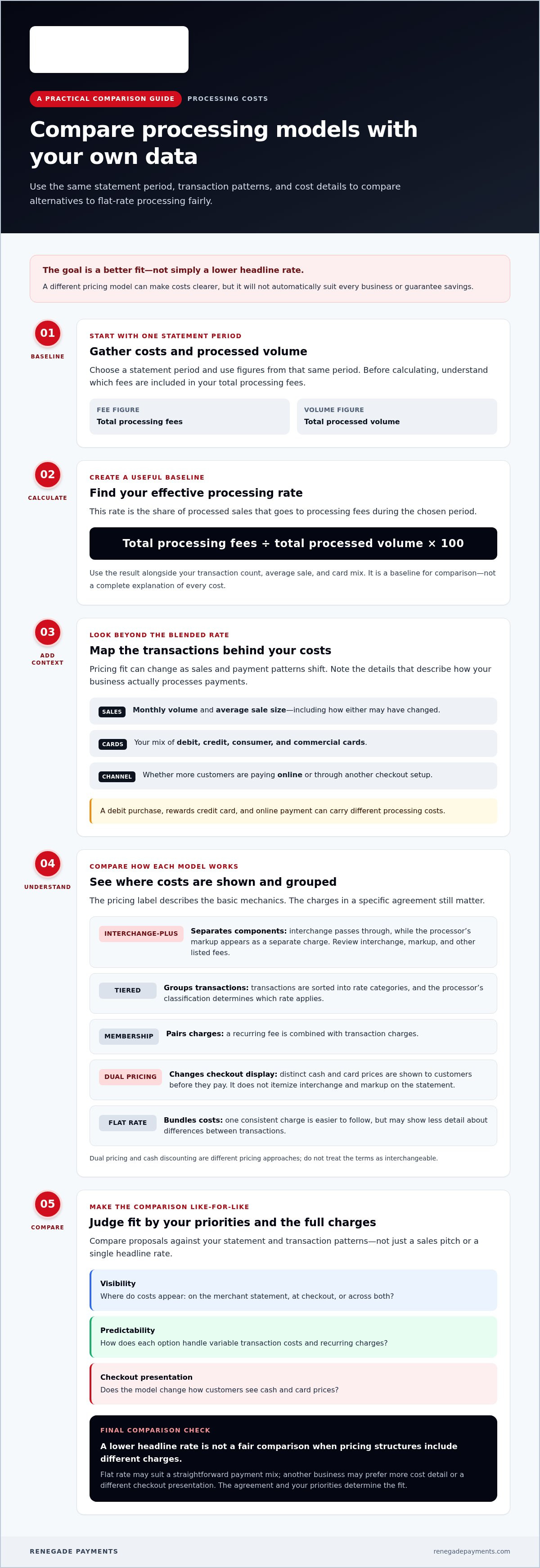
Your effective processing rate is the share of your processed sales that goes to processing fees during a chosen period. Calculate it by dividing total processing fees for that period by total processed volume, then multiplying by 100. Use figures from the same statement period, and make sure you understand which fees are included in the total. This gives you a useful baseline for comparing proposals, alongside your transaction count, average sale, and card mix. A lower headline rate alone isn’t a fair comparison if the pricing structures include different charges.
What are the main alternatives to flat rate processing?
The main alternatives to flat rate processing don’t all change costs in the same way. Some show more of the underlying fee structure. Others change how prices appear at checkout or how processing charges are grouped. Learn the mechanics first, then compare the models against your own costs and business priorities.
Interchange-plus: separate the underlying cost from the markup
Interchange is a transaction cost set within the card system. It varies by factors such as card type and how a payment is accepted. With interchange-plus, that cost passes through to the merchant, while the processor’s markup appears as a separate charge. The statement can therefore show the underlying interchange and the processor’s portion rather than combining them into one rate.
That separation makes the two components easier to identify, but it doesn’t mean every statement will look identical. Look for a clear breakdown of interchange, the processor markup, and any other listed charges. For a closer look at the model, explore interchange-plus payment processing.
Dual pricing and other alternatives: understand the basic mechanics
Dual pricing presents distinct cash and card prices at checkout. The customer sees the applicable price before paying. It changes how prices are displayed, rather than itemizing interchange and markup on the merchant’s statement. A cash discount is a different pricing approach, so don’t use the terms as if they mean the same thing.
Tiered pricing sorts transactions into categories, often with a different rate for each tier. The processor’s classification determines which rate applies. Membership pricing, also called subscription pricing, generally pairs a recurring fee with transaction charges. These are market models, not a description of every processor’s exact contract.
How the models differ in what they show
Each structure presents payment costs from a different angle. Interchange-plus separates the underlying transaction cost from processor markup. Dual pricing makes cash and card prices visible to customers at checkout. Tiered pricing groups transactions into rate categories, while membership pricing combines a recurring charge with transaction fees. The labels explain the basic mechanics, but the charges in a specific agreement still matter.
Keep two questions separate as you review the choices:
- Where do costs appear? On a merchant statement, at checkout, or across both.
- How are transactions charged? Through pass-through interchange plus markup, a displayed cash or card price, rate categories, or a recurring membership charge and transaction fees.
That distinction matters. A model may make one part of the payment experience clearer without making every processing cost easier to interpret. A transparent checkout price, for example, isn’t the same as a detailed statement breakdown.
Renegade Payments offers interchange-plus and dual pricing as distinct payment processing options. Tiered and membership pricing are other structures found in the market, but they aren’t interchangeable with those options. To see how the available options compare with your current costs, Renegade Payments also provides a complimentary statement analysis to identify potential costs and savings.
Which alternative fits your business? Compare the trade-offs
The right model depends on what your transactions look like and what you need to understand or manage. A simpler fee structure may be easier to follow. A more detailed one may make cost components easier to see. A model that changes checkout pricing also makes customer communication part of the decision. Compare the mechanics, then weigh them against your payment patterns.
Compare transparency, predictability, and fee allocation
Use this table as a starting point, not a promise about what a particular contract will cost. Fee details and terms vary. In particular, interchange-plus separates interchange from the processor markup, while dual pricing changes how customers see prices at checkout. Those are different kinds of transparency.
| Pricing model | Fee visibility | Predictability | Checkout presentation | Operational fit to consider |
|---|---|---|---|---|
| Flat rate | Bundled fee structure; underlying costs and markup may not appear separately. | A consistent rate can make the fee easier to anticipate, though total costs still vary with sales volume. | Usually keeps the pricing presentation straightforward. | May suit merchants who prioritize simplicity over a detailed cost breakdown. |
| Interchange-plus | Separates interchange from the processor’s stated markup. | Per-transaction costs can vary with underlying interchange and transaction mix. | Doesn’t inherently change how prices are presented to customers. | Useful when reviewing distinct cost components matters to reporting. |
| Dual pricing | Focuses on showing separate cash and card prices, not separating statement fees into interchange and markup. | Customer-facing prices are distinct; processing costs still depend on the agreement and transactions. | Requires clear, consistent display of both prices. | Requires staff and checkout processes that can explain and apply the displayed prices. |
| Tiered pricing | Groups transactions into rate categories, which may make the underlying costs less apparent. | Charges can depend on how transactions are categorized. | Typically doesn’t require distinct cash and card prices. | Review how transaction categories and rates are represented in reporting. |
| Membership pricing | Separates a recurring membership charge from transaction fees, but details depend on the terms. | A recurring fee adds a predictable element; transaction charges can still vary. | Typically doesn’t change the customer-facing price structure. | Account for the recurring charge as well as transaction activity. |
Match the model to payment patterns and checkout needs
Test each option against your own operation. Review payment channels, average sale, transaction volume, and card mix. Consider whether you need statement detail for bookkeeping, a bundled structure for simpler tracking, or clear cash and card prices at the point of sale. Online and in-person payments may have different cost patterns, so don’t assume one channel represents the whole business.
No pricing model is cheapest for every merchant; the outcome depends on actual transactions, contract terms, and applicable checkout requirements. Customer response matters, too. A pricing approach may affect how customers interpret the amount due and how confidently staff can explain it. Prioritize clear checkout communication alongside fee visibility.
Compare the full terms against a representative set of your transactions, including recurring and per-transaction charges. The best choice is the one whose cost structure and checkout process fit the way your business takes payments, not the one with the most appealing label. That’s how to evaluate alternatives to flat rate processing without confusing a simpler quote with a better overall fit.
How to compare alternatives using your own processing data
A pricing proposal only means something when it’s tested against your transactions. Use actual statements and records, not a sample business or a headline rate. This gives you a consistent way to compare alternatives to flat rate processing and see what may change in fees, reporting, or checkout.
Gather the records that make a comparison useful
Collect processing statements and transaction summaries from representative periods. Include sales volume, transaction count, average sale, payment channels, and card mix where available. Avoid relying on a single unusually busy or quiet month. Your comparison is useful only if the data reflects how your business normally accepts payments.
- Choose comparable periods. Use the same date range for statements and transaction records. If your business has seasonal swings, include periods that show those patterns instead of treating an outlier as typical.
- Calculate your current effective rate. Add the processing fees for the chosen period, then divide that total by processed volume and multiply by 100. Keep total fees separate from sales volume. Don’t mistake the processor’s advertised rate for your complete cost.
- Include every listed charge. Review monthly and recurring charges, per-transaction fees, and other statement charges. Note which costs vary with transaction activity and which appear regardless of volume.
- Map your transaction mix. Record in-person and online activity, average sale, transaction count, and card types where the records show them. This helps explain why a proposed model may calculate costs differently from your current arrangement.
Review a proposed alternative on the same basis
Apply the proposed pricing terms to the same period and transaction information. Compare projected total charges with current total fees, rather than comparing one rate with another. Identify which charges are separately stated, which may vary by transaction, and which recur. A merchant processing fees guide and a statement-review article can provide more context for the line items you’re evaluating.
Keep assumptions visible. If a proposal doesn’t explain how a charge applies to your transactions, don’t silently leave it out of the comparison. Flag it as unresolved. A side-by-side worksheet should show the period, volume, total fees, effective rate, and any costs treated differently under the proposed terms.
Make the switch decision with clear expectations
Weigh more than the projected total. Consider whether a clearer statement or a different checkout presentation is worth the operational change. Review the contract terms, including recurring charges and other fees, and verify current payment-network and state requirements that apply to your checkout approach. Requirements can change, so don’t rely on outdated assumptions.
No estimate guarantees savings. The purpose is to make the comparison fair and grounded in your own records. Renegade Payments offers a complimentary review of existing merchant statements to identify potential costs and savings. Request a complimentary savings analysis to put your current processing costs under review.
Compare flat-rate alternatives with Renegade Payments
There’s no universal replacement for flat-rate processing. The right option depends on your actual transaction mix and what you want to make clearer: the costs on your statement or the prices customers see at checkout. Renegade Payments offers two distinct approaches to consider: interchange-plus and dual pricing. Compare each against your own processing records before deciding.
Choose between clearer cost visibility and checkout-based fee allocation
Interchange-plus is designed for merchants who want interchange costs shown separately from the processor’s markup. That separation can make it easier to identify those components in your processing costs. It doesn’t change the prices customers see at checkout by itself.
Dual pricing presents distinct cash and card prices at checkout. Its focus is the customer-facing price display, not separating interchange from processor markup on a statement. Consider whether that presentation fits how you serve customers and how your staff handles transactions. For a deeper explanation of the mechanics, read the dual pricing guide.
These options address different priorities. Interchange-plus can provide more visibility into fee components. Dual pricing changes how cash and card prices are presented. Neither is automatically the right fit for every transaction pattern or checkout experience.
Turn your statement into a practical next step
A complimentary statement analysis gives you a grounded way to review your current processing costs and identify potential savings. It uses your existing merchant statements as a basis for comparing costs with available alternatives, rather than relying only on an advertised rate. Your transaction volume, card mix, payment channels, and statement charges all help shape a meaningful comparison.
Use that review to examine what matters to your business:
- Cost visibility: Can you distinguish the processor’s markup from other processing costs?
- Transaction fit: Does the option reflect the mix of payment types and channels you actually handle?
- Checkout experience: If prices are presented differently, will customers and staff understand what they see?
- Overall terms: Do the full charges and conditions make sense alongside your current costs?
A statement review can help put the numbers in context, but it isn’t a promise of savings. Use the findings to weigh potential cost differences against reporting clarity and any checkout changes. Then decide based on your records and priorities, not a one-size-fits-all claim about which pricing model is best.
Start with the figures you already have. Request a complimentary savings analysis to review your current processing costs and compare them with available options.
Make your next payment decision with confidence
The best pricing choice is the one you can explain with your own numbers and stand behind at checkout. Don’t switch just because a different model sounds simpler or promises a better deal. Use your processing records to decide what deserves a closer look, then choose a structure that supports how your business takes payments.
If you’re weighing alternatives to flat rate processing, Renegade Payments can review your existing merchant statements at no cost and help you compare dual pricing and interchange-plus options. That gives you a practical starting point for seeing how each approach relates to your costs and preferred checkout experience, without treating one model as the answer for every merchant.
Take the next step with your actual statement in hand. Start your complimentary savings analysis and make your decision from clearer information. You’re in control of the choice.
Frequently Asked Questions
What is the best alternative to flat rate processing?
There isn’t one best alternative for every business. Interchange-plus can suit merchants who want to see the processor’s markup separately from interchange, while dual pricing changes how cash and card prices appear at checkout. To narrow down alternatives to flat rate processing, decide what you want to improve first: statement visibility, checkout presentation, or cost predictability. Then compare options against your actual transactions and operating needs.
Is interchange-plus processing cheaper than flat rate?
Not automatically. Your total cost depends on your transactions, the processor’s markup, and the other charges in the agreement. For example, two businesses with similar sales totals may have different card mixes or payment channels, which can affect their processing costs. Compare the full charges for the same period, not just the advertised rates. Interchange-plus may make fee components clearer, but clarity alone doesn’t guarantee a lower bill.
How does dual pricing differ from interchange-plus pricing?
Dual pricing focuses on the prices shown to customers: it presents distinct cash and card prices at checkout. Interchange-plus focuses on how processing charges are structured for the merchant, with interchange and the processor’s markup shown separately. A business choosing between them is weighing different priorities. Consider whether you want more visibility into statement costs or a different checkout presentation, then factor in how your staff will explain and apply the pricing.
Can a small business use interchange-plus processing?
Yes. Business size alone doesn’t determine whether interchange-plus is suitable. A small retailer, for example, may prefer a detailed view of processing charges even if it handles fewer transactions than a larger merchant. The practical question is whether the pricing structure, contract terms, and statement detail work for your business. Review the charges and reporting alongside your transaction patterns before deciding. Renegade Payments offers interchange-plus processing for merchants evaluating this structure.
What information do I need to compare payment processing models?
Gather processor statements and transaction records covering comparable periods. Useful details include processed volume, transaction count, average sale, payment channel, and card mix when available. Also note recurring and per-transaction charges, plus any other fees listed on the statements. If your sales vary by season, include periods that reflect those shifts. This gives you more context than a rate quote alone and helps reveal whether a proposed model matches your day-to-day activity.
Does dual pricing eliminate credit card processing costs?
No. Dual pricing doesn’t make the underlying cost of accepting card payments disappear. It presents separate cash and card prices, which can help a merchant offset processing costs through its checkout pricing approach. The actual effect depends on the program’s terms and how transactions are handled. Before adopting it, consider whether customers can clearly understand the prices and whether the presentation fits your checkout process. Don’t treat “no cost” language as a substitute for reviewing the details.
How can I tell whether switching from flat rate will save my business money?
Compare your current total processing charges with the charges projected under the proposed terms, using the same transaction period and volume. Include recurring charges and per-transaction fees, and check that the comparison reflects your actual payment mix. Then consider any operational change, such as updating checkout communication. A statement review can help identify potential costs and savings, but no comparison can promise a result for future activity. Base the decision on the terms and records in front of you.
Frequently Asked Questions
Clear, straightforward answers about payment processing rules, rates, and terms.
Get your free savings
analysis in 24 hours
Upload a recent processing statement and we'll show you exactly how much you can save. No commitment, no pressure, no sales pitch.